

4.3 Alien Earth and Gaia
51
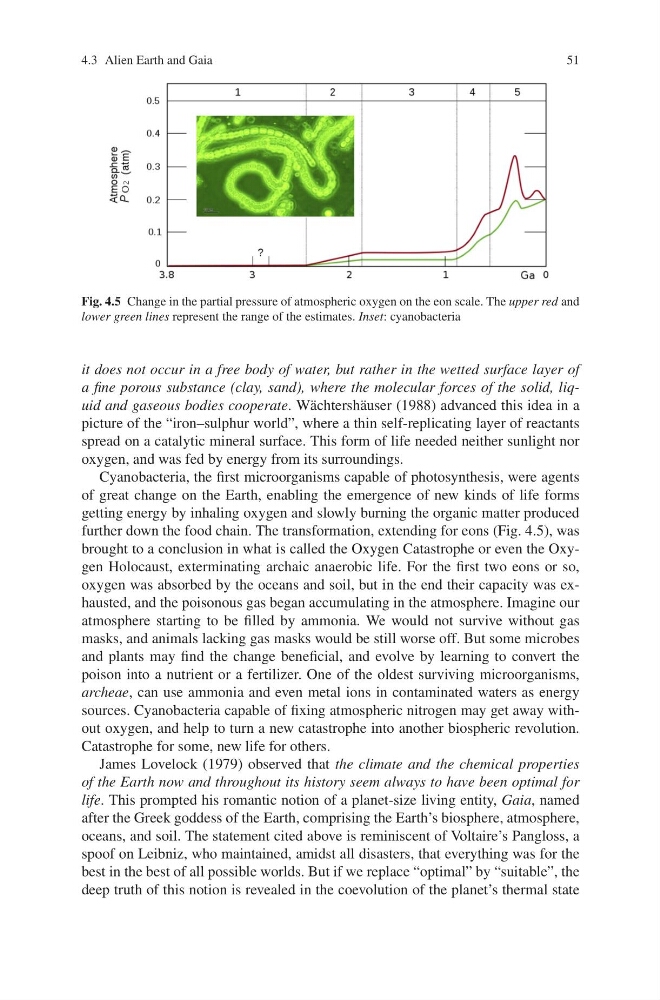
Fig. 4.5 Change in the partial pressure of atmospheric oxygen on the eon scale. The upper red and
lower green lines represent the range of the estimates. Inset: cyanobacteria
it does not occur in a free body of water, but rather in the wetted surface layer of
a fine porous substance (clay, sand), where the molecular forces of the solid, liquid and gaseous bodies cooperate. W¨ achtersh¨ auser (1988) advanced this idea in a
picture of the “iron–sulphur world”, where a thin self-replicating layer of reactants
spread on a catalytic mineral surface. This form of life needed neither sunlight nor
oxygen, and was fed by energy from its surroundings.
Cyanobacteria, the first microorganisms capable of photosynthesis, were agents
of great change on the Earth, enabling the emergence of new kinds of life forms
getting energy by inhaling oxygen and slowly burning the organic matter produced
further down the food chain. The transformation, extending for eons (Fig. 4.5), was
brought to a conclusion in what is called the Oxygen Catastrophe or even the Oxygen Holocaust, exterminating archaic anaerobic life. For the first two eons or so,
oxygen was absorbed by the oceans and soil, but in the end their capacity was exhausted, and the poisonous gas began accumulating in the atmosphere. Imagine our
atmosphere starting to be filled by ammonia. We would not survive without gas
masks, and animals lacking gas masks would be still worse off. But some microbes
and plants may find the change beneficial, and evolve by learning to convert the
poison into a nutrient or a fertilizer. One of the oldest surviving microorganisms,
archeae, can use ammonia and even metal ions in contaminated waters as energy
sources. Cyanobacteria capable of fixing atmospheric nitrogen may get away without oxygen, and help to turn a new catastrophe into another biospheric revolution.
Catastrophe for some, new life for others.
James Lovelock (1979) observed that the climate and the chemical properties
of the Earth now and throughout its history seem always to have been optimal for
life. This prompted his romantic notion of a planet-size living entity, Gaia, named
after the Greek goddess of the Earth, comprising the Earth’s biosphere, atmosphere,
oceans, and soil. The statement cited above is reminiscent of Voltaire’s Pangloss, a
spoof on Leibniz, who maintained, amidst all disasters, that everything was for the
best in the best of all possible worlds. But if we replace “optimal” by “suitable”, the
deep truth of this notion is revealed in the coevolution of the planet’s thermal state
51
Fig. 4.5 Change in the partial pressure of atmospheric oxygen on the eon scale. The upper red and
lower green lines represent the range of the estimates. Inset: cyanobacteria
it does not occur in a free body of water, but rather in the wetted surface layer of
a fine porous substance (clay, sand), where the molecular forces of the solid, liquid and gaseous bodies cooperate. W¨ achtersh¨ auser (1988) advanced this idea in a
picture of the “iron–sulphur world”, where a thin self-replicating layer of reactants
spread on a catalytic mineral surface. This form of life needed neither sunlight nor
oxygen, and was fed by energy from its surroundings.
Cyanobacteria, the first microorganisms capable of photosynthesis, were agents
of great change on the Earth, enabling the emergence of new kinds of life forms
getting energy by inhaling oxygen and slowly burning the organic matter produced
further down the food chain. The transformation, extending for eons (Fig. 4.5), was
brought to a conclusion in what is called the Oxygen Catastrophe or even the Oxygen Holocaust, exterminating archaic anaerobic life. For the first two eons or so,
oxygen was absorbed by the oceans and soil, but in the end their capacity was exhausted, and the poisonous gas began accumulating in the atmosphere. Imagine our
atmosphere starting to be filled by ammonia. We would not survive without gas
masks, and animals lacking gas masks would be still worse off. But some microbes
and plants may find the change beneficial, and evolve by learning to convert the
poison into a nutrient or a fertilizer. One of the oldest surviving microorganisms,
archeae, can use ammonia and even metal ions in contaminated waters as energy
sources. Cyanobacteria capable of fixing atmospheric nitrogen may get away without oxygen, and help to turn a new catastrophe into another biospheric revolution.
Catastrophe for some, new life for others.
James Lovelock (1979) observed that the climate and the chemical properties
of the Earth now and throughout its history seem always to have been optimal for
life. This prompted his romantic notion of a planet-size living entity, Gaia, named
after the Greek goddess of the Earth, comprising the Earth’s biosphere, atmosphere,
oceans, and soil. The statement cited above is reminiscent of Voltaire’s Pangloss, a
spoof on Leibniz, who maintained, amidst all disasters, that everything was for the
best in the best of all possible worlds. But if we replace “optimal” by “suitable”, the
deep truth of this notion is revealed in the coevolution of the planet’s thermal state