

4.2 Memory and Function
47
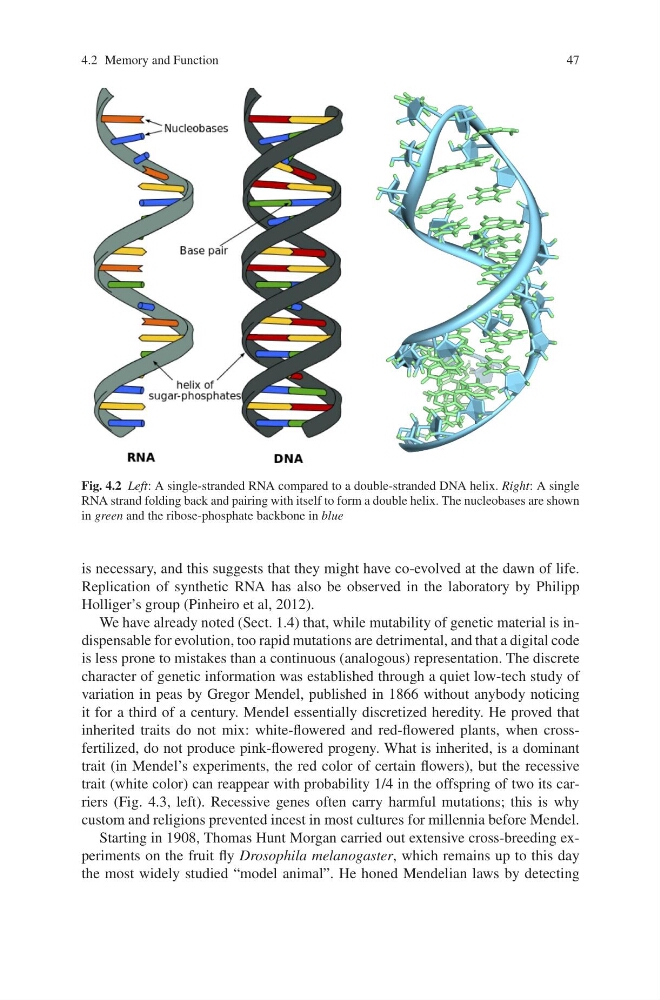
Fig. 4.2 Left: A single-stranded RNA compared to a double-stranded DNA helix. Right: A single
RNA strand folding back and pairing with itself to form a double helix. The nucleobases are shown
in green and the ribose-phosphate backbone in blue
is necessary, and this suggests that they might have co-evolved at the dawn of life.
Replication of synthetic RNA has also be observed in the laboratory by Philipp
Holliger’s group (Pinheiro et al, 2012).
We have already noted (Sect. 1.4) that, while mutability of genetic material is indispensable for evolution, too rapid mutations are detrimental, and that a digital code
is less prone to mistakes than a continuous (analogous) representation. The discrete
character of genetic information was established through a quiet low-tech study of
variation in peas by Gregor Mendel, published in 1866 without anybody noticing
it for a third of a century. Mendel essentially discretized heredity. He proved that
inherited traits do not mix: white-flowered and red-flowered plants, when crossfertilized, do not produce pink-flowered progeny. What is inherited, is a dominant
trait (in Mendel’s experiments, the red color of certain flowers), but the recessive
trait (white color) can reappear with probability 1/4 in the offspring of two its carriers (Fig. 4.3, left). Recessive genes often carry harmful mutations; this is why
custom and religions prevented incest in most cultures for millennia before Mendel.
Starting in 1908, Thomas Hunt Morgan carried out extensive cross-breeding experiments on the fruit fly Drosophila melanogaster, which remains up to this day
the most widely studied “model animal”. He honed Mendelian laws by detecting
47
Fig. 4.2 Left: A single-stranded RNA compared to a double-stranded DNA helix. Right: A single
RNA strand folding back and pairing with itself to form a double helix. The nucleobases are shown
in green and the ribose-phosphate backbone in blue
is necessary, and this suggests that they might have co-evolved at the dawn of life.
Replication of synthetic RNA has also be observed in the laboratory by Philipp
Holliger’s group (Pinheiro et al, 2012).
We have already noted (Sect. 1.4) that, while mutability of genetic material is indispensable for evolution, too rapid mutations are detrimental, and that a digital code
is less prone to mistakes than a continuous (analogous) representation. The discrete
character of genetic information was established through a quiet low-tech study of
variation in peas by Gregor Mendel, published in 1866 without anybody noticing
it for a third of a century. Mendel essentially discretized heredity. He proved that
inherited traits do not mix: white-flowered and red-flowered plants, when crossfertilized, do not produce pink-flowered progeny. What is inherited, is a dominant
trait (in Mendel’s experiments, the red color of certain flowers), but the recessive
trait (white color) can reappear with probability 1/4 in the offspring of two its carriers (Fig. 4.3, left). Recessive genes often carry harmful mutations; this is why
custom and religions prevented incest in most cultures for millennia before Mendel.
Starting in 1908, Thomas Hunt Morgan carried out extensive cross-breeding experiments on the fruit fly Drosophila melanogaster, which remains up to this day
the most widely studied “model animal”. He honed Mendelian laws by detecting