

44
4 Life Evolves
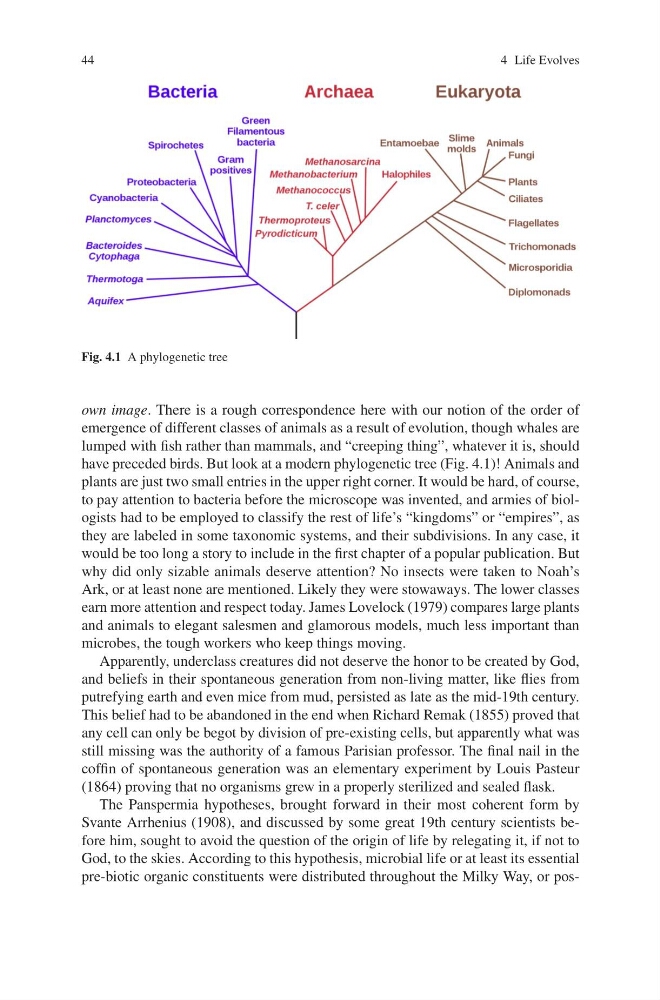
Fig. 4.1 A phylogenetic tree
own image. There is a rough correspondence here with our notion of the order of
emergence of different classes of animals as a result of evolution, though whales are
lumped with fish rather than mammals, and “creeping thing”, whatever it is, should
have preceded birds. But look at a modern phylogenetic tree (Fig. 4.1)! Animals and
plants are just two small entries in the upper right corner. It would be hard, of course,
to pay attention to bacteria before the microscope was invented, and armies of biologists had to be employed to classify the rest of life’s “kingdoms” or “empires”, as
they are labeled in some taxonomic systems, and their subdivisions. In any case, it
would be too long a story to include in the first chapter of a popular publication. But
why did only sizable animals deserve attention? No insects were taken to Noah’s
Ark, or at least none are mentioned. Likely they were stowaways. The lower classes
earn more attention and respect today. James Lovelock (1979) compares large plants
and animals to elegant salesmen and glamorous models, much less important than
microbes, the tough workers who keep things moving.
Apparently, underclass creatures did not deserve the honor to be created by God,
and beliefs in their spontaneous generation from non-living matter, like flies from
putrefying earth and even mice from mud, persisted as late as the mid-19th century.
This belief had to be abandoned in the end when Richard Remak (1855) proved that
any cell can only be begot by division of pre-existing cells, but apparently what was
still missing was the authority of a famous Parisian professor. The final nail in the
coffin of spontaneous generation was an elementary experiment by Louis Pasteur
(1864) proving that no organisms grew in a properly sterilized and sealed flask.
The Panspermia hypotheses, brought forward in their most coherent form by
Svante Arrhenius (1908), and discussed by some great 19th century scientists before him, sought to avoid the question of the origin of life by relegating it, if not to
God, to the skies. According to this hypothesis, microbial life or at least its essential
pre-biotic organic constituents were distributed throughout the Milky Way, or pos-
4 Life Evolves
Fig. 4.1 A phylogenetic tree
own image. There is a rough correspondence here with our notion of the order of
emergence of different classes of animals as a result of evolution, though whales are
lumped with fish rather than mammals, and “creeping thing”, whatever it is, should
have preceded birds. But look at a modern phylogenetic tree (Fig. 4.1)! Animals and
plants are just two small entries in the upper right corner. It would be hard, of course,
to pay attention to bacteria before the microscope was invented, and armies of biologists had to be employed to classify the rest of life’s “kingdoms” or “empires”, as
they are labeled in some taxonomic systems, and their subdivisions. In any case, it
would be too long a story to include in the first chapter of a popular publication. But
why did only sizable animals deserve attention? No insects were taken to Noah’s
Ark, or at least none are mentioned. Likely they were stowaways. The lower classes
earn more attention and respect today. James Lovelock (1979) compares large plants
and animals to elegant salesmen and glamorous models, much less important than
microbes, the tough workers who keep things moving.
Apparently, underclass creatures did not deserve the honor to be created by God,
and beliefs in their spontaneous generation from non-living matter, like flies from
putrefying earth and even mice from mud, persisted as late as the mid-19th century.
This belief had to be abandoned in the end when Richard Remak (1855) proved that
any cell can only be begot by division of pre-existing cells, but apparently what was
still missing was the authority of a famous Parisian professor. The final nail in the
coffin of spontaneous generation was an elementary experiment by Louis Pasteur
(1864) proving that no organisms grew in a properly sterilized and sealed flask.
The Panspermia hypotheses, brought forward in their most coherent form by
Svante Arrhenius (1908), and discussed by some great 19th century scientists before him, sought to avoid the question of the origin of life by relegating it, if not to
God, to the skies. According to this hypothesis, microbial life or at least its essential
pre-biotic organic constituents were distributed throughout the Milky Way, or pos-