

3.7 Self-Organized Universe
41
led eventually to the contrast between advances triggered by the Renaissance and
the Industrial Revolution and the misery of China in the 19th and 20th centuries.
The decline of the East did not have intrinsic roots in the mystic Eastern soul: this
was promptly proven by first Japan, and then India and China embracing Western
science and technology and often surpassing their originators. China and South Korea have won all the more recent Physics Olympiads, while a photo of the US team
was full of East-Asian faces, with only a single white boy.
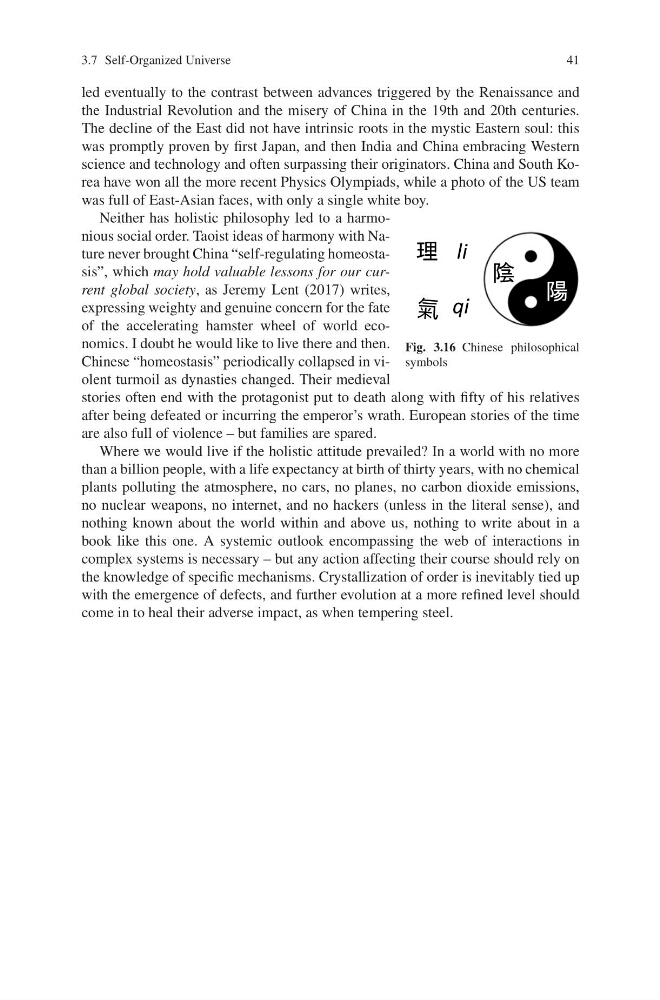
li
qi
Fig. 3.16 Chinese philosophical
symbols
Neither has holistic philosophy led to a harmonious social order. Taoist ideas of harmony with Nature never brought China “self-regulating homeostasis”, which may hold valuable lessons for our current global society, as Jeremy Lent (2017) writes,
expressing weighty and genuine concern for the fate
of the accelerating hamster wheel of world economics. I doubt he would like to live there and then.
Chinese “homeostasis” periodically collapsed in violent turmoil as dynasties changed. Their medieval
stories often end with the protagonist put to death along with fifty of his relatives
after being defeated or incurring the emperor’s wrath. European stories of the time
are also full of violence – but families are spared.
Where we would live if the holistic attitude prevailed? In a world with no more
than a billion people, with a life expectancy at birth of thirty years, with no chemical
plants polluting the atmosphere, no cars, no planes, no carbon dioxide emissions,
no nuclear weapons, no internet, and no hackers (unless in the literal sense), and
nothing known about the world within and above us, nothing to write about in a
book like this one. A systemic outlook encompassing the web of interactions in
complex systems is necessary – but any action affecting their course should rely on
the knowledge of specific mechanisms. Crystallization of order is inevitably tied up
with the emergence of defects, and further evolution at a more refined level should
come in to heal their adverse impact, as when tempering steel.
41
led eventually to the contrast between advances triggered by the Renaissance and
the Industrial Revolution and the misery of China in the 19th and 20th centuries.
The decline of the East did not have intrinsic roots in the mystic Eastern soul: this
was promptly proven by first Japan, and then India and China embracing Western
science and technology and often surpassing their originators. China and South Korea have won all the more recent Physics Olympiads, while a photo of the US team
was full of East-Asian faces, with only a single white boy.
li
qi
Fig. 3.16 Chinese philosophical
symbols
Neither has holistic philosophy led to a harmonious social order. Taoist ideas of harmony with Nature never brought China “self-regulating homeostasis”, which may hold valuable lessons for our current global society, as Jeremy Lent (2017) writes,
expressing weighty and genuine concern for the fate
of the accelerating hamster wheel of world economics. I doubt he would like to live there and then.
Chinese “homeostasis” periodically collapsed in violent turmoil as dynasties changed. Their medieval
stories often end with the protagonist put to death along with fifty of his relatives
after being defeated or incurring the emperor’s wrath. European stories of the time
are also full of violence – but families are spared.
Where we would live if the holistic attitude prevailed? In a world with no more
than a billion people, with a life expectancy at birth of thirty years, with no chemical
plants polluting the atmosphere, no cars, no planes, no carbon dioxide emissions,
no nuclear weapons, no internet, and no hackers (unless in the literal sense), and
nothing known about the world within and above us, nothing to write about in a
book like this one. A systemic outlook encompassing the web of interactions in
complex systems is necessary – but any action affecting their course should rely on
the knowledge of specific mechanisms. Crystallization of order is inevitably tied up
with the emergence of defects, and further evolution at a more refined level should
come in to heal their adverse impact, as when tempering steel.