

3.6 Branching Patterns
39
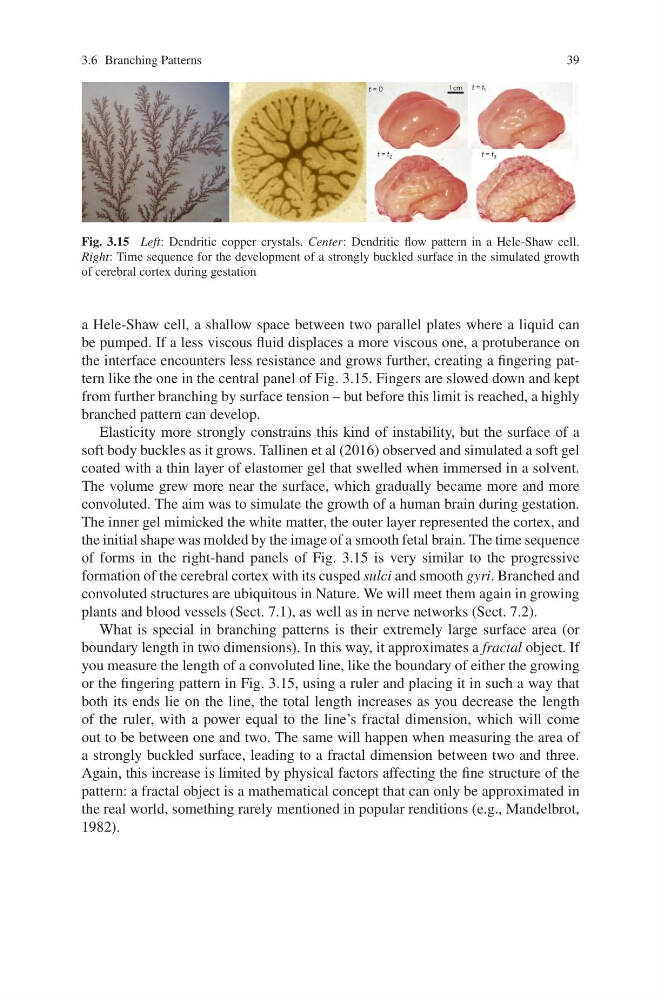
Fig. 3.15 Left: Dendritic copper crystals. Center: Dendritic flow pattern in a Hele-Shaw cell.
Right: Time sequence for the development of a strongly buckled surface in the simulated growth
of cerebral cortex during gestation
a Hele-Shaw cell, a shallow space between two parallel plates where a liquid can
be pumped. If a less viscous fluid displaces a more viscous one, a protuberance on
the interface encounters less resistance and grows further, creating a fingering pattern like the one in the central panel of Fig. 3.15. Fingers are slowed down and kept
from further branching by surface tension – but before this limit is reached, a highly
branched pattern can develop.
Elasticity more strongly constrains this kind of instability, but the surface of a
soft body buckles as it grows. Tallinen et al (2016) observed and simulated a soft gel
coated with a thin layer of elastomer gel that swelled when immersed in a solvent.
The volume grew more near the surface, which gradually became more and more
convoluted. The aim was to simulate the growth of a human brain during gestation.
The inner gel mimicked the white matter, the outer layer represented the cortex, and
the initial shape was molded by the image of a smooth fetal brain. The time sequence
of forms in the right-hand panels of Fig. 3.15 is very similar to the progressive
formation of the cerebral cortex with its cusped sulci and smooth gyri. Branched and
convoluted structures are ubiquitous in Nature. We will meet them again in growing
plants and blood vessels (Sect. 7.1), as well as in nerve networks (Sect. 7.2).
What is special in branching patterns is their extremely large surface area (or
boundary length in two dimensions). In this way, it approximates a fractal object. If
you measure the length of a convoluted line, like the boundary of either the growing
or the fingering pattern in Fig. 3.15, using a ruler and placing it in such a way that
both its ends lie on the line, the total length increases as you decrease the length
of the ruler, with a power equal to the line’s fractal dimension, which will come
out to be between one and two. The same will happen when measuring the area of
a strongly buckled surface, leading to a fractal dimension between two and three.
Again, this increase is limited by physical factors affecting the fine structure of the
pattern: a fractal object is a mathematical concept that can only be approximated in
the real world, something rarely mentioned in popular renditions (e.g., Mandelbrot,
1982).
39
Fig. 3.15 Left: Dendritic copper crystals. Center: Dendritic flow pattern in a Hele-Shaw cell.
Right: Time sequence for the development of a strongly buckled surface in the simulated growth
of cerebral cortex during gestation
a Hele-Shaw cell, a shallow space between two parallel plates where a liquid can
be pumped. If a less viscous fluid displaces a more viscous one, a protuberance on
the interface encounters less resistance and grows further, creating a fingering pattern like the one in the central panel of Fig. 3.15. Fingers are slowed down and kept
from further branching by surface tension – but before this limit is reached, a highly
branched pattern can develop.
Elasticity more strongly constrains this kind of instability, but the surface of a
soft body buckles as it grows. Tallinen et al (2016) observed and simulated a soft gel
coated with a thin layer of elastomer gel that swelled when immersed in a solvent.
The volume grew more near the surface, which gradually became more and more
convoluted. The aim was to simulate the growth of a human brain during gestation.
The inner gel mimicked the white matter, the outer layer represented the cortex, and
the initial shape was molded by the image of a smooth fetal brain. The time sequence
of forms in the right-hand panels of Fig. 3.15 is very similar to the progressive
formation of the cerebral cortex with its cusped sulci and smooth gyri. Branched and
convoluted structures are ubiquitous in Nature. We will meet them again in growing
plants and blood vessels (Sect. 7.1), as well as in nerve networks (Sect. 7.2).
What is special in branching patterns is their extremely large surface area (or
boundary length in two dimensions). In this way, it approximates a fractal object. If
you measure the length of a convoluted line, like the boundary of either the growing
or the fingering pattern in Fig. 3.15, using a ruler and placing it in such a way that
both its ends lie on the line, the total length increases as you decrease the length
of the ruler, with a power equal to the line’s fractal dimension, which will come
out to be between one and two. The same will happen when measuring the area of
a strongly buckled surface, leading to a fractal dimension between two and three.
Again, this increase is limited by physical factors affecting the fine structure of the
pattern: a fractal object is a mathematical concept that can only be approximated in
the real world, something rarely mentioned in popular renditions (e.g., Mandelbrot,
1982).