

3.3 Liquid Crystals
31
on, the liquid crystal orients along the beam direction, the polarization of the light
is not rotated any more, and the beam is blocked by the adverse polarizer at the exit.
Of course, the nematic alignment within such pixels has to be uniform.
Sometimes liquids solidify without becoming more ordered. Glass and carbonbased elastomers are disordered, amorphous solids. When glass melts, there is no
abrupt transition, it just gradually becomes more malleable, which is convenient for
molding its forms. Essentially, solid glass is a liquid with a very high viscosity that
decreases as the temperature rises. Elastomers are entangled polymer chains interacting only through weak intermolecular forces. They are viscoelastic, which means
that their response to deformation is intermediate between that of solids and liquids.
Rubber is hardened by cross-linking these chains. Molecules of liquid crystals can
be polymerized, either connecting “head to tail” (main-chain) or being attached to
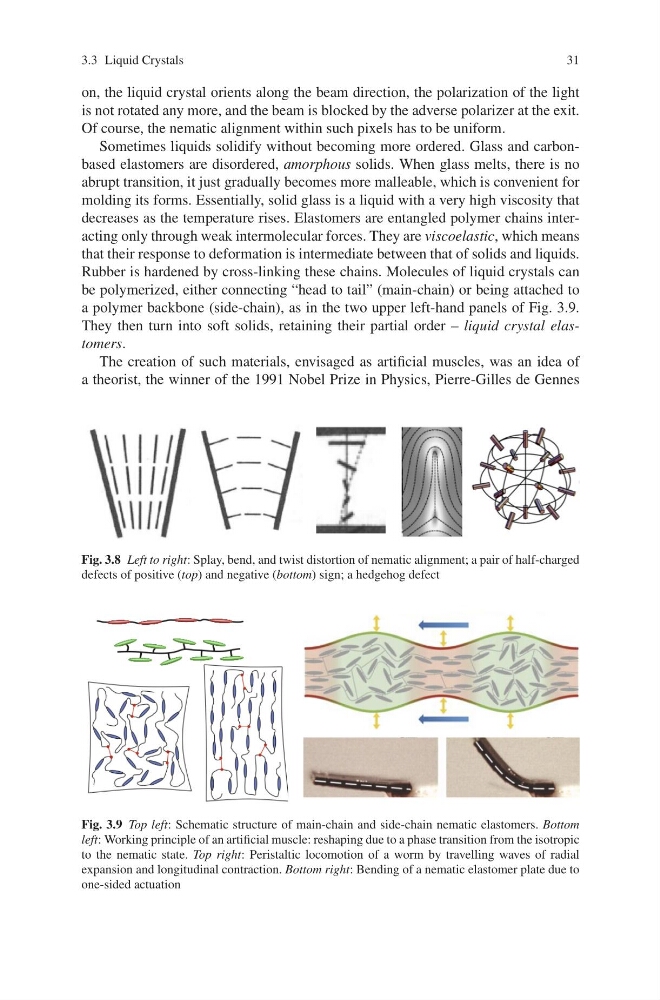
a polymer backbone (side-chain), as in the two upper left-hand panels of Fig. 3.9.
They then turn into soft solids, retaining their partial order – liquid crystal elastomers.
The creation of such materials, envisaged as artificial muscles, was an idea of
a theorist, the winner of the 1991 Nobel Prize in Physics, Pierre-Gilles de Gennes
Fig. 3.8 Left to right: Splay, bend, and twist distortion of nematic alignment; a pair of half-charged
defects of positive (top) and negative (bottom) sign; a hedgehog defect
Fig. 3.9 Top left: Schematic structure of main-chain and side-chain nematic elastomers. Bottom
left: Working principle of an artificial muscle: reshaping due to a phase transition from the isotropic
to the nematic state. Top right: Peristaltic locomotion of a worm by travelling waves of radial
expansion and longitudinal contraction. Bottom right: Bending of a nematic elastomer plate due to
one-sided actuation
31
on, the liquid crystal orients along the beam direction, the polarization of the light
is not rotated any more, and the beam is blocked by the adverse polarizer at the exit.
Of course, the nematic alignment within such pixels has to be uniform.
Sometimes liquids solidify without becoming more ordered. Glass and carbonbased elastomers are disordered, amorphous solids. When glass melts, there is no
abrupt transition, it just gradually becomes more malleable, which is convenient for
molding its forms. Essentially, solid glass is a liquid with a very high viscosity that
decreases as the temperature rises. Elastomers are entangled polymer chains interacting only through weak intermolecular forces. They are viscoelastic, which means
that their response to deformation is intermediate between that of solids and liquids.
Rubber is hardened by cross-linking these chains. Molecules of liquid crystals can
be polymerized, either connecting “head to tail” (main-chain) or being attached to
a polymer backbone (side-chain), as in the two upper left-hand panels of Fig. 3.9.
They then turn into soft solids, retaining their partial order – liquid crystal elastomers.
The creation of such materials, envisaged as artificial muscles, was an idea of
a theorist, the winner of the 1991 Nobel Prize in Physics, Pierre-Gilles de Gennes
Fig. 3.8 Left to right: Splay, bend, and twist distortion of nematic alignment; a pair of half-charged
defects of positive (top) and negative (bottom) sign; a hedgehog defect
Fig. 3.9 Top left: Schematic structure of main-chain and side-chain nematic elastomers. Bottom
left: Working principle of an artificial muscle: reshaping due to a phase transition from the isotropic
to the nematic state. Top right: Peristaltic locomotion of a worm by travelling waves of radial
expansion and longitudinal contraction. Bottom right: Bending of a nematic elastomer plate due to
one-sided actuation