

3.3 Liquid Crystals
29
that we seek to test. A soft filling material will change its volume depending on the
fluid’s composition, ionic strength, or some admixture of biomolecules, which, in
turn, will change the color of the transmitted or reflected light (Stein et al, 2013).
In a similar way, the material in the interstices of a colloidal crystal may respond
to all kinds of factors, besides the chemistry of the imbibed fluid, including electric
field, temperature, or mechanical stress. It is not necessary to remove the particles to
obtain chameleon-like optical effects due to swelling and shrinking, as in the upper
left panel of Fig. 3.6. This was proposed as a way to construct a full-colour digital
display (Arsenault et al, 2007). Our TV and computer screens are not built in this
way, at least not yet, since displays based on the change in polarization of liquid
crystals (LCD) or electroluminescent diode (LED) are currently more practical.
Octopuses and their cephalopod relatives, squid and cuttlefish, create optical
effects in still more sophisticated ways. Rather than carrying a permanent photocrystalline layer, they create it on the go. Their skin has arrays of papillae, small
rounded protuberances containing pigmented cells – chromatophores – controlled
by muscles, which can dynamically modify their size and shape (Allen et al, 2013).
In addition, their skin has light-sensitive elements, and parts of the brain are distributed in their tentacles; this distributed sensing and actuation contributes to extremely fast action. Modern technology imitates it in the design of flexible camouflage sheets that can autonomously sense and adapt to the coloration of their surroundings (Yu et al, 2014).
3.3 Liquid Crystals
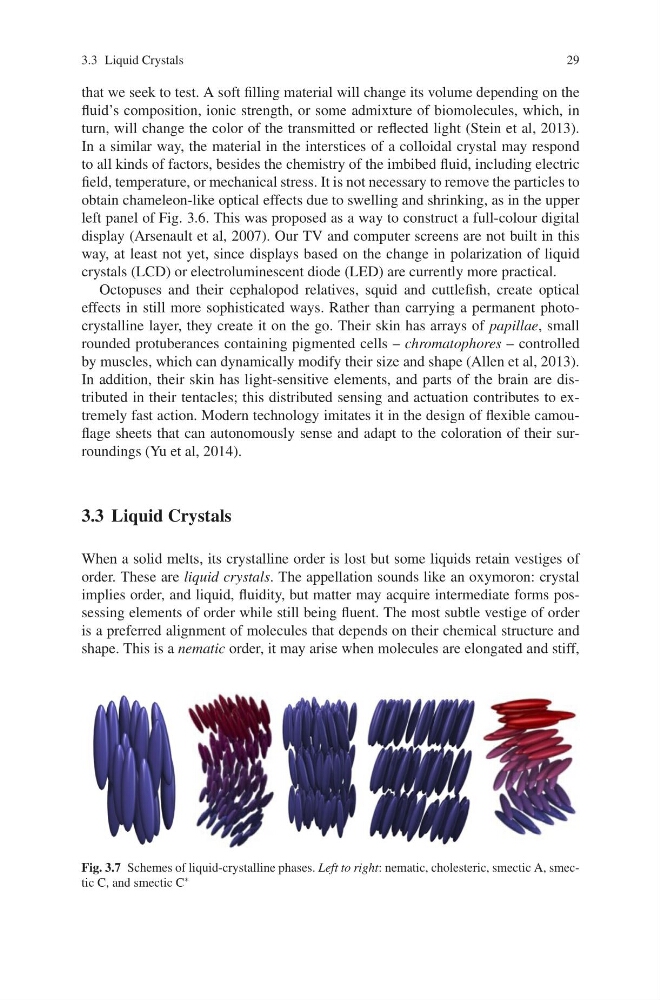
When a solid melts, its crystalline order is lost but some liquids retain vestiges of
order. These are liquid crystals. The appellation sounds like an oxymoron: crystal
implies order, and liquid, fluidity, but matter may acquire intermediate forms possessing elements of order while still being fluent. The most subtle vestige of order
is a preferred alignment of molecules that depends on their chemical structure and
shape. This is a nematic order, it may arise when molecules are elongated and stiff,
Fig. 3.7 Schemes of liquid-crystalline phases. Left to right: nematic, cholesteric, smectic A, smectic C, and smectic C ∗
29
that we seek to test. A soft filling material will change its volume depending on the
fluid’s composition, ionic strength, or some admixture of biomolecules, which, in
turn, will change the color of the transmitted or reflected light (Stein et al, 2013).
In a similar way, the material in the interstices of a colloidal crystal may respond
to all kinds of factors, besides the chemistry of the imbibed fluid, including electric
field, temperature, or mechanical stress. It is not necessary to remove the particles to
obtain chameleon-like optical effects due to swelling and shrinking, as in the upper
left panel of Fig. 3.6. This was proposed as a way to construct a full-colour digital
display (Arsenault et al, 2007). Our TV and computer screens are not built in this
way, at least not yet, since displays based on the change in polarization of liquid
crystals (LCD) or electroluminescent diode (LED) are currently more practical.
Octopuses and their cephalopod relatives, squid and cuttlefish, create optical
effects in still more sophisticated ways. Rather than carrying a permanent photocrystalline layer, they create it on the go. Their skin has arrays of papillae, small
rounded protuberances containing pigmented cells – chromatophores – controlled
by muscles, which can dynamically modify their size and shape (Allen et al, 2013).
In addition, their skin has light-sensitive elements, and parts of the brain are distributed in their tentacles; this distributed sensing and actuation contributes to extremely fast action. Modern technology imitates it in the design of flexible camouflage sheets that can autonomously sense and adapt to the coloration of their surroundings (Yu et al, 2014).
3.3 Liquid Crystals
When a solid melts, its crystalline order is lost but some liquids retain vestiges of
order. These are liquid crystals. The appellation sounds like an oxymoron: crystal
implies order, and liquid, fluidity, but matter may acquire intermediate forms possessing elements of order while still being fluent. The most subtle vestige of order
is a preferred alignment of molecules that depends on their chemical structure and
shape. This is a nematic order, it may arise when molecules are elongated and stiff,
Fig. 3.7 Schemes of liquid-crystalline phases. Left to right: nematic, cholesteric, smectic A, smectic C, and smectic C ∗