

20
2 Aggregation
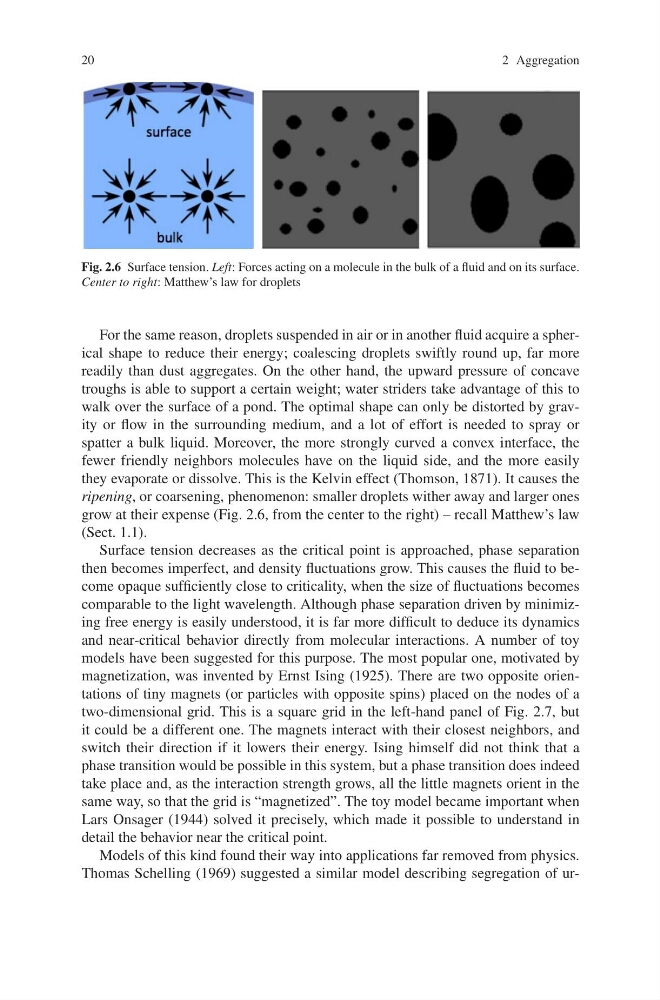
Fig. 2.6 Surface tension. Left: Forces acting on a molecule in the bulk of a fluid and on its surface.
Center to right: Matthew’s law for droplets
For the same reason, droplets suspended in air or in another fluid acquire a spherical shape to reduce their energy; coalescing droplets swiftly round up, far more
readily than dust aggregates. On the other hand, the upward pressure of concave
troughs is able to support a certain weight; water striders take advantage of this to
walk over the surface of a pond. The optimal shape can only be distorted by gravity or flow in the surrounding medium, and a lot of effort is needed to spray or
spatter a bulk liquid. Moreover, the more strongly curved a convex interface, the
fewer friendly neighbors molecules have on the liquid side, and the more easily
they evaporate or dissolve. This is the Kelvin effect (Thomson, 1871). It causes the
ripening, or coarsening, phenomenon: smaller droplets wither away and larger ones
grow at their expense (Fig. 2.6, from the center to the right) – recall Matthew’s law
(Sect. 1.1).
Surface tension decreases as the critical point is approached, phase separation
then becomes imperfect, and density fluctuations grow. This causes the fluid to become opaque sufficiently close to criticality, when the size of fluctuations becomes
comparable to the light wavelength. Although phase separation driven by minimizing free energy is easily understood, it is far more difficult to deduce its dynamics
and near-critical behavior directly from molecular interactions. A number of toy
models have been suggested for this purpose. The most popular one, motivated by
magnetization, was invented by Ernst Ising (1925). There are two opposite orientations of tiny magnets (or particles with opposite spins) placed on the nodes of a
two-dimensional grid. This is a square grid in the left-hand panel of Fig. 2.7, but
it could be a different one. The magnets interact with their closest neighbors, and
switch their direction if it lowers their energy. Ising himself did not think that a
phase transition would be possible in this system, but a phase transition does indeed
take place and, as the interaction strength grows, all the little magnets orient in the
same way, so that the grid is “magnetized”. The toy model became important when
Lars Onsager (1944) solved it precisely, which made it possible to understand in
detail the behavior near the critical point.
Models of this kind found their way into applications far removed from physics.
Thomas Schelling (1969) suggested a similar model describing segregation of ur-
2 Aggregation
Fig. 2.6 Surface tension. Left: Forces acting on a molecule in the bulk of a fluid and on its surface.
Center to right: Matthew’s law for droplets
For the same reason, droplets suspended in air or in another fluid acquire a spherical shape to reduce their energy; coalescing droplets swiftly round up, far more
readily than dust aggregates. On the other hand, the upward pressure of concave
troughs is able to support a certain weight; water striders take advantage of this to
walk over the surface of a pond. The optimal shape can only be distorted by gravity or flow in the surrounding medium, and a lot of effort is needed to spray or
spatter a bulk liquid. Moreover, the more strongly curved a convex interface, the
fewer friendly neighbors molecules have on the liquid side, and the more easily
they evaporate or dissolve. This is the Kelvin effect (Thomson, 1871). It causes the
ripening, or coarsening, phenomenon: smaller droplets wither away and larger ones
grow at their expense (Fig. 2.6, from the center to the right) – recall Matthew’s law
(Sect. 1.1).
Surface tension decreases as the critical point is approached, phase separation
then becomes imperfect, and density fluctuations grow. This causes the fluid to become opaque sufficiently close to criticality, when the size of fluctuations becomes
comparable to the light wavelength. Although phase separation driven by minimizing free energy is easily understood, it is far more difficult to deduce its dynamics
and near-critical behavior directly from molecular interactions. A number of toy
models have been suggested for this purpose. The most popular one, motivated by
magnetization, was invented by Ernst Ising (1925). There are two opposite orientations of tiny magnets (or particles with opposite spins) placed on the nodes of a
two-dimensional grid. This is a square grid in the left-hand panel of Fig. 2.7, but
it could be a different one. The magnets interact with their closest neighbors, and
switch their direction if it lowers their energy. Ising himself did not think that a
phase transition would be possible in this system, but a phase transition does indeed
take place and, as the interaction strength grows, all the little magnets orient in the
same way, so that the grid is “magnetized”. The toy model became important when
Lars Onsager (1944) solved it precisely, which made it possible to understand in
detail the behavior near the critical point.
Models of this kind found their way into applications far removed from physics.
Thomas Schelling (1969) suggested a similar model describing segregation of ur-