

14
2 Aggregation
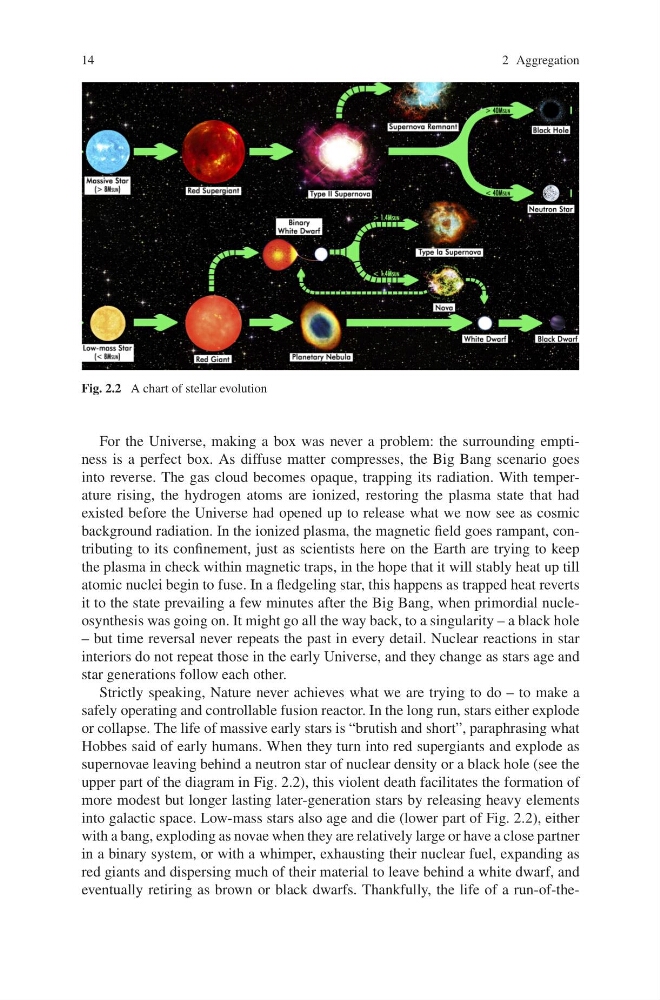
Fig. 2.2 A chart of stellar evolution
For the Universe, making a box was never a problem: the surrounding emptiness is a perfect box. As diffuse matter compresses, the Big Bang scenario goes
into reverse. The gas cloud becomes opaque, trapping its radiation. With temperature rising, the hydrogen atoms are ionized, restoring the plasma state that had
existed before the Universe had opened up to release what we now see as cosmic
background radiation. In the ionized plasma, the magnetic field goes rampant, contributing to its confinement, just as scientists here on the Earth are trying to keep
the plasma in check within magnetic traps, in the hope that it will stably heat up till
atomic nuclei begin to fuse. In a fledgeling star, this happens as trapped heat reverts
it to the state prevailing a few minutes after the Big Bang, when primordial nucleosynthesis was going on. It might go all the way back, to a singularity – a black hole
– but time reversal never repeats the past in every detail. Nuclear reactions in star
interiors do not repeat those in the early Universe, and they change as stars age and
star generations follow each other.
Strictly speaking, Nature never achieves what we are trying to do – to make a
safely operating and controllable fusion reactor. In the long run, stars either explode
or collapse. The life of massive early stars is “brutish and short”, paraphrasing what
Hobbes said of early humans. When they turn into red supergiants and explode as
supernovae leaving behind a neutron star of nuclear density or a black hole (see the
upper part of the diagram in Fig. 2.2), this violent death facilitates the formation of
more modest but longer lasting later-generation stars by releasing heavy elements
into galactic space. Low-mass stars also age and die (lower part of Fig. 2.2), either
with a bang, exploding as novae when they are relatively large or have a close partner
in a binary system, or with a whimper, exhausting their nuclear fuel, expanding as
red giants and dispersing much of their material to leave behind a white dwarf, and
eventually retiring as brown or black dwarfs. Thankfully, the life of a run-of-the-
2 Aggregation
Fig. 2.2 A chart of stellar evolution
For the Universe, making a box was never a problem: the surrounding emptiness is a perfect box. As diffuse matter compresses, the Big Bang scenario goes
into reverse. The gas cloud becomes opaque, trapping its radiation. With temperature rising, the hydrogen atoms are ionized, restoring the plasma state that had
existed before the Universe had opened up to release what we now see as cosmic
background radiation. In the ionized plasma, the magnetic field goes rampant, contributing to its confinement, just as scientists here on the Earth are trying to keep
the plasma in check within magnetic traps, in the hope that it will stably heat up till
atomic nuclei begin to fuse. In a fledgeling star, this happens as trapped heat reverts
it to the state prevailing a few minutes after the Big Bang, when primordial nucleosynthesis was going on. It might go all the way back, to a singularity – a black hole
– but time reversal never repeats the past in every detail. Nuclear reactions in star
interiors do not repeat those in the early Universe, and they change as stars age and
star generations follow each other.
Strictly speaking, Nature never achieves what we are trying to do – to make a
safely operating and controllable fusion reactor. In the long run, stars either explode
or collapse. The life of massive early stars is “brutish and short”, paraphrasing what
Hobbes said of early humans. When they turn into red supergiants and explode as
supernovae leaving behind a neutron star of nuclear density or a black hole (see the
upper part of the diagram in Fig. 2.2), this violent death facilitates the formation of
more modest but longer lasting later-generation stars by releasing heavy elements
into galactic space. Low-mass stars also age and die (lower part of Fig. 2.2), either
with a bang, exploding as novae when they are relatively large or have a close partner
in a binary system, or with a whimper, exhausting their nuclear fuel, expanding as
red giants and dispersing much of their material to leave behind a white dwarf, and
eventually retiring as brown or black dwarfs. Thankfully, the life of a run-of-the-