

130
8 Biomorphic Technologies
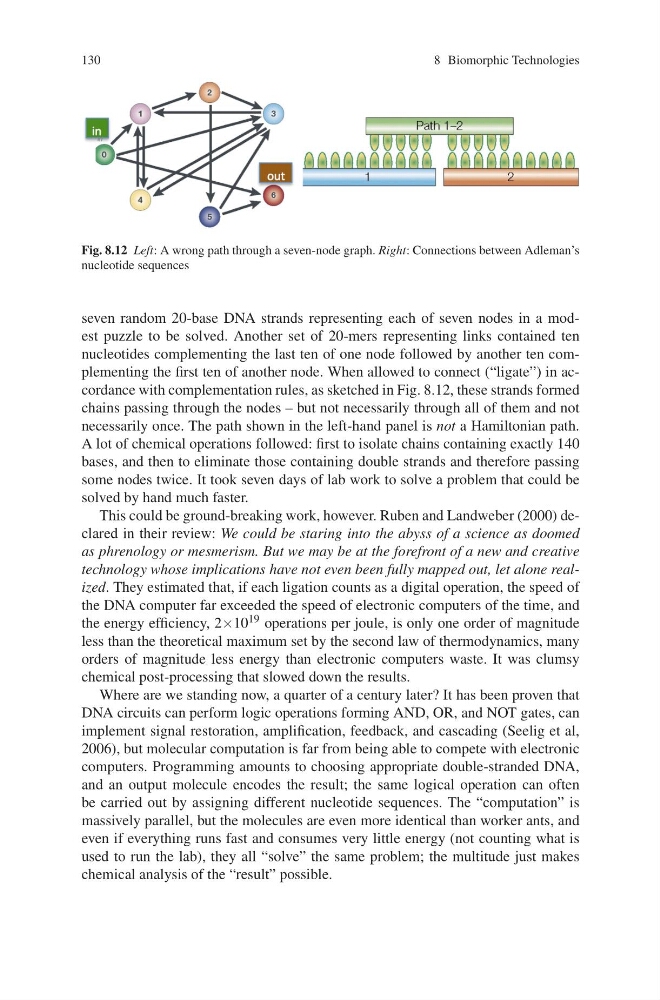
Fig. 8.12 Left: A wrong path through a seven-node graph. Right: Connections between Adleman’s
nucleotide sequences
seven random 20-base DNA strands representing each of seven nodes in a modest puzzle to be solved. Another set of 20-mers representing links contained ten
nucleotides complementing the last ten of one node followed by another ten complementing the first ten of another node. When allowed to connect (“ligate”) in accordance with complementation rules, as sketched in Fig. 8.12, these strands formed
chains passing through the nodes – but not necessarily through all of them and not
necessarily once. The path shown in the left-hand panel is not a Hamiltonian path.
A lot of chemical operations followed: first to isolate chains containing exactly 140
bases, and then to eliminate those containing double strands and therefore passing
some nodes twice. It took seven days of lab work to solve a problem that could be
solved by hand much faster.
This could be ground-breaking work, however. Ruben and Landweber (2000) declared in their review: We could be staring into the abyss of a science as doomed
as phrenology or mesmerism. But we may be at the forefront of a new and creative
technology whose implications have not even been fully mapped out, let alone realized. They estimated that, if each ligation counts as a digital operation, the speed of
the DNA computer far exceeded the speed of electronic computers of the time, and
the energy efficiency, 2×10 19 operations per joule, is only one order of magnitude
less than the theoretical maximum set by the second law of thermodynamics, many
orders of magnitude less energy than electronic computers waste. It was clumsy
chemical post-processing that slowed down the results.
Where are we standing now, a quarter of a century later? It has been proven that
DNA circuits can perform logic operations forming AND, OR, and NOT gates, can
implement signal restoration, amplification, feedback, and cascading (Seelig et al,
2006), but molecular computation is far from being able to compete with electronic
computers. Programming amounts to choosing appropriate double-stranded DNA,
and an output molecule encodes the result; the same logical operation can often
be carried out by assigning different nucleotide sequences. The “computation” is
massively parallel, but the molecules are even more identical than worker ants, and
even if everything runs fast and consumes very little energy (not counting what is
used to run the lab), they all “solve” the same problem; the multitude just makes
chemical analysis of the “result” possible.
8 Biomorphic Technologies
Fig. 8.12 Left: A wrong path through a seven-node graph. Right: Connections between Adleman’s
nucleotide sequences
seven random 20-base DNA strands representing each of seven nodes in a modest puzzle to be solved. Another set of 20-mers representing links contained ten
nucleotides complementing the last ten of one node followed by another ten complementing the first ten of another node. When allowed to connect (“ligate”) in accordance with complementation rules, as sketched in Fig. 8.12, these strands formed
chains passing through the nodes – but not necessarily through all of them and not
necessarily once. The path shown in the left-hand panel is not a Hamiltonian path.
A lot of chemical operations followed: first to isolate chains containing exactly 140
bases, and then to eliminate those containing double strands and therefore passing
some nodes twice. It took seven days of lab work to solve a problem that could be
solved by hand much faster.
This could be ground-breaking work, however. Ruben and Landweber (2000) declared in their review: We could be staring into the abyss of a science as doomed
as phrenology or mesmerism. But we may be at the forefront of a new and creative
technology whose implications have not even been fully mapped out, let alone realized. They estimated that, if each ligation counts as a digital operation, the speed of
the DNA computer far exceeded the speed of electronic computers of the time, and
the energy efficiency, 2×10 19 operations per joule, is only one order of magnitude
less than the theoretical maximum set by the second law of thermodynamics, many
orders of magnitude less energy than electronic computers waste. It was clumsy
chemical post-processing that slowed down the results.
Where are we standing now, a quarter of a century later? It has been proven that
DNA circuits can perform logic operations forming AND, OR, and NOT gates, can
implement signal restoration, amplification, feedback, and cascading (Seelig et al,
2006), but molecular computation is far from being able to compete with electronic
computers. Programming amounts to choosing appropriate double-stranded DNA,
and an output molecule encodes the result; the same logical operation can often
be carried out by assigning different nucleotide sequences. The “computation” is
massively parallel, but the molecules are even more identical than worker ants, and
even if everything runs fast and consumes very little energy (not counting what is
used to run the lab), they all “solve” the same problem; the multitude just makes
chemical analysis of the “result” possible.