

8.3 Digital Morphogenesis
123
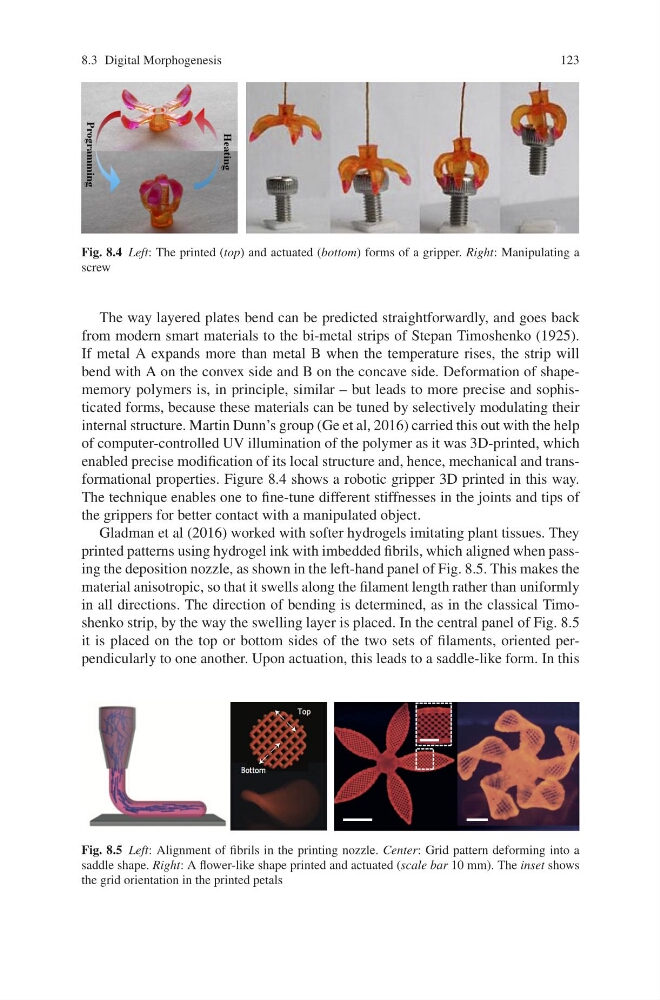
Fig. 8.4 Left: The printed (top) and actuated (bottom) forms of a gripper. Right: Manipulating a
screw
The way layered plates bend can be predicted straightforwardly, and goes back
from modern smart materials to the bi-metal strips of Stepan Timoshenko (1925).
If metal A expands more than metal B when the temperature rises, the strip will
bend with A on the convex side and B on the concave side. Deformation of shapememory polymers is, in principle, similar – but leads to more precise and sophisticated forms, because these materials can be tuned by selectively modulating their
internal structure. Martin Dunn’s group (Ge et al, 2016) carried this out with the help
of computer-controlled UV illumination of the polymer as it was 3D-printed, which
enabled precise modification of its local structure and, hence, mechanical and transformational properties. Figure 8.4 shows a robotic gripper 3D printed in this way.
The technique enables one to fine-tune different stiffnesses in the joints and tips of
the grippers for better contact with a manipulated object.
Gladman et al (2016) worked with softer hydrogels imitating plant tissues. They
printed patterns using hydrogel ink with imbedded fibrils, which aligned when passing the deposition nozzle, as shown in the left-hand panel of Fig. 8.5. This makes the
material anisotropic, so that it swells along the filament length rather than uniformly
in all directions. The direction of bending is determined, as in the classical Timoshenko strip, by the way the swelling layer is placed. In the central panel of Fig. 8.5
it is placed on the top or bottom sides of the two sets of filaments, oriented perpendicularly to one another. Upon actuation, this leads to a saddle-like form. In this
Fig. 8.5 Left: Alignment of fibrils in the printing nozzle. Center: Grid pattern deforming into a
saddle shape. Right: A flower-like shape printed and actuated (scale bar 10 mm). The inset shows
the grid orientation in the printed petals
123
Fig. 8.4 Left: The printed (top) and actuated (bottom) forms of a gripper. Right: Manipulating a
screw
The way layered plates bend can be predicted straightforwardly, and goes back
from modern smart materials to the bi-metal strips of Stepan Timoshenko (1925).
If metal A expands more than metal B when the temperature rises, the strip will
bend with A on the convex side and B on the concave side. Deformation of shapememory polymers is, in principle, similar – but leads to more precise and sophisticated forms, because these materials can be tuned by selectively modulating their
internal structure. Martin Dunn’s group (Ge et al, 2016) carried this out with the help
of computer-controlled UV illumination of the polymer as it was 3D-printed, which
enabled precise modification of its local structure and, hence, mechanical and transformational properties. Figure 8.4 shows a robotic gripper 3D printed in this way.
The technique enables one to fine-tune different stiffnesses in the joints and tips of
the grippers for better contact with a manipulated object.
Gladman et al (2016) worked with softer hydrogels imitating plant tissues. They
printed patterns using hydrogel ink with imbedded fibrils, which aligned when passing the deposition nozzle, as shown in the left-hand panel of Fig. 8.5. This makes the
material anisotropic, so that it swells along the filament length rather than uniformly
in all directions. The direction of bending is determined, as in the classical Timoshenko strip, by the way the swelling layer is placed. In the central panel of Fig. 8.5
it is placed on the top or bottom sides of the two sets of filaments, oriented perpendicularly to one another. Upon actuation, this leads to a saddle-like form. In this
Fig. 8.5 Left: Alignment of fibrils in the printing nozzle. Center: Grid pattern deforming into a
saddle shape. Right: A flower-like shape printed and actuated (scale bar 10 mm). The inset shows
the grid orientation in the printed petals