

118
8 Biomorphic Technologies
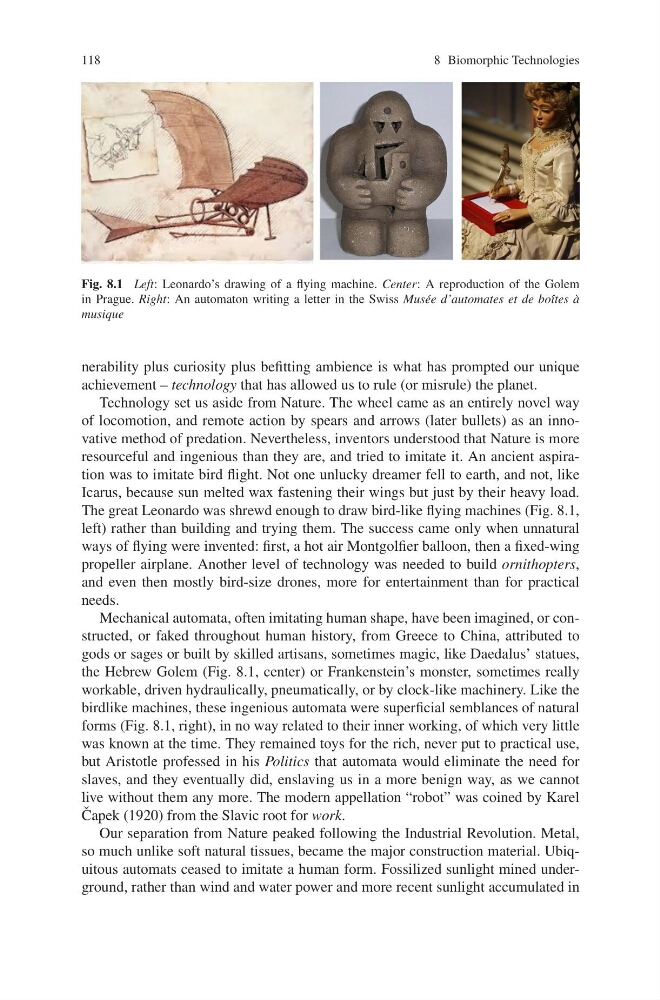
Fig. 8.1 Left: Leonardo’s drawing of a flying machine. Center: A reproduction of the Golem
in Prague. Right: An automaton writing a letter in the Swiss Mus´ ee d’automates et de boˆ ıtes `
a
musique
nerability plus curiosity plus befitting ambience is what has prompted our unique
achievement – technology that has allowed us to rule (or misrule) the planet.
Technology set us aside from Nature. The wheel came as an entirely novel way
of locomotion, and remote action by spears and arrows (later bullets) as an innovative method of predation. Nevertheless, inventors understood that Nature is more
resourceful and ingenious than they are, and tried to imitate it. An ancient aspiration was to imitate bird flight. Not one unlucky dreamer fell to earth, and not, like
Icarus, because sun melted wax fastening their wings but just by their heavy load.
The great Leonardo was shrewd enough to draw bird-like flying machines (Fig. 8.1,
left) rather than building and trying them. The success came only when unnatural
ways of flying were invented: first, a hot air Montgolfier balloon, then a fixed-wing
propeller airplane. Another level of technology was needed to build ornithopters,
and even then mostly bird-size drones, more for entertainment than for practical
needs.
Mechanical automata, often imitating human shape, have been imagined, or constructed, or faked throughout human history, from Greece to China, attributed to
gods or sages or built by skilled artisans, sometimes magic, like Daedalus’ statues,
the Hebrew Golem (Fig. 8.1, center) or Frankenstein’s monster, sometimes really
workable, driven hydraulically, pneumatically, or by clock-like machinery. Like the
birdlike machines, these ingenious automata were superficial semblances of natural
forms (Fig. 8.1, right), in no way related to their inner working, of which very little
was known at the time. They remained toys for the rich, never put to practical use,
but Aristotle professed in his Politics that automata would eliminate the need for
slaves, and they eventually did, enslaving us in a more benign way, as we cannot
live without them any more. The modern appellation “robot” was coined by Karel
ˇ
Capek (1920) from the Slavic root for work.
Our separation from Nature peaked following the Industrial Revolution. Metal,
so much unlike soft natural tissues, became the major construction material. Ubiquitous automats ceased to imitate a human form. Fossilized sunlight mined underground, rather than wind and water power and more recent sunlight accumulated in
8 Biomorphic Technologies
Fig. 8.1 Left: Leonardo’s drawing of a flying machine. Center: A reproduction of the Golem
in Prague. Right: An automaton writing a letter in the Swiss Mus´ ee d’automates et de boˆ ıtes `
a
musique
nerability plus curiosity plus befitting ambience is what has prompted our unique
achievement – technology that has allowed us to rule (or misrule) the planet.
Technology set us aside from Nature. The wheel came as an entirely novel way
of locomotion, and remote action by spears and arrows (later bullets) as an innovative method of predation. Nevertheless, inventors understood that Nature is more
resourceful and ingenious than they are, and tried to imitate it. An ancient aspiration was to imitate bird flight. Not one unlucky dreamer fell to earth, and not, like
Icarus, because sun melted wax fastening their wings but just by their heavy load.
The great Leonardo was shrewd enough to draw bird-like flying machines (Fig. 8.1,
left) rather than building and trying them. The success came only when unnatural
ways of flying were invented: first, a hot air Montgolfier balloon, then a fixed-wing
propeller airplane. Another level of technology was needed to build ornithopters,
and even then mostly bird-size drones, more for entertainment than for practical
needs.
Mechanical automata, often imitating human shape, have been imagined, or constructed, or faked throughout human history, from Greece to China, attributed to
gods or sages or built by skilled artisans, sometimes magic, like Daedalus’ statues,
the Hebrew Golem (Fig. 8.1, center) or Frankenstein’s monster, sometimes really
workable, driven hydraulically, pneumatically, or by clock-like machinery. Like the
birdlike machines, these ingenious automata were superficial semblances of natural
forms (Fig. 8.1, right), in no way related to their inner working, of which very little
was known at the time. They remained toys for the rich, never put to practical use,
but Aristotle professed in his Politics that automata would eliminate the need for
slaves, and they eventually did, enslaving us in a more benign way, as we cannot
live without them any more. The modern appellation “robot” was coined by Karel
ˇ
Capek (1920) from the Slavic root for work.
Our separation from Nature peaked following the Industrial Revolution. Metal,
so much unlike soft natural tissues, became the major construction material. Ubiquitous automats ceased to imitate a human form. Fossilized sunlight mined underground, rather than wind and water power and more recent sunlight accumulated in