

100
6 Cells United
1980s, by Lev Beloussov and Larry Taber. Beloussov et al (1994) presented the
elongation by intercalation caused by an external force as a prime example of an
active mechanical response, which is directed towards restoring a naturally stressed
state. He went even further with the hyperrestoration principle, stating that a living tissue always overshoots it reaction. Taber (2009) presented several examples
contradicting the hyperrestoration hypothesis, but both he and Beloussov with their
coworkers have examined many mechanical effects in development over the course
of more than thirty years of studies.
Beloussov (2015) unconvincingly criticized the positional information concept
that establishes relations between cell positions and their fates (Sect. 6.3), and even
the very idea of genetically programmed development, while stressing interactions
among cells as the principal morphogenetic force. I mentioned before some problematic aspects of the theory of morphogenetic gradients, but its strength is in intercellular signaling complementing externally imposed gradients and driven, like
everything in life, by genes. Mechanics could never be as specific and precise, but
it plays a subtle role in modifying chemical signaling. Morphomechanics remains
outside the mainstream where the shepherds of flocks of students and postdocs are
laureled by prizes for untangling chain by chain the webs of protein interactions.
6.6 Growth and Movements of Plants
It is unfair to talk only about animals. Plants are feeding us, directly or through a
food chain. But plants are silent, and they don’t write books. Plants, like animals,
start their life with the merger of an egg and a sperm cell, and meiosis. As an animal
egg polarizes to form its head and anus, a plant seed polarizes to form its shoot and
root – but here the similarity ends. While the animal’s (or its larva’s) organs already
develop in the embryo and afterwards only grow and mature, plants continue their
phyllotaxis, the process of generating new phylla – leaves, roots, stalks, florets –
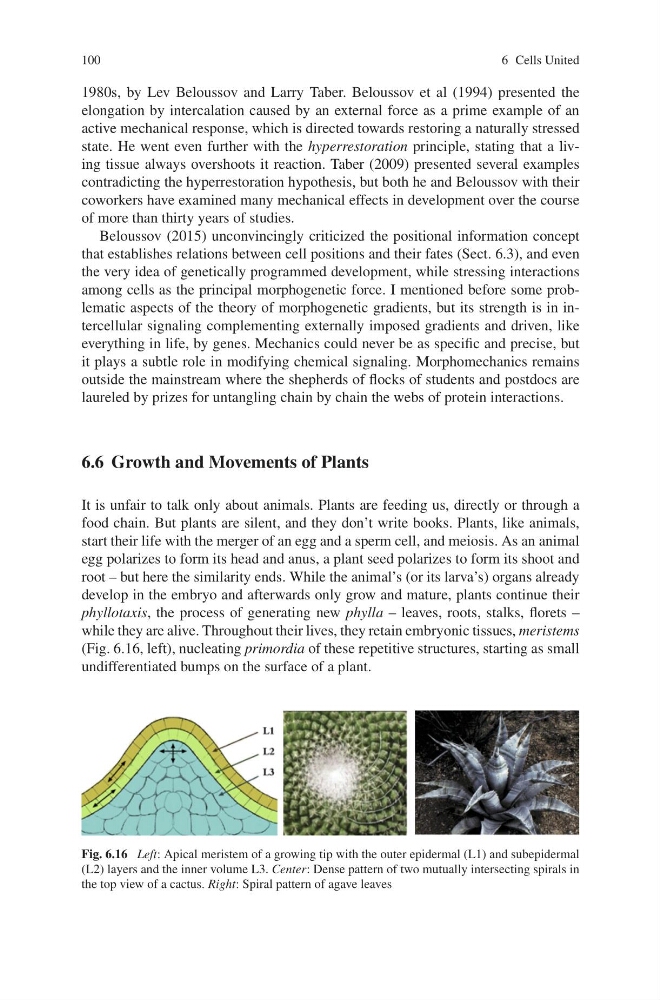
while they are alive. Throughout their lives, they retain embryonic tissues, meristems
(Fig. 6.16, left), nucleating primordia of these repetitive structures, starting as small
undifferentiated bumps on the surface of a plant.
Fig. 6.16 Left: Apical meristem of a growing tip with the outer epidermal (L1) and subepidermal
(L2) layers and the inner volume L3. Center: Dense pattern of two mutually intersecting spirals in
the top view of a cactus. Right: Spiral pattern of agave leaves
6 Cells United
1980s, by Lev Beloussov and Larry Taber. Beloussov et al (1994) presented the
elongation by intercalation caused by an external force as a prime example of an
active mechanical response, which is directed towards restoring a naturally stressed
state. He went even further with the hyperrestoration principle, stating that a living tissue always overshoots it reaction. Taber (2009) presented several examples
contradicting the hyperrestoration hypothesis, but both he and Beloussov with their
coworkers have examined many mechanical effects in development over the course
of more than thirty years of studies.
Beloussov (2015) unconvincingly criticized the positional information concept
that establishes relations between cell positions and their fates (Sect. 6.3), and even
the very idea of genetically programmed development, while stressing interactions
among cells as the principal morphogenetic force. I mentioned before some problematic aspects of the theory of morphogenetic gradients, but its strength is in intercellular signaling complementing externally imposed gradients and driven, like
everything in life, by genes. Mechanics could never be as specific and precise, but
it plays a subtle role in modifying chemical signaling. Morphomechanics remains
outside the mainstream where the shepherds of flocks of students and postdocs are
laureled by prizes for untangling chain by chain the webs of protein interactions.
6.6 Growth and Movements of Plants
It is unfair to talk only about animals. Plants are feeding us, directly or through a
food chain. But plants are silent, and they don’t write books. Plants, like animals,
start their life with the merger of an egg and a sperm cell, and meiosis. As an animal
egg polarizes to form its head and anus, a plant seed polarizes to form its shoot and
root – but here the similarity ends. While the animal’s (or its larva’s) organs already
develop in the embryo and afterwards only grow and mature, plants continue their
phyllotaxis, the process of generating new phylla – leaves, roots, stalks, florets –
while they are alive. Throughout their lives, they retain embryonic tissues, meristems
(Fig. 6.16, left), nucleating primordia of these repetitive structures, starting as small
undifferentiated bumps on the surface of a plant.
Fig. 6.16 Left: Apical meristem of a growing tip with the outer epidermal (L1) and subepidermal
(L2) layers and the inner volume L3. Center: Dense pattern of two mutually intersecting spirals in
the top view of a cactus. Right: Spiral pattern of agave leaves