

98
6 Cells United
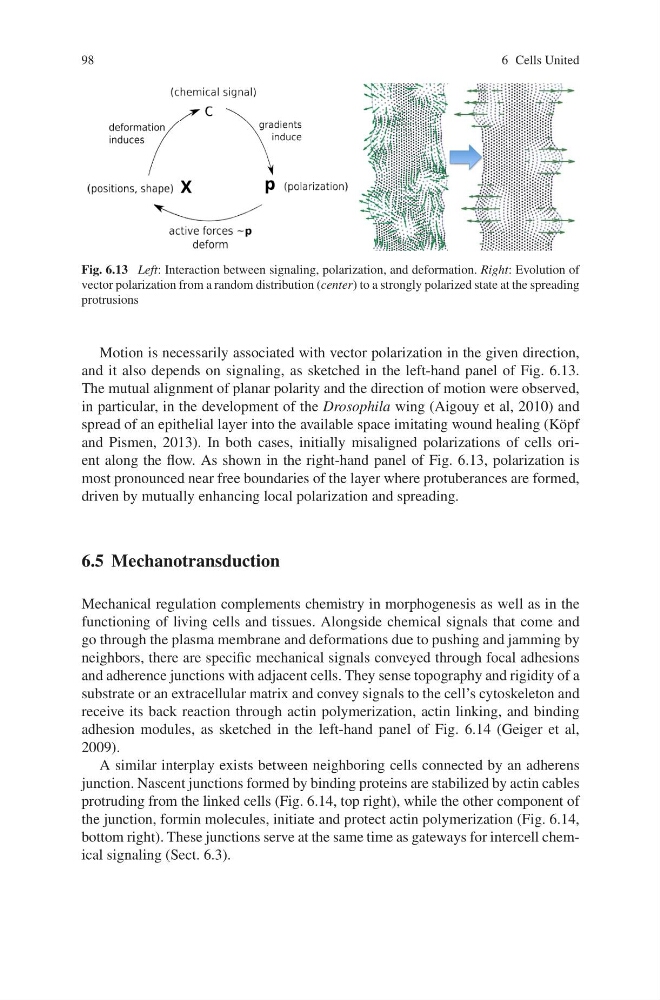
Fig. 6.13 Left: Interaction between signaling, polarization, and deformation. Right: Evolution of
vector polarization from a random distribution (center) to a strongly polarized state at the spreading
protrusions
Motion is necessarily associated with vector polarization in the given direction,
and it also depends on signaling, as sketched in the left-hand panel of Fig. 6.13.
The mutual alignment of planar polarity and the direction of motion were observed,
in particular, in the development of the Drosophila wing (Aigouy et al, 2010) and
spread of an epithelial layer into the available space imitating wound healing (K¨ opf
and Pismen, 2013). In both cases, initially misaligned polarizations of cells orient along the flow. As shown in the right-hand panel of Fig. 6.13, polarization is
most pronounced near free boundaries of the layer where protuberances are formed,
driven by mutually enhancing local polarization and spreading.
6.5 Mechanotransduction
Mechanical regulation complements chemistry in morphogenesis as well as in the
functioning of living cells and tissues. Alongside chemical signals that come and
go through the plasma membrane and deformations due to pushing and jamming by
neighbors, there are specific mechanical signals conveyed through focal adhesions
and adherence junctions with adjacent cells. They sense topography and rigidity of a
substrate or an extracellular matrix and convey signals to the cell’s cytoskeleton and
receive its back reaction through actin polymerization, actin linking, and binding
adhesion modules, as sketched in the left-hand panel of Fig. 6.14 (Geiger et al,
2009).
A similar interplay exists between neighboring cells connected by an adherens
junction. Nascent junctions formed by binding proteins are stabilized by actin cables
protruding from the linked cells (Fig. 6.14, top right), while the other component of
the junction, formin molecules, initiate and protect actin polymerization (Fig. 6.14,
bottom right). These junctions serve at the same time as gateways for intercell chemical signaling (Sect. 6.3).
6 Cells United
Fig. 6.13 Left: Interaction between signaling, polarization, and deformation. Right: Evolution of
vector polarization from a random distribution (center) to a strongly polarized state at the spreading
protrusions
Motion is necessarily associated with vector polarization in the given direction,
and it also depends on signaling, as sketched in the left-hand panel of Fig. 6.13.
The mutual alignment of planar polarity and the direction of motion were observed,
in particular, in the development of the Drosophila wing (Aigouy et al, 2010) and
spread of an epithelial layer into the available space imitating wound healing (K¨ opf
and Pismen, 2013). In both cases, initially misaligned polarizations of cells orient along the flow. As shown in the right-hand panel of Fig. 6.13, polarization is
most pronounced near free boundaries of the layer where protuberances are formed,
driven by mutually enhancing local polarization and spreading.
6.5 Mechanotransduction
Mechanical regulation complements chemistry in morphogenesis as well as in the
functioning of living cells and tissues. Alongside chemical signals that come and
go through the plasma membrane and deformations due to pushing and jamming by
neighbors, there are specific mechanical signals conveyed through focal adhesions
and adherence junctions with adjacent cells. They sense topography and rigidity of a
substrate or an extracellular matrix and convey signals to the cell’s cytoskeleton and
receive its back reaction through actin polymerization, actin linking, and binding
adhesion modules, as sketched in the left-hand panel of Fig. 6.14 (Geiger et al,
2009).
A similar interplay exists between neighboring cells connected by an adherens
junction. Nascent junctions formed by binding proteins are stabilized by actin cables
protruding from the linked cells (Fig. 6.14, top right), while the other component of
the junction, formin molecules, initiate and protect actin polymerization (Fig. 6.14,
bottom right). These junctions serve at the same time as gateways for intercell chemical signaling (Sect. 6.3).