

77
4
BOX: Can Cashew Nuts Attract Tsetse Flies?
Tsetse flies are widespread in
many parts of Africa. They are
much feared because they are
the carriers of the so-called
sleeping sickness, which is usually
fatal without therapy. What can
be done about this and what is
the role of cashew nuts?
The cashew tree was first
discovered by the Portuguese
in northeastern Brazil and can
now be found in many tropical
countries. The trees, up to 12 m
high, bear kidney-shaped fruits in
whose shells the cashew kernels
(or cashew nuts) are found
(. Fig. 4.20). The production of
cashew kernels worldwide in
2016 was 4.9 million t a −1 . These
nuts are mainly roasted and
salted and offered as food, but
they can also be used to press an
oil consisting mainly of oleic and
linoleic acid. The shells remain as
a waste material.
But these cashew shells are of
particular interest. Out of them,
an oil can be extracted, the
cashew nut shell liquid (CNSL),
which is available worldwide at
approx. 0.5 Mio t a −1 . It is toxic
and therefore not suitable as
food. It contains cardanol, a
mixture of phenols which have
long-chain, unsaturated alkyl
groups bound in meta-position
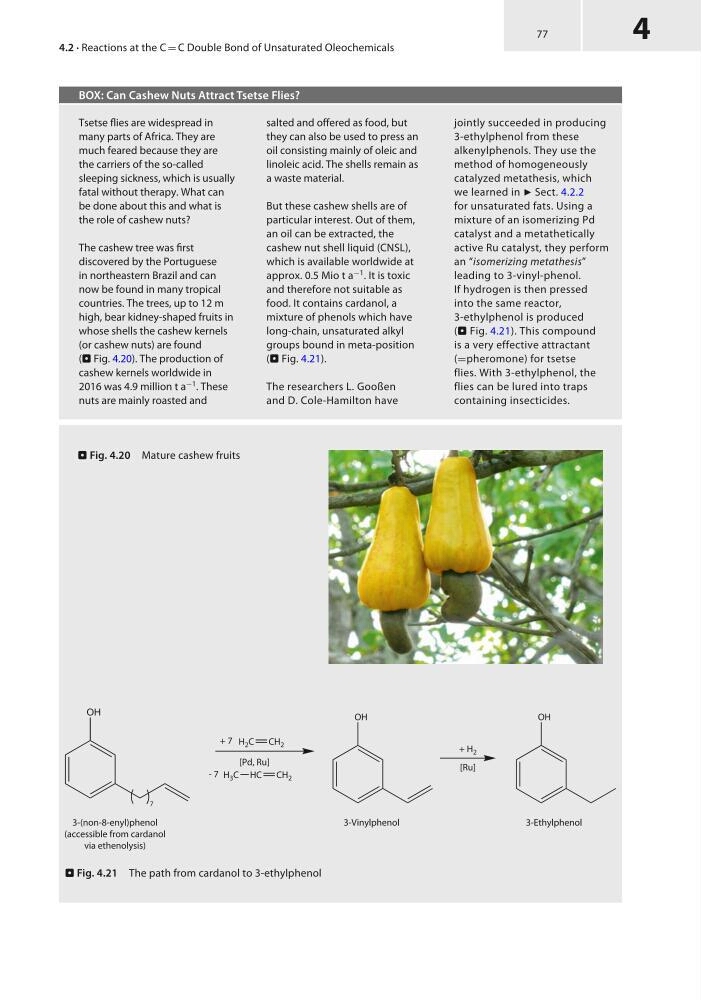
(. Fig. 4.21).
The researchers L. Gooßen
and D. Cole-Hamilton have
jointly succeeded in producing
3-ethylphenol from these
alkenylphenols. They use the
method of homogeneously
catalyzed metathesis, which
we learned in 7 Sect. 4.2.2
for unsaturated fats. Using a
mixture of an isomerizing Pd
catalyst and a metathetically
active Ru catalyst, they perform
an “isomerizing metathesis”
leading to 3-vinyl-phenol.
If hydrogen is then pressed
into the same reactor,
3-ethylphenol is produced
(. Fig. 4.21). This compound
is a very effective attractant
(=pheromone) for tsetse
flies. With 3-ethylphenol, the
flies can be lured into traps
containing insecticides.
. Fig. 4.20 Mature cashew fruits
. Fig. 4.21 The path from cardanol to 3-ethylphenol
4.2 · Reactions at the C = C Double Bond of Unsaturated Oleochemicals
4
BOX: Can Cashew Nuts Attract Tsetse Flies?
Tsetse flies are widespread in
many parts of Africa. They are
much feared because they are
the carriers of the so-called
sleeping sickness, which is usually
fatal without therapy. What can
be done about this and what is
the role of cashew nuts?
The cashew tree was first
discovered by the Portuguese
in northeastern Brazil and can
now be found in many tropical
countries. The trees, up to 12 m
high, bear kidney-shaped fruits in
whose shells the cashew kernels
(or cashew nuts) are found
(. Fig. 4.20). The production of
cashew kernels worldwide in
2016 was 4.9 million t a −1 . These
nuts are mainly roasted and
salted and offered as food, but
they can also be used to press an
oil consisting mainly of oleic and
linoleic acid. The shells remain as
a waste material.
But these cashew shells are of
particular interest. Out of them,
an oil can be extracted, the
cashew nut shell liquid (CNSL),
which is available worldwide at
approx. 0.5 Mio t a −1 . It is toxic
and therefore not suitable as
food. It contains cardanol, a
mixture of phenols which have
long-chain, unsaturated alkyl
groups bound in meta-position
(. Fig. 4.21).
The researchers L. Gooßen
and D. Cole-Hamilton have
jointly succeeded in producing
3-ethylphenol from these
alkenylphenols. They use the
method of homogeneously
catalyzed metathesis, which
we learned in 7 Sect. 4.2.2
for unsaturated fats. Using a
mixture of an isomerizing Pd
catalyst and a metathetically
active Ru catalyst, they perform
an “isomerizing metathesis”
leading to 3-vinyl-phenol.
If hydrogen is then pressed
into the same reactor,
3-ethylphenol is produced
(. Fig. 4.21). This compound
is a very effective attractant
(=pheromone) for tsetse
flies. With 3-ethylphenol, the
flies can be lured into traps
containing insecticides.
. Fig. 4.20 Mature cashew fruits
. Fig. 4.21 The path from cardanol to 3-ethylphenol
4.2 · Reactions at the C = C Double Bond of Unsaturated Oleochemicals