

54
Chapter 3 · The Basics of Oleochemistry - Basic Oleochemicals
3
thus enable an almost isothermal operation.
This results in sulfonation degrees of up to 98%.
Approx. 30 kg of products can be produced per
hour per reactor tube. Scale-up, i.e. the increase in
reactor capacity, can be achieved quite simply by
feeding a larger number of pipes with reactants.
Sulfation of Fatty Alcohol Ethoxylates
to Fatty Alcohol Ether Sulfates (FAES)
In the reaction overview (. Fig. 3.14), it has
already been pointed out that fatty alcohol ethoxylates (FAE) can also be sulfated to fatty alcohol ether sulfates (FAES), as they also contain a
terminal hydroxyl group, just like fatty alcohols.
FAES are also excellent surfactants, which are
mainly used in shampoos (see BOX: A Typical
Hair Shampoo). Compared to FAS, they are more
water-soluble due to the additional glycol units.
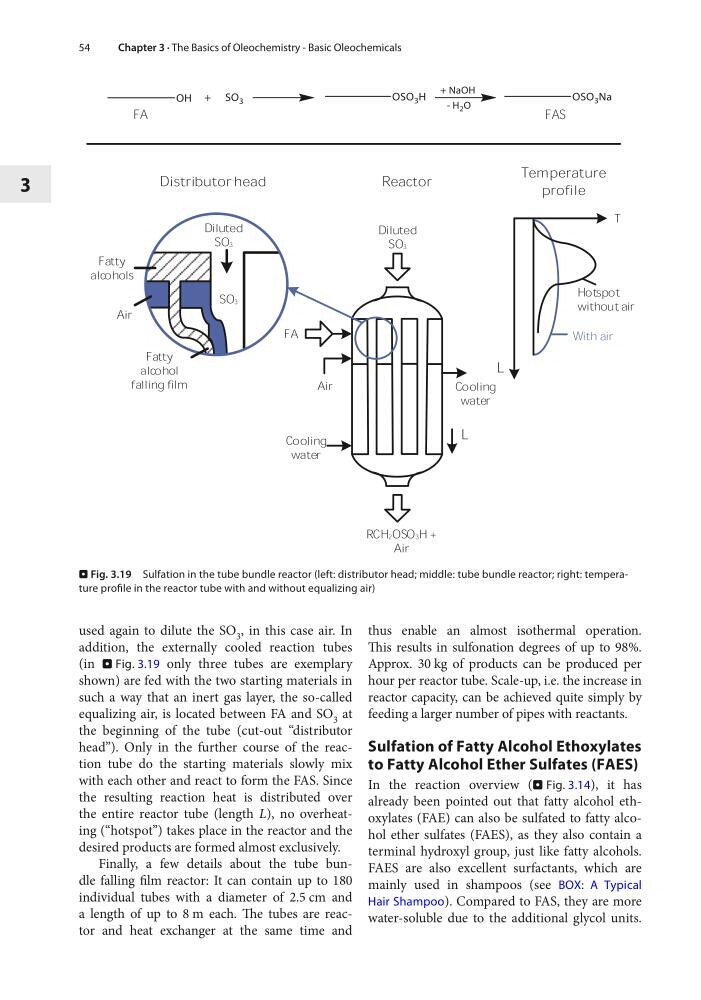
used again to dilute the SO 3 , in this case air. In
addition, the externally cooled reaction tubes
(in . Fig. 3.19 only three tubes are exemplary
shown) are fed with the two starting materials in
such a way that an inert gas layer, the so-called
equalizing air, is located between FA and SO 3 at
the beginning of the tube (cut-out “distributor
head”). Only in the further course of the reaction tube do the starting materials slowly mix
with each other and react to form the FAS. Since
the resulting reaction heat is distributed over
the entire reactor tube (length L), no overheating (“hotspot”) takes place in the reactor and the
desired products are formed almost exclusively.
Finally, a few details about the tube bundle falling film reactor: It can contain up to 180
individual tubes with a diameter of 2.5 cm and
a length of up to 8 m each. The tubes are reactor and heat exchanger at the same time and
. Fig. 3.19 Sulfation in the tube bundle reactor (left: distributor head; middle: tube bundle reactor; right: temperature profile in the reactor tube with and without equalizing air)
Chapter 3 · The Basics of Oleochemistry - Basic Oleochemicals
3
thus enable an almost isothermal operation.
This results in sulfonation degrees of up to 98%.
Approx. 30 kg of products can be produced per
hour per reactor tube. Scale-up, i.e. the increase in
reactor capacity, can be achieved quite simply by
feeding a larger number of pipes with reactants.
Sulfation of Fatty Alcohol Ethoxylates
to Fatty Alcohol Ether Sulfates (FAES)
In the reaction overview (. Fig. 3.14), it has
already been pointed out that fatty alcohol ethoxylates (FAE) can also be sulfated to fatty alcohol ether sulfates (FAES), as they also contain a
terminal hydroxyl group, just like fatty alcohols.
FAES are also excellent surfactants, which are
mainly used in shampoos (see BOX: A Typical
Hair Shampoo). Compared to FAS, they are more
water-soluble due to the additional glycol units.
used again to dilute the SO 3 , in this case air. In
addition, the externally cooled reaction tubes
(in . Fig. 3.19 only three tubes are exemplary
shown) are fed with the two starting materials in
such a way that an inert gas layer, the so-called
equalizing air, is located between FA and SO 3 at
the beginning of the tube (cut-out “distributor
head”). Only in the further course of the reaction tube do the starting materials slowly mix
with each other and react to form the FAS. Since
the resulting reaction heat is distributed over
the entire reactor tube (length L), no overheating (“hotspot”) takes place in the reactor and the
desired products are formed almost exclusively.
Finally, a few details about the tube bundle falling film reactor: It can contain up to 180
individual tubes with a diameter of 2.5 cm and
a length of up to 8 m each. The tubes are reactor and heat exchanger at the same time and
. Fig. 3.19 Sulfation in the tube bundle reactor (left: distributor head; middle: tube bundle reactor; right: temperature profile in the reactor tube with and without equalizing air)