

41
3
e.g. by crystallization or adsorption, but very often
refining by continuous distillation is preferred in
industry. However, fatty acids have relatively high
boiling temperatures: Capric acid (C10:0) boils
at 270 °C, stearic acid (C18:0) even at 370 °C, for
example. Distillation must therefore be carried out
in a vacuum, e.g. at 2–5 mbar. Technically, there are
many variants of vacuum distillation of fatty acids.
Today, distillation columns that contain structural
packings and thus minimize the pressure loss of
the column are preferred. Modern plants can continuously purify up to 100,000 tons of fatty acids
per year. In 2017, the capacity for fatty acids from
vegetable oils worldwide was approx. 13 million
tons, of which approx. 50% in the oil-producing
countries of Southeast Asia (Malaysia, Indonesia,
China, Thailand, Philippines) alone. These figures
do not include the amount of fatty acids used in
soap production (7 Sect. 3.1.3).
Fatty acids are widely used:
5 They are used directly, e.g. as auxiliaries in
the plastics or rubber industry.
5 They are converted at the carboxy group,
e.g. ethoxylated, esterified or amidated
(7 Sect. 3.2).
5 They are chemically modified in the fat chain,
e.g. by chlorination, epoxidation or dimerization (7 Chap. 4).
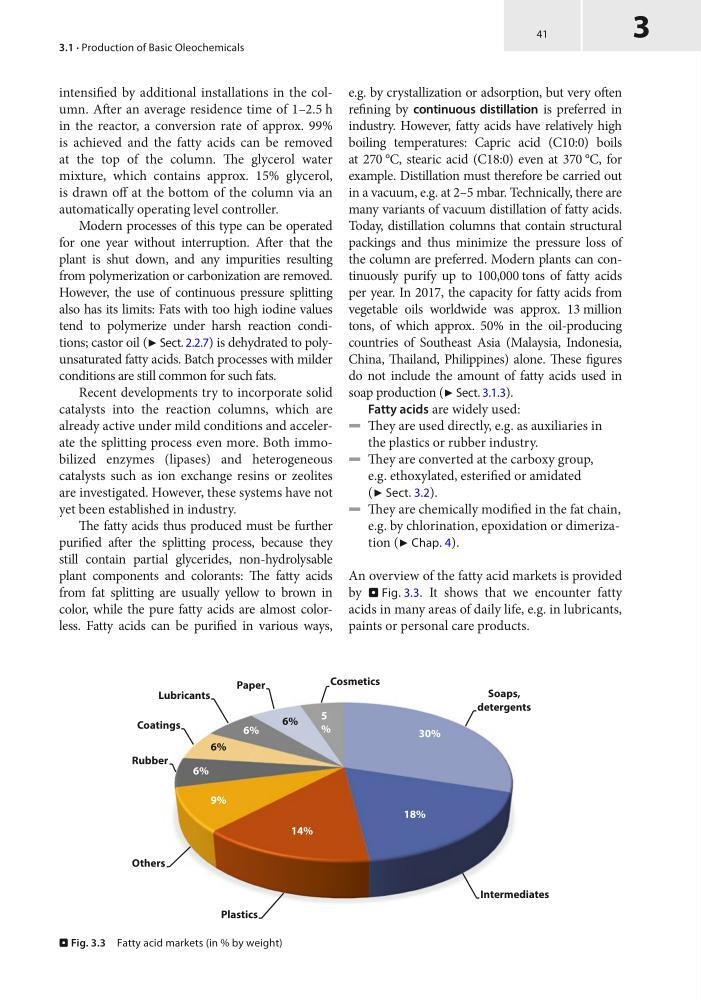
An overview of the fatty acid markets is provided
by . Fig. 3.3. It shows that we encounter fatty
acids in many areas of daily life, e.g. in lubricants,
paints or personal care products.
intensified by additional installations in the column. After an average residence time of 1–2.5 h
in the reactor, a conversion rate of approx. 99%
is achieved and the fatty acids can be removed
at the top of the column. The glycerol water
mixture, which contains approx. 15% glycerol,
is drawn off at the bottom of the column via an
automatically operating level controller.
Modern processes of this type can be operated
for one year without interruption. After that the
plant is shut down, and any impurities resulting
from polymerization or carbonization are removed.
However, the use of continuous pressure splitting
also has its limits: Fats with too high iodine values
tend to polymerize under harsh reaction conditions; castor oil (7 Sect. 2.2.7) is dehydrated to polyunsaturated fatty acids. Batch processes with milder
conditions are still common for such fats.
Recent developments try to incorporate solid
catalysts into the reaction columns, which are
already active under mild conditions and accelerate the splitting process even more. Both immobilized enzymes (lipases) and heterogeneous
catalysts such as ion exchange resins or zeolites
are investigated. However, these systems have not
yet been established in industry.
The fatty acids thus produced must be further
purified after the splitting process, because they
still contain partial glycerides, non-hydrolysable
plant components and colorants: The fatty acids
from fat splitting are usually yellow to brown in
color, while the pure fatty acids are almost colorless. Fatty acids can be purified in various ways,
Soaps,
detergents
Intermediates
Plastics
Others
Rubber
Coatings
Lubricants
Paper
Cosmetics
5
%
6%
6%
6%
6%
30%
18%
14%
9%
. Fig. 3.3 Fatty acid markets (in % by weight)
3.1 · Production of Basic Oleochemicals
3
e.g. by crystallization or adsorption, but very often
refining by continuous distillation is preferred in
industry. However, fatty acids have relatively high
boiling temperatures: Capric acid (C10:0) boils
at 270 °C, stearic acid (C18:0) even at 370 °C, for
example. Distillation must therefore be carried out
in a vacuum, e.g. at 2–5 mbar. Technically, there are
many variants of vacuum distillation of fatty acids.
Today, distillation columns that contain structural
packings and thus minimize the pressure loss of
the column are preferred. Modern plants can continuously purify up to 100,000 tons of fatty acids
per year. In 2017, the capacity for fatty acids from
vegetable oils worldwide was approx. 13 million
tons, of which approx. 50% in the oil-producing
countries of Southeast Asia (Malaysia, Indonesia,
China, Thailand, Philippines) alone. These figures
do not include the amount of fatty acids used in
soap production (7 Sect. 3.1.3).
Fatty acids are widely used:
5 They are used directly, e.g. as auxiliaries in
the plastics or rubber industry.
5 They are converted at the carboxy group,
e.g. ethoxylated, esterified or amidated
(7 Sect. 3.2).
5 They are chemically modified in the fat chain,
e.g. by chlorination, epoxidation or dimerization (7 Chap. 4).
An overview of the fatty acid markets is provided
by . Fig. 3.3. It shows that we encounter fatty
acids in many areas of daily life, e.g. in lubricants,
paints or personal care products.
intensified by additional installations in the column. After an average residence time of 1–2.5 h
in the reactor, a conversion rate of approx. 99%
is achieved and the fatty acids can be removed
at the top of the column. The glycerol water
mixture, which contains approx. 15% glycerol,
is drawn off at the bottom of the column via an
automatically operating level controller.
Modern processes of this type can be operated
for one year without interruption. After that the
plant is shut down, and any impurities resulting
from polymerization or carbonization are removed.
However, the use of continuous pressure splitting
also has its limits: Fats with too high iodine values
tend to polymerize under harsh reaction conditions; castor oil (7 Sect. 2.2.7) is dehydrated to polyunsaturated fatty acids. Batch processes with milder
conditions are still common for such fats.
Recent developments try to incorporate solid
catalysts into the reaction columns, which are
already active under mild conditions and accelerate the splitting process even more. Both immobilized enzymes (lipases) and heterogeneous
catalysts such as ion exchange resins or zeolites
are investigated. However, these systems have not
yet been established in industry.
The fatty acids thus produced must be further
purified after the splitting process, because they
still contain partial glycerides, non-hydrolysable
plant components and colorants: The fatty acids
from fat splitting are usually yellow to brown in
color, while the pure fatty acids are almost colorless. Fatty acids can be purified in various ways,
Soaps,
detergents
Intermediates
Plastics
Others
Rubber
Coatings
Lubricants
Paper
Cosmetics
5
%
6%
6%
6%
6%
30%
18%
14%
9%
. Fig. 3.3 Fatty acid markets (in % by weight)
3.1 · Production of Basic Oleochemicals