

29
2
2.2.10 Jatropha Oil
The jatropha (Jatropha curcas) belongs to the
spurge family (Euphorbiaceae) and is native in
tropical and subtropical areas. The special feature of
this plant is that, due to its frugality and robustness,
it also grows in dry savannahs, where food plants
cannot survive. It is therefore ideal for growing oil
plants in desert-like and erosion-endangered areas.
The jatropha shrub can grow up to 8 m high and
forms plum-sized fruits that contain several seeds.
These seeds consist of up to 60% oil (. Fig. 2.15).
Although the press cake contains up to 60% crude
protein, it is unsuitable as food for humans or
animals because it contains toxic substances, the
phorbol esters, which cannot yet be removed.
Jatropha oil contains about 75% unsaturated
fatty acids, especially oleic acid (42%) and linoleic
acid (35%), and only small amounts of saturated
fatty acids such as palmitic acid (14%) or stearic
acid (6%). However, the composition of the
jatropha oils varies considerably. In recent years,
jatropha oil has attracted special attention because
it can also be used as diesel fuel (“biodiesel”) due
to its high cetane numbers (approx. 60). Parts of
South America, Africa and Asia have therefore
seen a sharp increase in the cultivation of jatropha.
However, this plant will not be able to solve the
energy problems of the industrialized countries.
2.2.9 Safflower Oil
The safflower (Carthamus tinctorius) belongs
- like the sunflower - to the family of daisies.
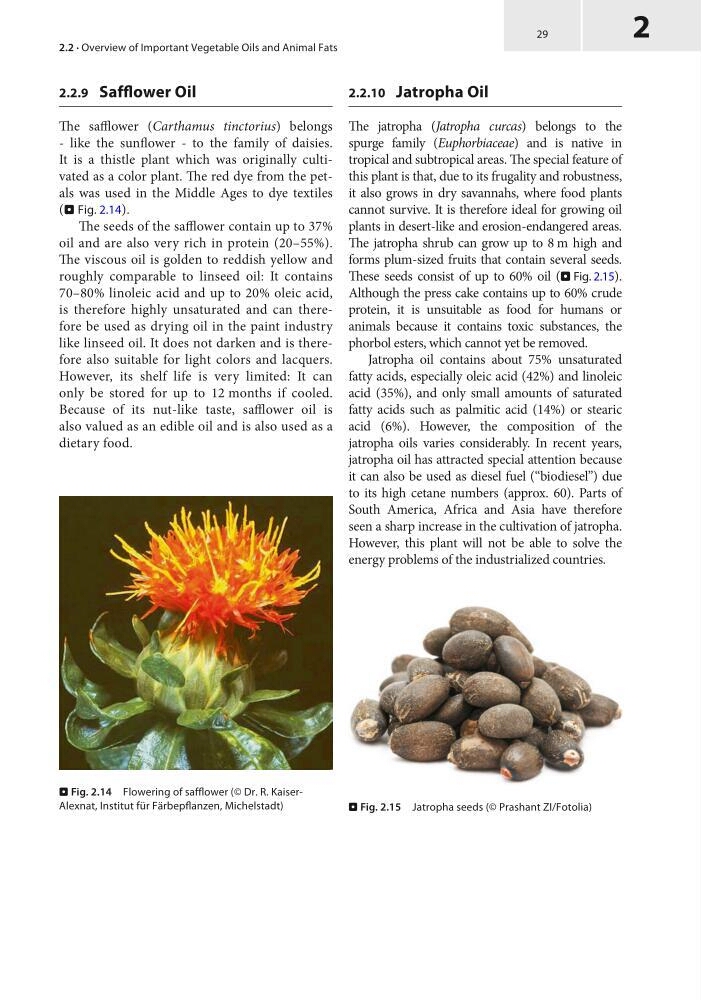
It is a thistle plant which was originally cultivated as a color plant. The red dye from the petals was used in the Middle Ages to dye textiles
(. Fig. 2.14).
The seeds of the safflower contain up to 37%
oil and are also very rich in protein (20–55%).
The viscous oil is golden to reddish yellow and
roughly comparable to linseed oil: It contains
70–80% linoleic acid and up to 20% oleic acid,
is therefore highly unsaturated and can therefore be used as drying oil in the paint industry
like linseed oil. It does not darken and is therefore also suitable for light colors and lacquers.
However, its shelf life is very limited: It can
only be stored for up to 12 months if cooled.
Because of its nut-like taste, safflower oil is
also valued as an edible oil and is also used as a
dietary food.
. Fig. 2.14 Flowering of safflower (© Dr. R. KaiserAlexnat, Institut für Färbepflanzen, Michelstadt)
2.2 · Overview of Important Vegetable Oils and Animal Fats
. Fig. 2.15 Jatropha seeds (© Prashant ZI/Fotolia)
2
2.2.10 Jatropha Oil
The jatropha (Jatropha curcas) belongs to the
spurge family (Euphorbiaceae) and is native in
tropical and subtropical areas. The special feature of
this plant is that, due to its frugality and robustness,
it also grows in dry savannahs, where food plants
cannot survive. It is therefore ideal for growing oil
plants in desert-like and erosion-endangered areas.
The jatropha shrub can grow up to 8 m high and
forms plum-sized fruits that contain several seeds.
These seeds consist of up to 60% oil (. Fig. 2.15).
Although the press cake contains up to 60% crude
protein, it is unsuitable as food for humans or
animals because it contains toxic substances, the
phorbol esters, which cannot yet be removed.
Jatropha oil contains about 75% unsaturated
fatty acids, especially oleic acid (42%) and linoleic
acid (35%), and only small amounts of saturated
fatty acids such as palmitic acid (14%) or stearic
acid (6%). However, the composition of the
jatropha oils varies considerably. In recent years,
jatropha oil has attracted special attention because
it can also be used as diesel fuel (“biodiesel”) due
to its high cetane numbers (approx. 60). Parts of
South America, Africa and Asia have therefore
seen a sharp increase in the cultivation of jatropha.
However, this plant will not be able to solve the
energy problems of the industrialized countries.
2.2.9 Safflower Oil
The safflower (Carthamus tinctorius) belongs
- like the sunflower - to the family of daisies.
It is a thistle plant which was originally cultivated as a color plant. The red dye from the petals was used in the Middle Ages to dye textiles
(. Fig. 2.14).
The seeds of the safflower contain up to 37%
oil and are also very rich in protein (20–55%).
The viscous oil is golden to reddish yellow and
roughly comparable to linseed oil: It contains
70–80% linoleic acid and up to 20% oleic acid,
is therefore highly unsaturated and can therefore be used as drying oil in the paint industry
like linseed oil. It does not darken and is therefore also suitable for light colors and lacquers.
However, its shelf life is very limited: It can
only be stored for up to 12 months if cooled.
Because of its nut-like taste, safflower oil is
also valued as an edible oil and is also used as a
dietary food.
. Fig. 2.14 Flowering of safflower (© Dr. R. KaiserAlexnat, Institut für Färbepflanzen, Michelstadt)
2.2 · Overview of Important Vegetable Oils and Animal Fats
. Fig. 2.15 Jatropha seeds (© Prashant ZI/Fotolia)