

27
2
atmospheric oxygen and finally becomes solid:
Several fatty acid molecules combine to form a
large, branched molecule. An oil with this behavior is also called “drying oil“. These drying oils
are excellently suited for the production of ecologically compatible lacquers, paints, printing
inks and varnishes. Further applications can be
found in the paper, leather and oilcloth industries and in the production of linoleum floor
coverings (7 Sect. 4.2.2.5). The name “linoleum”
already refers to the name of the main raw material, linseed oil (lat. oleum lini).
2.2.7 Castor Oil
Castor oil (Ricinus communis) belongs to the
Euphorbiaceae family and comes from the tropics of Asia and Africa. Today, India, China, Brazil and Thailand are the main growing areas;
containing the linseeds (. Fig. 2.11). Flax can be
divided into oil flax, oil fiber flax and fiber flax,
with the linseed oil content decreasing and the
fiber content increasing in this order. The fabric
of the flax fiber is called linen.
Linen was already known to the Sumerians
and Egyptians 5000 years ago, and also in Europe,
linen was already cultivated in the younger Stone
Age. Fiber flax needs relatively much water for its
growth; the oil flax prefers drier, warmer regions
with temperatures around 20 °C. Linseed has an oil
content between 30 and 50%. As . Table 2.3 shows,
linseed oil obtained by grinding, pressing and/
or extraction contains high proportions of linolenic acid (50–60% C18:3) in addition to oleic acid
(C18:1) and linoleic acid (C18:2). However, the
key figures for linseed oil are sometimes subject to
very strong fluctuations, especially the iodine value
(BOX: Quality Criteria for Oleochemists).
The high proportion of triple unsaturated
fatty acid leads to the fact that linseed oil gradually polymerizes in the air by reactions with
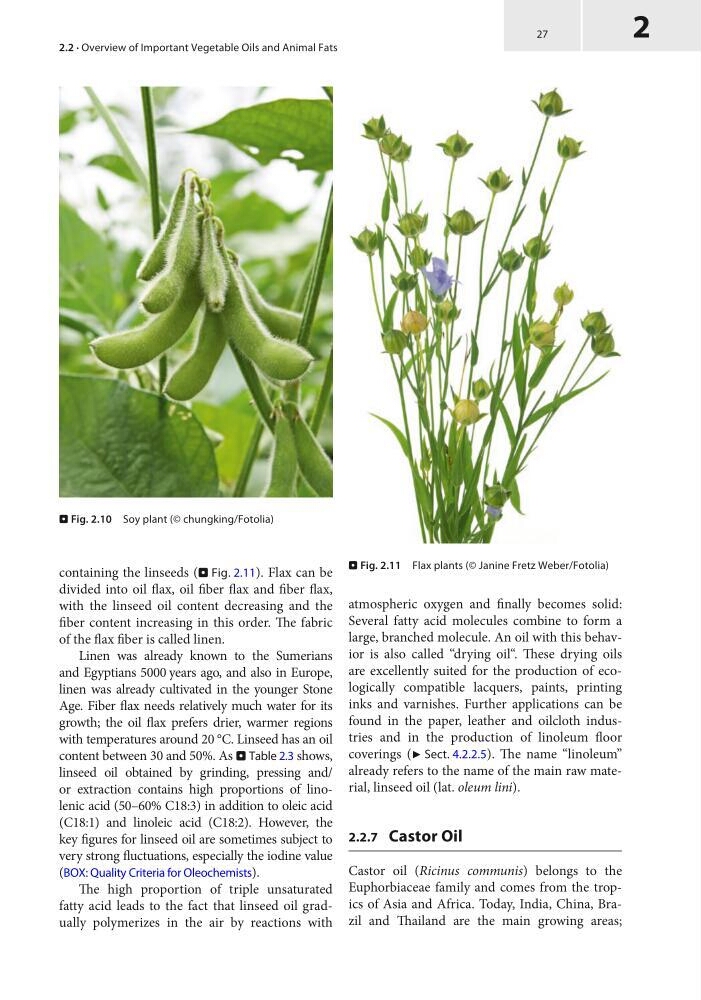
. Fig. 2.10 Soy plant (© chungking/Fotolia)
. Fig. 2.11 Flax plants (© Janine Fretz Weber/Fotolia)
2.2 · Overview of Important Vegetable Oils and Animal Fats
2
atmospheric oxygen and finally becomes solid:
Several fatty acid molecules combine to form a
large, branched molecule. An oil with this behavior is also called “drying oil“. These drying oils
are excellently suited for the production of ecologically compatible lacquers, paints, printing
inks and varnishes. Further applications can be
found in the paper, leather and oilcloth industries and in the production of linoleum floor
coverings (7 Sect. 4.2.2.5). The name “linoleum”
already refers to the name of the main raw material, linseed oil (lat. oleum lini).
2.2.7 Castor Oil
Castor oil (Ricinus communis) belongs to the
Euphorbiaceae family and comes from the tropics of Asia and Africa. Today, India, China, Brazil and Thailand are the main growing areas;
containing the linseeds (. Fig. 2.11). Flax can be
divided into oil flax, oil fiber flax and fiber flax,
with the linseed oil content decreasing and the
fiber content increasing in this order. The fabric
of the flax fiber is called linen.
Linen was already known to the Sumerians
and Egyptians 5000 years ago, and also in Europe,
linen was already cultivated in the younger Stone
Age. Fiber flax needs relatively much water for its
growth; the oil flax prefers drier, warmer regions
with temperatures around 20 °C. Linseed has an oil
content between 30 and 50%. As . Table 2.3 shows,
linseed oil obtained by grinding, pressing and/
or extraction contains high proportions of linolenic acid (50–60% C18:3) in addition to oleic acid
(C18:1) and linoleic acid (C18:2). However, the
key figures for linseed oil are sometimes subject to
very strong fluctuations, especially the iodine value
(BOX: Quality Criteria for Oleochemists).
The high proportion of triple unsaturated
fatty acid leads to the fact that linseed oil gradually polymerizes in the air by reactions with
. Fig. 2.10 Soy plant (© chungking/Fotolia)
. Fig. 2.11 Flax plants (© Janine Fretz Weber/Fotolia)
2.2 · Overview of Important Vegetable Oils and Animal Fats