

18
Chapter 2 · The Raw Materials of Oleochemistry - Oil Plants
2
ever kept liquid olive oil in the refrigerator will
certainly have observed a slight cloudiness after
some time. In the following sections, we will
simply refer to “fats”, but we will always refer to
“fats and oils”.
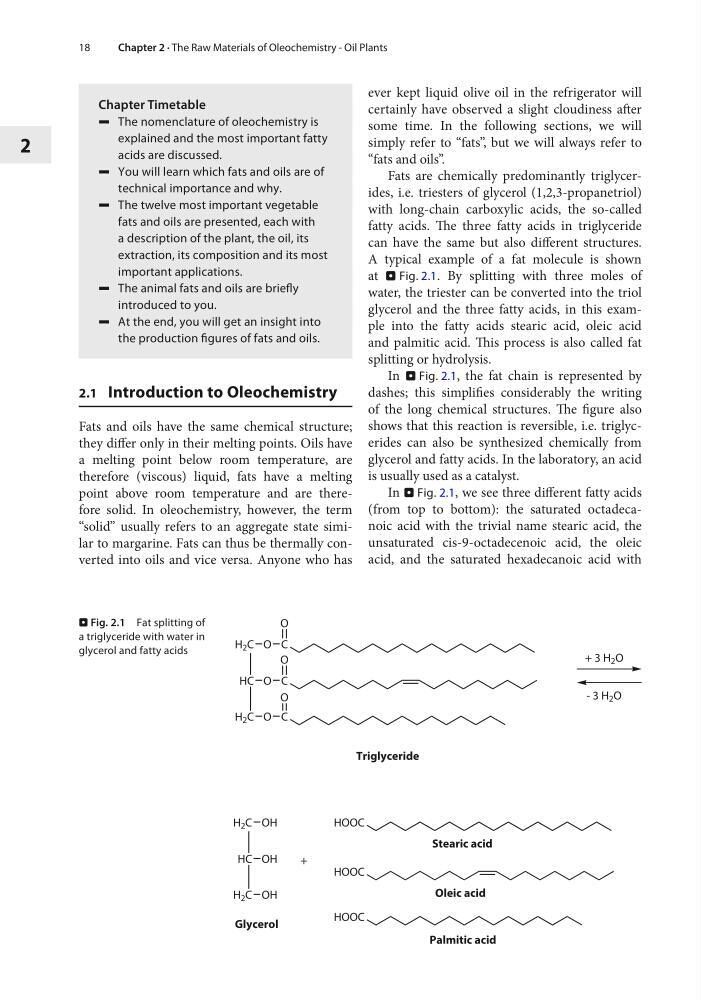
Fats are chemically predominantly triglycerides, i.e. triesters of glycerol (1,2,3-propanetriol)
with long-chain carboxylic acids, the so-called
fatty acids. The three fatty acids in triglyceride
can have the same but also different structures.
A typical example of a fat molecule is shown
at . Fig. 2.1. By splitting with three moles of
water, the triester can be converted into the triol
glycerol and the three fatty acids, in this example into the fatty acids stearic acid, oleic acid
and palmitic acid. This process is also called fat
splitting or hydrolysis.
In . Fig. 2.1, the fat chain is represented by
dashes; this simplifies considerably the writing
of the long chemical structures. The figure also
shows that this reaction is reversible, i.e. triglycerides can also be synthesized chemically from
glycerol and fatty acids. In the laboratory, an acid
is usually used as a catalyst.
In . Fig. 2.1, we see three different fatty acids
(from top to bottom): the saturated octadecanoic acid with the trivial name stearic acid, the
unsaturated cis-9-octadecenoic acid, the oleic
acid, and the saturated hexadecanoic acid with
Chapter Timetable
5 The nomenclature of oleochemistry is
explained and the most important fatty
acids are discussed.
5 You will learn which fats and oils are of
technical importance and why.
5 The twelve most important vegetable
fats and oils are presented, each with
a description of the plant, the oil, its
extraction, its composition and its most
important applications.
5 The animal fats and oils are briefly
introduced to you.
5 At the end, you will get an insight into
the production figures of fats and oils.
2.1 Introduction to Oleochemistry
Fats and oils have the same chemical structure;
they differ only in their melting points. Oils have
a melting point below room temperature, are
therefore (viscous) liquid, fats have a melting
point above room temperature and are therefore solid. In oleochemistry, however, the term
“solid” usually refers to an aggregate state similar to margarine. Fats can thus be thermally converted into oils and vice versa. Anyone who has
. Fig. 2.1 Fat splitting of
a triglyceride with water in
glycerol and fatty acids
H 2 C O C
O
HC O C
O
H 2 C O C
O
Triglyceride
+ 3 H 2 O
- 3 H 2 O
H 2 C OH
HC OH
H 2 C OH
+
HOOC
HOOC
HOOC
Stearic acid
Oleic acid
Palmitic acid
Glycerol
Chapter 2 · The Raw Materials of Oleochemistry - Oil Plants
2
ever kept liquid olive oil in the refrigerator will
certainly have observed a slight cloudiness after
some time. In the following sections, we will
simply refer to “fats”, but we will always refer to
“fats and oils”.
Fats are chemically predominantly triglycerides, i.e. triesters of glycerol (1,2,3-propanetriol)
with long-chain carboxylic acids, the so-called
fatty acids. The three fatty acids in triglyceride
can have the same but also different structures.
A typical example of a fat molecule is shown
at . Fig. 2.1. By splitting with three moles of
water, the triester can be converted into the triol
glycerol and the three fatty acids, in this example into the fatty acids stearic acid, oleic acid
and palmitic acid. This process is also called fat
splitting or hydrolysis.
In . Fig. 2.1, the fat chain is represented by
dashes; this simplifies considerably the writing
of the long chemical structures. The figure also
shows that this reaction is reversible, i.e. triglycerides can also be synthesized chemically from
glycerol and fatty acids. In the laboratory, an acid
is usually used as a catalyst.
In . Fig. 2.1, we see three different fatty acids
(from top to bottom): the saturated octadecanoic acid with the trivial name stearic acid, the
unsaturated cis-9-octadecenoic acid, the oleic
acid, and the saturated hexadecanoic acid with
Chapter Timetable
5 The nomenclature of oleochemistry is
explained and the most important fatty
acids are discussed.
5 You will learn which fats and oils are of
technical importance and why.
5 The twelve most important vegetable
fats and oils are presented, each with
a description of the plant, the oil, its
extraction, its composition and its most
important applications.
5 The animal fats and oils are briefly
introduced to you.
5 At the end, you will get an insight into
the production figures of fats and oils.
2.1 Introduction to Oleochemistry
Fats and oils have the same chemical structure;
they differ only in their melting points. Oils have
a melting point below room temperature, are
therefore (viscous) liquid, fats have a melting
point above room temperature and are therefore solid. In oleochemistry, however, the term
“solid” usually refers to an aggregate state similar to margarine. Fats can thus be thermally converted into oils and vice versa. Anyone who has
. Fig. 2.1 Fat splitting of
a triglyceride with water in
glycerol and fatty acids
H 2 C O C
O
HC O C
O
H 2 C O C
O
Triglyceride
+ 3 H 2 O
- 3 H 2 O
H 2 C OH
HC OH
H 2 C OH
+
HOOC
HOOC
HOOC
Stearic acid
Oleic acid
Palmitic acid
Glycerol