

8
Chapter 1 · The Overview - Introduction
1
millions of years as coal, natural gas or crude oil
is removed from the soil and is mainly used for
energy purposes. In these combustion processes,
carbon is ultimately converted into carbon dioxide, which poses the problem of increasing CO 2
concentrations in our atmosphere.
In a few decades, the oil and gas reserves will
slowly run out, in a few centuries also the coal
reserves. By then at the latest, the “second solar
period” of mankind will begin with the almost
exclusive use of renewable raw materials and
probably with increased use of carbon dioxide
and hydrogen electrolytically produced from
water.
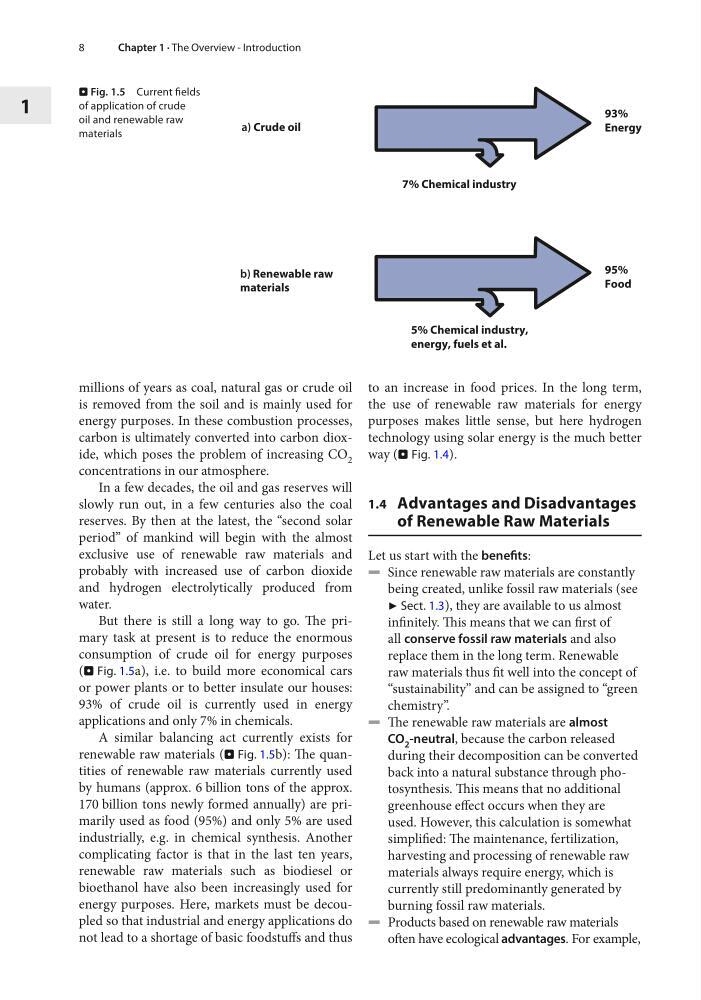
But there is still a long way to go. The primary task at present is to reduce the enormous
consumption of crude oil for energy purposes
(. Fig. 1.5a), i.e. to build more economical cars
or power plants or to better insulate our houses:
93% of crude oil is currently used in energy
applications and only 7% in chemicals.
A similar balancing act currently exists for
renewable raw materials (. Fig. 1.5b): The quantities of renewable raw materials currently used
by humans (approx. 6 billion tons of the approx.
170 billion tons newly formed annually) are primarily used as food (95%) and only 5% are used
industrially, e.g. in chemical synthesis. Another
complicating factor is that in the last ten years,
renewable raw materials such as biodiesel or
bioethanol have also been increasingly used for
energy purposes. Here, markets must be decoupled so that industrial and energy applications do
not lead to a shortage of basic foodstuffs and thus
. Fig. 1.5 Current fields
of application of crude
oil and renewable raw
materials
a) Crude oil
b) Renewable raw
materials
7% Chemical industry
5% Chemical industry,
energy, fuels et al.
93%
Energy
95%
Food
to an increase in food prices. In the long term,
the use of renewable raw materials for energy
purposes makes little sense, but here hydrogen
technology using solar energy is the much better
way (. Fig. 1.4).
1.4 Advantages and Disadvantages
of Renewable Raw Materials
Let us start with the benefits:
5 Since renewable raw materials are constantly
being created, unlike fossil raw materials (see
7 Sect. 1.3), they are available to us almost
infinitely. This means that we can first of
all conserve fossil raw materials and also
replace them in the long term. Renewable
raw materials thus fit well into the concept of
“sustainability” and can be assigned to “green
chemistry”.
5 The renewable raw materials are almost
CO 2 -neutral, because the carbon released
during their decomposition can be converted
back into a natural substance through photosynthesis. This means that no additional
greenhouse effect occurs when they are
used. However, this calculation is somewhat
simplified: The maintenance, fertilization,
harvesting and processing of renewable raw
materials always require energy, which is
currently still predominantly generated by
burning fossil raw materials.
5 Products based on renewable raw materials
often have ecological advantages. For example,
Chapter 1 · The Overview - Introduction
1
millions of years as coal, natural gas or crude oil
is removed from the soil and is mainly used for
energy purposes. In these combustion processes,
carbon is ultimately converted into carbon dioxide, which poses the problem of increasing CO 2
concentrations in our atmosphere.
In a few decades, the oil and gas reserves will
slowly run out, in a few centuries also the coal
reserves. By then at the latest, the “second solar
period” of mankind will begin with the almost
exclusive use of renewable raw materials and
probably with increased use of carbon dioxide
and hydrogen electrolytically produced from
water.
But there is still a long way to go. The primary task at present is to reduce the enormous
consumption of crude oil for energy purposes
(. Fig. 1.5a), i.e. to build more economical cars
or power plants or to better insulate our houses:
93% of crude oil is currently used in energy
applications and only 7% in chemicals.
A similar balancing act currently exists for
renewable raw materials (. Fig. 1.5b): The quantities of renewable raw materials currently used
by humans (approx. 6 billion tons of the approx.
170 billion tons newly formed annually) are primarily used as food (95%) and only 5% are used
industrially, e.g. in chemical synthesis. Another
complicating factor is that in the last ten years,
renewable raw materials such as biodiesel or
bioethanol have also been increasingly used for
energy purposes. Here, markets must be decoupled so that industrial and energy applications do
not lead to a shortage of basic foodstuffs and thus
. Fig. 1.5 Current fields
of application of crude
oil and renewable raw
materials
a) Crude oil
b) Renewable raw
materials
7% Chemical industry
5% Chemical industry,
energy, fuels et al.
93%
Energy
95%
Food
to an increase in food prices. In the long term,
the use of renewable raw materials for energy
purposes makes little sense, but here hydrogen
technology using solar energy is the much better
way (. Fig. 1.4).
1.4 Advantages and Disadvantages
of Renewable Raw Materials
Let us start with the benefits:
5 Since renewable raw materials are constantly
being created, unlike fossil raw materials (see
7 Sect. 1.3), they are available to us almost
infinitely. This means that we can first of
all conserve fossil raw materials and also
replace them in the long term. Renewable
raw materials thus fit well into the concept of
“sustainability” and can be assigned to “green
chemistry”.
5 The renewable raw materials are almost
CO 2 -neutral, because the carbon released
during their decomposition can be converted
back into a natural substance through photosynthesis. This means that no additional
greenhouse effect occurs when they are
used. However, this calculation is somewhat
simplified: The maintenance, fertilization,
harvesting and processing of renewable raw
materials always require energy, which is
currently still predominantly generated by
burning fossil raw materials.
5 Products based on renewable raw materials
often have ecological advantages. For example,