

192
Chapter 10 · Cyclic Carbohydrates - Cyclodextrins
10
Due to this particular property, cyclodextrins
have a very special behavior compared to other
oligosaccharides: They form host/guest complexes (also called inclusion complexes). This
property is based on the fact that cyclodextrins
are more polar (hydrophilic) toward the outside because the hydroxyl groups are directed
externally. This creates a hydrophobic cavity
inside the cyclodextrins, which can interact
with apolar substances. Cyclodextrins, like surfactants, are thus amphoteric. However, they
do not form micelles, but are able to dissolve
hydrophobic substances in water by incorporating them into their hydrophobic pocket.
Cyclodextrins themselves thus remain water
soluble. The size of the cavity depends on the
number of glucose monomers that compose
the cyclodextrins. In . Fig. 10.2, the sizes of
the most important representatives are given.
In addition, it is schematically shown how the
spatial structure of cyclodextrins can be illustrated: They form a cut-off cone with a cavity in the middle. The primary OH groups of
glucose are on the “smaller side” and the secondary OH groups are on the “larger side”. The
carbon atoms of the ring thus form the shell
of the cone, which is hydrophobic toward the
inside.
Chapter Timetable
5 We will take a closer look at the structure
and production of cyclodextrins.
5 The special reactivity of cyclodextrins will
be discussed.
5 The most important applications and
derivatizations are briefly presented.
10.1 Chemical Structure
of Cyclodextrins
Cyclodextrins are, as the name already suggests,
cyclic dextrins (7 Sect. 8.4) and are therefore oligosaccharides. Like dextrins, cyclodextrins also
consist of glucose monomers, which are linked
together via an α-1,4-glycosidic bond. However,
cyclodextrins (CD) do not have an end: They form
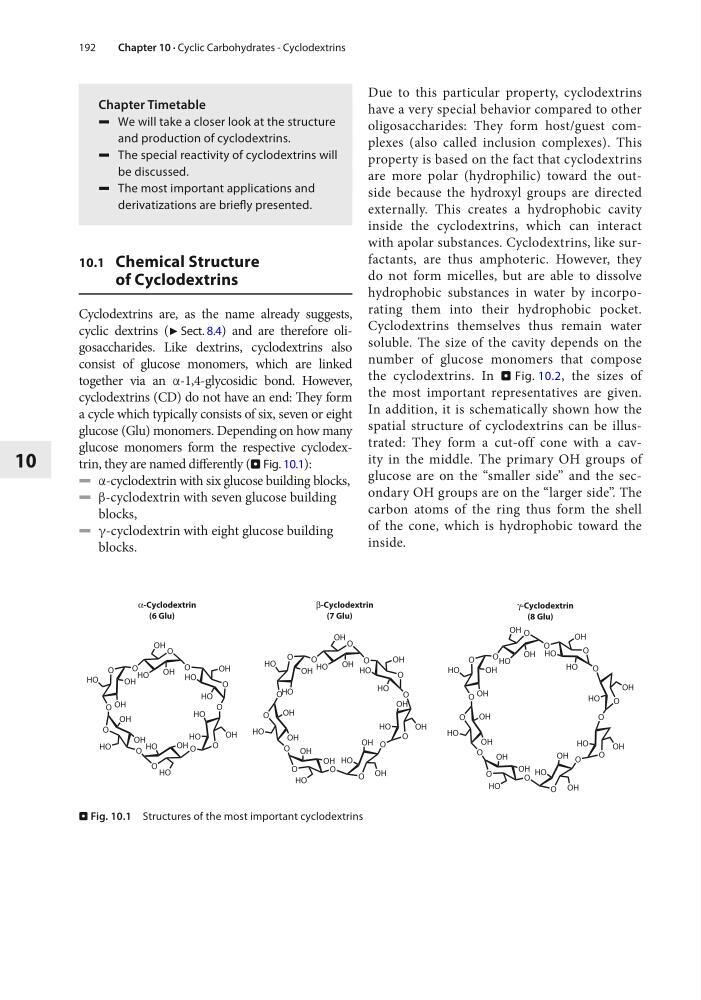
a cycle which typically consists of six, seven or eight
glucose (Glu) monomers. Depending on how many
glucose monomers form the respective cyclodextrin, they are named differently (. Fig. 10.1):
5 α-cyclodextrin with six glucose building blocks,
5 β-cyclodextrin with seven glucose building
blocks,
5 γ-cyclodextrin with eight glucose building
blocks.
O
HO
OH
O
O
HO
HO
O
O
HO
HO
O
O
OH
HO
O
O
OH
OH
O
O
OH
OH
O
HO
HO
OH
OH
OH
HO
α-Cyclodextrin
(6 Glu)
O
HO
OH
O
O
HO
HO
O
O
OH
HO
O
OH
OH
O
O
OH
OH
O
O
HO
OH
O
HO
HO
OH
OH
OH
HO
O
OH
HO
O
OH
O
β-Cyclodextrin
(7 Glu)
O
HO
OH
O
O
HO
HO
O
O
OH
HO
O
OH
OH
O
O
OH
OH
O
O
OH
OH
O
HO
HO
OH
OH
OH
HO
O
O
HO
O
OH
O
O
HO
OH
γ-Cyclodextrin
(8 Glu)
. Fig. 10.1 Structures of the most important cyclodextrins
Chapter 10 · Cyclic Carbohydrates - Cyclodextrins
10
Due to this particular property, cyclodextrins
have a very special behavior compared to other
oligosaccharides: They form host/guest complexes (also called inclusion complexes). This
property is based on the fact that cyclodextrins
are more polar (hydrophilic) toward the outside because the hydroxyl groups are directed
externally. This creates a hydrophobic cavity
inside the cyclodextrins, which can interact
with apolar substances. Cyclodextrins, like surfactants, are thus amphoteric. However, they
do not form micelles, but are able to dissolve
hydrophobic substances in water by incorporating them into their hydrophobic pocket.
Cyclodextrins themselves thus remain water
soluble. The size of the cavity depends on the
number of glucose monomers that compose
the cyclodextrins. In . Fig. 10.2, the sizes of
the most important representatives are given.
In addition, it is schematically shown how the
spatial structure of cyclodextrins can be illustrated: They form a cut-off cone with a cavity in the middle. The primary OH groups of
glucose are on the “smaller side” and the secondary OH groups are on the “larger side”. The
carbon atoms of the ring thus form the shell
of the cone, which is hydrophobic toward the
inside.
Chapter Timetable
5 We will take a closer look at the structure
and production of cyclodextrins.
5 The special reactivity of cyclodextrins will
be discussed.
5 The most important applications and
derivatizations are briefly presented.
10.1 Chemical Structure
of Cyclodextrins
Cyclodextrins are, as the name already suggests,
cyclic dextrins (7 Sect. 8.4) and are therefore oligosaccharides. Like dextrins, cyclodextrins also
consist of glucose monomers, which are linked
together via an α-1,4-glycosidic bond. However,
cyclodextrins (CD) do not have an end: They form
a cycle which typically consists of six, seven or eight
glucose (Glu) monomers. Depending on how many
glucose monomers form the respective cyclodextrin, they are named differently (. Fig. 10.1):
5 α-cyclodextrin with six glucose building blocks,
5 β-cyclodextrin with seven glucose building
blocks,
5 γ-cyclodextrin with eight glucose building
blocks.
O
HO
OH
O
O
HO
HO
O
O
HO
HO
O
O
OH
HO
O
O
OH
OH
O
O
OH
OH
O
HO
HO
OH
OH
OH
HO
α-Cyclodextrin
(6 Glu)
O
HO
OH
O
O
HO
HO
O
O
OH
HO
O
OH
OH
O
O
OH
OH
O
O
HO
OH
O
HO
HO
OH
OH
OH
HO
O
OH
HO
O
OH
O
β-Cyclodextrin
(7 Glu)
O
HO
OH
O
O
HO
HO
O
O
OH
HO
O
OH
OH
O
O
OH
OH
O
O
OH
OH
O
HO
HO
OH
OH
OH
HO
O
O
HO
O
OH
O
O
HO
OH
γ-Cyclodextrin
(8 Glu)
. Fig. 10.1 Structures of the most important cyclodextrins