

185
9
sequence of the monomers is not uniform. In
principle, three different areas can be distinguished: Homopolymeric regions from α-l
guluronic acid, homopolymeric regions from
β-d manuronic acid as well as heteropolymeric
regions in which both monomers are alternately
present. The molar mass is typically in the range
of 50,000–200,000 Dalton.
Alginic acid is obtained from brown algae
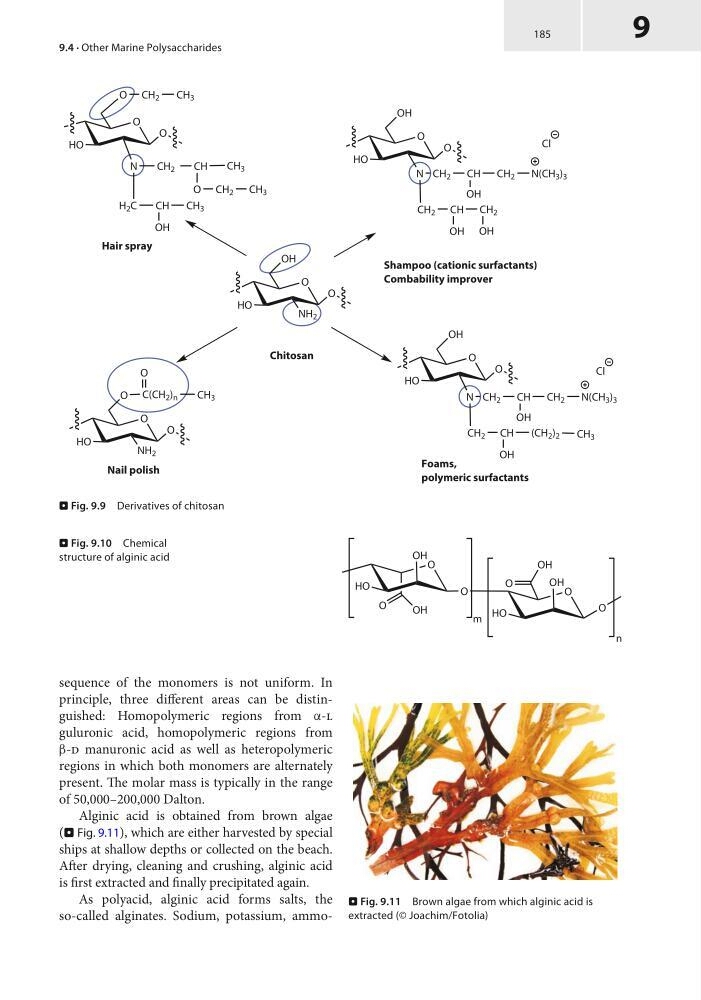
(. Fig. 9.11), which are either harvested by special
ships at shallow depths or collected on the beach.
After drying, cleaning and crushing, alginic acid
is first extracted and finally precipitated again.
As polyacid, alginic acid forms salts, the
so-called alginates. Sodium, potassium, ammoHair spray
Shampoo (cationic surfactants)
Combability improver
Foams,
polymeric surfactants
Nail polish
Chitosan
O
HO
NH 2
O
OH
O
HO
NH 2
O
O C(CH 2 ) n
O
CH 3
O
HO
O
O CH 2
CH 3
N
H 2 C
CH
OH
CH 3
CH 2
CH
O CH 2 CH 3
CH 3
O
HO
O
OH
N
CH 2 CH
OH
CH 2
CH 2 CH CH 2
OH
OH
N(CH 3 ) 3
O
HO
O
OH
N
CH 2 CH
OH
(CH 2 ) 2
CH 2 CH CH 2
OH
N(CH 3 ) 3
CH 3
Cl
Cl
. Fig. 9.9 Derivatives of chitosan
. Fig. 9.10 Chemical
structure of alginic acid
O
HO
OH
O
OH
O
O
HO
OH
O
OH
O
m
n
. Fig. 9.11 Brown algae from which alginic acid is
extracted (© Joachim/Fotolia)
9.4 · Other Marine Polysaccharides
9
sequence of the monomers is not uniform. In
principle, three different areas can be distinguished: Homopolymeric regions from α-l
guluronic acid, homopolymeric regions from
β-d manuronic acid as well as heteropolymeric
regions in which both monomers are alternately
present. The molar mass is typically in the range
of 50,000–200,000 Dalton.
Alginic acid is obtained from brown algae
(. Fig. 9.11), which are either harvested by special
ships at shallow depths or collected on the beach.
After drying, cleaning and crushing, alginic acid
is first extracted and finally precipitated again.
As polyacid, alginic acid forms salts, the
so-called alginates. Sodium, potassium, ammoHair spray
Shampoo (cationic surfactants)
Combability improver
Foams,
polymeric surfactants
Nail polish
Chitosan
O
HO
NH 2
O
OH
O
HO
NH 2
O
O C(CH 2 ) n
O
CH 3
O
HO
O
O CH 2
CH 3
N
H 2 C
CH
OH
CH 3
CH 2
CH
O CH 2 CH 3
CH 3
O
HO
O
OH
N
CH 2 CH
OH
CH 2
CH 2 CH CH 2
OH
OH
N(CH 3 ) 3
O
HO
O
OH
N
CH 2 CH
OH
(CH 2 ) 2
CH 2 CH CH 2
OH
N(CH 3 ) 3
CH 3
Cl
Cl
. Fig. 9.9 Derivatives of chitosan
. Fig. 9.10 Chemical
structure of alginic acid
O
HO
OH
O
OH
O
O
HO
OH
O
OH
O
m
n
. Fig. 9.11 Brown algae from which alginic acid is
extracted (© Joachim/Fotolia)
9.4 · Other Marine Polysaccharides