

172
Chapter 8 · Products with a Little Twist - Starch
8
modified. In addition to etherification to simple alkyl ether, hydroxyalkyl starches, ether with
unsaturated substituents or carboxy ether can
also be specifically produced (7 Sect. 7.3 “Cellulose ether”). Like starch esters, starch ether are
used not only in the textile and paper industries,
but also as food additives, especially in cases of
lower degree of substitution.
Ether synthesis of starch is not possible by
direct etherification of the hydroxyl groups
with an alcohol and water separation. In order
to achieve sufficient conversions at temperatures below the gelatinization temperature
(approx. 50 °C), the substrates must be activated. According to the principle of Williamson ether synthesis, etherification is usually
carried out in an alkaline medium in which the
hydroxyl groups of the starch are deprotonated
by hydroxide ions and thus activated. Further
reaction then takes place, for example, with
alkyl halides, epoxides or lactones (. Fig. 8.9).
Important hydroxyalkyl starches are hydroxyethyl and hydroxypropyl starches, accessible
from the reaction with ethylene oxide or propylene oxide, respectively, followed by neutralization. The products are water soluble and show
a reduced sensitivity to acidic media compared
to starch esters. In contrast to the production of
starch esters, substitution with epoxides takes
place predominantly on the carbon atom C2 of
the glucose unit.
Glycolic acid lactone is used to introduce
carboxy groups into starch and the so-called carboxymethyl starch is produced. Solutions of carboxymethyl starches show high viscosities even
at low concentrations.
Cationic substituents can also be introduced
by means of an etherification reaction. If starch is
reacted with diethylaminoethyl chloride in basic
environment, diethylammonium methyl starch is
formed with chloride as counterion. These cationic starches have a particularly high affinity for
about 13.2% nitrogen by weight and are suitable
as explosives analogous to the nitrate esters of
cellulose (7 Chap. 7) and glycerol (7 Chap. 5).
The production is also carried out analogously
with a mixture of nitric acid and sulfuric acid
(so-called nitrating acid), with which it is possible to nitrate almost all OH groups on carbon
atoms 2, 3 and 6 of the starch.
Organic Esters
Among the esters of starch with organic acids,
starch acetates, the esters of starch with acetic acid, have gained particular importance. A
distinction must again be made between different products with different DS: High degrees of
acetylation can be easily achieved, even selective
control to mono-di- and triacetates is possible.
The highly substituted starch acetates are particularly suitable for the production of films used
as food packaging. Rather low degrees of acetylation modify properties of the starch such as viscosity, film formation or clarity of the solutions.
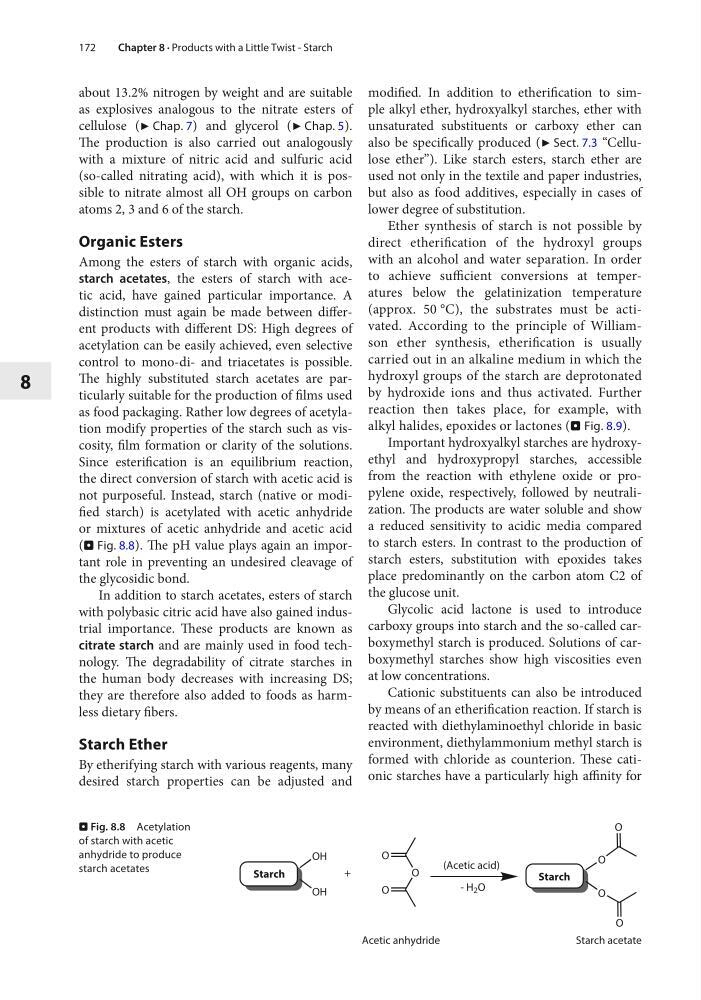
Since esterification is an equilibrium reaction,
the direct conversion of starch with acetic acid is
not purposeful. Instead, starch (native or modified starch) is acetylated with acetic anhydride
or mixtures of acetic anhydride and acetic acid
(. Fig. 8.8). The pH value plays again an important role in preventing an undesired cleavage of
the glycosidic bond.
In addition to starch acetates, esters of starch
with polybasic citric acid have also gained industrial importance. These products are known as
citrate starch and are mainly used in food technology. The degradability of citrate starches in
the human body decreases with increasing DS;
they are therefore also added to foods as harmless dietary fibers.
Starch Ether
By etherifying starch with various reagents, many
desired starch properties can be adjusted and
. Fig. 8.8 Acetylation
of starch with acetic
anhydride to produce
starch acetates
Starch
OH
OH
+
O
O
O
Acetic anhydride
Starch
O
O
- H 2 O
O
O
(Acetic acid)
Starch acetate
Chapter 8 · Products with a Little Twist - Starch
8
modified. In addition to etherification to simple alkyl ether, hydroxyalkyl starches, ether with
unsaturated substituents or carboxy ether can
also be specifically produced (7 Sect. 7.3 “Cellulose ether”). Like starch esters, starch ether are
used not only in the textile and paper industries,
but also as food additives, especially in cases of
lower degree of substitution.
Ether synthesis of starch is not possible by
direct etherification of the hydroxyl groups
with an alcohol and water separation. In order
to achieve sufficient conversions at temperatures below the gelatinization temperature
(approx. 50 °C), the substrates must be activated. According to the principle of Williamson ether synthesis, etherification is usually
carried out in an alkaline medium in which the
hydroxyl groups of the starch are deprotonated
by hydroxide ions and thus activated. Further
reaction then takes place, for example, with
alkyl halides, epoxides or lactones (. Fig. 8.9).
Important hydroxyalkyl starches are hydroxyethyl and hydroxypropyl starches, accessible
from the reaction with ethylene oxide or propylene oxide, respectively, followed by neutralization. The products are water soluble and show
a reduced sensitivity to acidic media compared
to starch esters. In contrast to the production of
starch esters, substitution with epoxides takes
place predominantly on the carbon atom C2 of
the glucose unit.
Glycolic acid lactone is used to introduce
carboxy groups into starch and the so-called carboxymethyl starch is produced. Solutions of carboxymethyl starches show high viscosities even
at low concentrations.
Cationic substituents can also be introduced
by means of an etherification reaction. If starch is
reacted with diethylaminoethyl chloride in basic
environment, diethylammonium methyl starch is
formed with chloride as counterion. These cationic starches have a particularly high affinity for
about 13.2% nitrogen by weight and are suitable
as explosives analogous to the nitrate esters of
cellulose (7 Chap. 7) and glycerol (7 Chap. 5).
The production is also carried out analogously
with a mixture of nitric acid and sulfuric acid
(so-called nitrating acid), with which it is possible to nitrate almost all OH groups on carbon
atoms 2, 3 and 6 of the starch.
Organic Esters
Among the esters of starch with organic acids,
starch acetates, the esters of starch with acetic acid, have gained particular importance. A
distinction must again be made between different products with different DS: High degrees of
acetylation can be easily achieved, even selective
control to mono-di- and triacetates is possible.
The highly substituted starch acetates are particularly suitable for the production of films used
as food packaging. Rather low degrees of acetylation modify properties of the starch such as viscosity, film formation or clarity of the solutions.
Since esterification is an equilibrium reaction,
the direct conversion of starch with acetic acid is
not purposeful. Instead, starch (native or modified starch) is acetylated with acetic anhydride
or mixtures of acetic anhydride and acetic acid
(. Fig. 8.8). The pH value plays again an important role in preventing an undesired cleavage of
the glycosidic bond.
In addition to starch acetates, esters of starch
with polybasic citric acid have also gained industrial importance. These products are known as
citrate starch and are mainly used in food technology. The degradability of citrate starches in
the human body decreases with increasing DS;
they are therefore also added to foods as harmless dietary fibers.
Starch Ether
By etherifying starch with various reagents, many
desired starch properties can be adjusted and
. Fig. 8.8 Acetylation
of starch with acetic
anhydride to produce
starch acetates
Starch
OH
OH
+
O
O
O
Acetic anhydride
Starch
O
O
- H 2 O
O
O
(Acetic acid)
Starch acetate