

167
8
of application the starch is to be used later. As
soon as starch no longer exists in its native
form, it is referred to as modified starch.
5 By partial hydrolysis of the acetal bond
(i.e. glycosidic bond), starches with a lower
molecular weight can be produced ( dextrins,
soluble starches, swelling starches) up to complete degradation into the individual sugar
building blocks (maltose, glucose). These
hydrolyzes are carried out either by acids or
certain enzymes (so-called saccharification).
Saccharified starches do not belong to the
modified starches.
Some of these conversions are described in more
detail in 7 Sect. 8.4.
Therefore, most of the starch marketed is modified. A basic distinction can be made between
three different types of modification:
5 In the case of thermally (i.e. exclusively physically) treated starches, the principal chemical
structure and in some cases also the grain
structure of the starch remain intact.
5 In the so-called derivatized starches, the
reactivity of the free hydroxyl groups of the
starch is exploited. For example, these can be
converted into starch ethers or starch esters.
The oxidation of these hydroxyl groups or the
oxidative cleavage of adjacent hydroxyl groups
also plays a role. Starch can be used to carry
out several of these changes, depending on
which property is desired and in which field
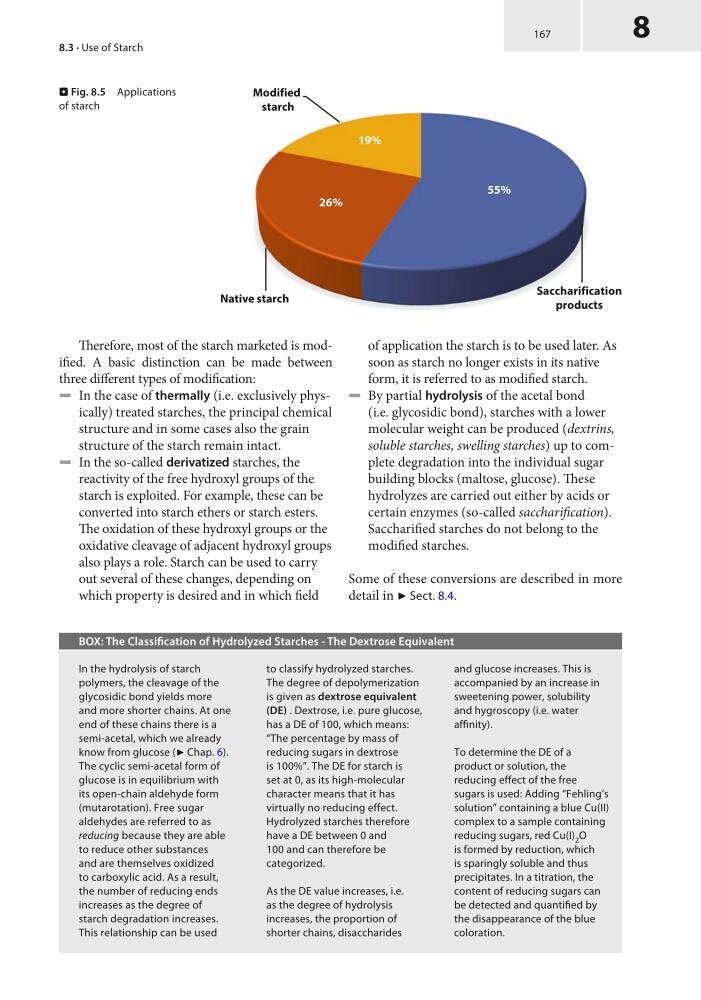
. Fig. 8.5 Applications
of starch
Saccharification
products
Native starch
Modified
starch
55%
26%
19%
BOX: The Classification of Hydrolyzed Starches - The Dextrose Equivalent
In the hydrolysis of starch
polymers, the cleavage of the
glycosidic bond yields more
and more shorter chains. At one
end of these chains there is a
semi-acetal, which we already
know from glucose (7 Chap. 6).
The cyclic semi-acetal form of
glucose is in equilibrium with
its open-chain aldehyde form
(mutarotation). Free sugar
aldehydes are referred to as
reducing because they are able
to reduce other substances
and are themselves oxidized
to carboxylic acid. As a result,
the number of reducing ends
increases as the degree of
starch degradation increases.
This relationship can be used
to classify hydrolyzed starches.
The degree of depolymerization
is given as dextrose equivalent
(DE) . Dextrose, i.e. pure glucose,
has a DE of 100, which means:
“The percentage by mass of
reducing sugars in dextrose
is 100%”. The DE for starch is
set at 0, as its high-molecular
character means that it has
virtually no reducing effect.
Hydrolyzed starches therefore
have a DE between 0 and
100 and can therefore be
categorized.
As the DE value increases, i.e.
as the degree of hydrolysis
increases, the proportion of
shorter chains, disaccharides
and glucose increases. This is
accompanied by an increase in
sweetening power, solubility
and hygroscopy (i.e. water
affinity).
To determine the DE of a
product or solution, the
reducing effect of the free
sugars is used: Adding “Fehling’s
solution” containing a blue Cu(II)
complex to a sample containing
reducing sugars, red Cu(I) 2 O
is formed by reduction, which
is sparingly soluble and thus
precipitates. In a titration, the
content of reducing sugars can
be detected and quantified by
the disappearance of the blue
coloration.
8.3 · Use of Starch
8
of application the starch is to be used later. As
soon as starch no longer exists in its native
form, it is referred to as modified starch.
5 By partial hydrolysis of the acetal bond
(i.e. glycosidic bond), starches with a lower
molecular weight can be produced ( dextrins,
soluble starches, swelling starches) up to complete degradation into the individual sugar
building blocks (maltose, glucose). These
hydrolyzes are carried out either by acids or
certain enzymes (so-called saccharification).
Saccharified starches do not belong to the
modified starches.
Some of these conversions are described in more
detail in 7 Sect. 8.4.
Therefore, most of the starch marketed is modified. A basic distinction can be made between
three different types of modification:
5 In the case of thermally (i.e. exclusively physically) treated starches, the principal chemical
structure and in some cases also the grain
structure of the starch remain intact.
5 In the so-called derivatized starches, the
reactivity of the free hydroxyl groups of the
starch is exploited. For example, these can be
converted into starch ethers or starch esters.
The oxidation of these hydroxyl groups or the
oxidative cleavage of adjacent hydroxyl groups
also plays a role. Starch can be used to carry
out several of these changes, depending on
which property is desired and in which field
. Fig. 8.5 Applications
of starch
Saccharification
products
Native starch
Modified
starch
55%
26%
19%
BOX: The Classification of Hydrolyzed Starches - The Dextrose Equivalent
In the hydrolysis of starch
polymers, the cleavage of the
glycosidic bond yields more
and more shorter chains. At one
end of these chains there is a
semi-acetal, which we already
know from glucose (7 Chap. 6).
The cyclic semi-acetal form of
glucose is in equilibrium with
its open-chain aldehyde form
(mutarotation). Free sugar
aldehydes are referred to as
reducing because they are able
to reduce other substances
and are themselves oxidized
to carboxylic acid. As a result,
the number of reducing ends
increases as the degree of
starch degradation increases.
This relationship can be used
to classify hydrolyzed starches.
The degree of depolymerization
is given as dextrose equivalent
(DE) . Dextrose, i.e. pure glucose,
has a DE of 100, which means:
“The percentage by mass of
reducing sugars in dextrose
is 100%”. The DE for starch is
set at 0, as its high-molecular
character means that it has
virtually no reducing effect.
Hydrolyzed starches therefore
have a DE between 0 and
100 and can therefore be
categorized.
As the DE value increases, i.e.
as the degree of hydrolysis
increases, the proportion of
shorter chains, disaccharides
and glucose increases. This is
accompanied by an increase in
sweetening power, solubility
and hygroscopy (i.e. water
affinity).
To determine the DE of a
product or solution, the
reducing effect of the free
sugars is used: Adding “Fehling’s
solution” containing a blue Cu(II)
complex to a sample containing
reducing sugars, red Cu(I) 2 O
is formed by reduction, which
is sparingly soluble and thus
precipitates. In a titration, the
content of reducing sugars can
be detected and quantified by
the disappearance of the blue
coloration.
8.3 · Use of Starch