

106
Chapter 5 · The Coproduct of Oleochemistry - Glycerol
5
sure (20–40 bar). The temperature is significantly lower compared to steam reforming and is
between 125 and 250 °C, depending on the catalyst. Typical heterogeneous catalysts are based
on the metals platinum or palladium; nickel–tin
alloys are also used. The catalyst support is also
of great importance: The formation of hydrogen
is preferred by neutral or basic supports, e.g. aluminum oxides.
In the SCWG process, glycerol is decomposed
into synthesis gas in supercritical water. If very
dilute solutions (<2%) are used, this reaction
proceeds readily without the addition of a catalyst. For higher concentrated (5–17%) starting
mixtures, a catalyst must be added, e.g. a ruthenium catalyst with 3% ruthenium on a titanium
dioxide support. At temperatures of 700 °C, glycerol conversions of up to 90% can be obtained.
However, working in supercritical water is technically not easy: Sincere corrosion issues likely
occur.
Work is currently underway to transfer the
APR process to a technical scale. Virent Energy
Systems, which has named its APR process “BioForming”, is cooperating in this field with the
major companies Shell, Cargill and Honda.
Both Eqs. 5.6 and 5.7, result in the sum Eq. 5.8.
Overall, according to this equation, glycerol is
converted into hydrogen and carbon dioxide.
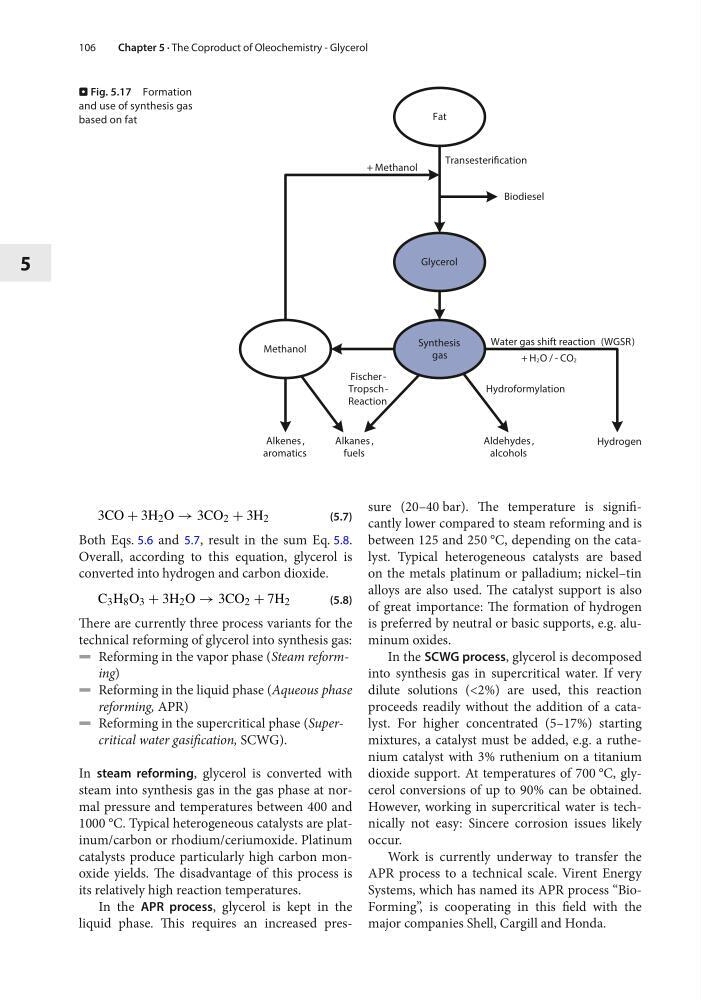
There are currently three process variants for the
technical reforming of glycerol into synthesis gas:
5 Reforming in the vapor phase (Steam reforming)
5 Reforming in the liquid phase (Aqueous phase
reforming, APR)
5 Reforming in the supercritical phase (Supercritical water gasification, SCWG).
In steam reforming, glycerol is converted with
steam into synthesis gas in the gas phase at normal pressure and temperatures between 400 and
1000 °C. Typical heterogeneous catalysts are platinum/carbon or rhodium/ceriumoxide. Platinum
catalysts produce particularly high carbon monoxide yields. The disadvantage of this process is
its relatively high reaction temperatures.
In the APR process, glycerol is kept in the
liquid phase. This requires an increased pres(5.7)
3CO + 3H 2 O → 3CO 2 + 3H 2
(5.8)
C 3 H 8 O 3 + 3H 2 O → 3CO 2 + 7H 2
. Fig. 5.17 Formation
and use of synthesis gas
based on fat
Glycerol
Fat
Synthesis
gas
Methanol
Biodiesel
Transesteriication
+ Methanol
Water gas shift reaction (WGSR)
Hydrogen
Hydroformylation
Aldehydes ,
alcohols
Fischer -
Tropsch -
Reaction
Alkanes ,
fuels
Alkenes ,
aromatics
+ H2O / - CO2
Chapter 5 · The Coproduct of Oleochemistry - Glycerol
5
sure (20–40 bar). The temperature is significantly lower compared to steam reforming and is
between 125 and 250 °C, depending on the catalyst. Typical heterogeneous catalysts are based
on the metals platinum or palladium; nickel–tin
alloys are also used. The catalyst support is also
of great importance: The formation of hydrogen
is preferred by neutral or basic supports, e.g. aluminum oxides.
In the SCWG process, glycerol is decomposed
into synthesis gas in supercritical water. If very
dilute solutions (<2%) are used, this reaction
proceeds readily without the addition of a catalyst. For higher concentrated (5–17%) starting
mixtures, a catalyst must be added, e.g. a ruthenium catalyst with 3% ruthenium on a titanium
dioxide support. At temperatures of 700 °C, glycerol conversions of up to 90% can be obtained.
However, working in supercritical water is technically not easy: Sincere corrosion issues likely
occur.
Work is currently underway to transfer the
APR process to a technical scale. Virent Energy
Systems, which has named its APR process “BioForming”, is cooperating in this field with the
major companies Shell, Cargill and Honda.
Both Eqs. 5.6 and 5.7, result in the sum Eq. 5.8.
Overall, according to this equation, glycerol is
converted into hydrogen and carbon dioxide.
There are currently three process variants for the
technical reforming of glycerol into synthesis gas:
5 Reforming in the vapor phase (Steam reforming)
5 Reforming in the liquid phase (Aqueous phase
reforming, APR)
5 Reforming in the supercritical phase (Supercritical water gasification, SCWG).
In steam reforming, glycerol is converted with
steam into synthesis gas in the gas phase at normal pressure and temperatures between 400 and
1000 °C. Typical heterogeneous catalysts are platinum/carbon or rhodium/ceriumoxide. Platinum
catalysts produce particularly high carbon monoxide yields. The disadvantage of this process is
its relatively high reaction temperatures.
In the APR process, glycerol is kept in the
liquid phase. This requires an increased pres(5.7)
3CO + 3H 2 O → 3CO 2 + 3H 2
(5.8)
C 3 H 8 O 3 + 3H 2 O → 3CO 2 + 7H 2
. Fig. 5.17 Formation
and use of synthesis gas
based on fat
Glycerol
Fat
Synthesis
gas
Methanol
Biodiesel
Transesteriication
+ Methanol
Water gas shift reaction (WGSR)
Hydrogen
Hydroformylation
Aldehydes ,
alcohols
Fischer -
Tropsch -
Reaction
Alkanes ,
fuels
Alkenes ,
aromatics
+ H2O / - CO2