

101
5
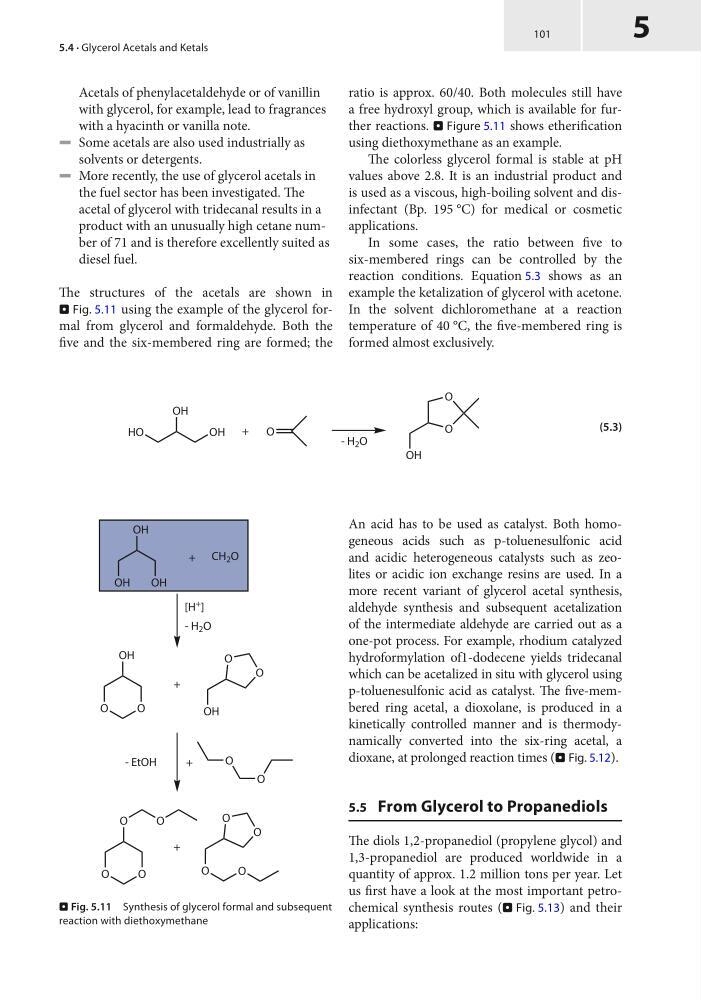
ratio is approx. 60/40. Both molecules still have
a free hydroxyl group, which is available for further reactions. . Figure 5.11 shows etherification
using diethoxymethane as an example.
The colorless glycerol formal is stable at pH
values above 2.8. It is an industrial product and
is used as a viscous, high-boiling solvent and disinfectant (Bp. 195 °C) for medical or cosmetic
applications.
In some cases, the ratio between five to
six-membered rings can be controlled by the
reaction conditions. Equation 5.3 shows as an
example the ketalization of glycerol with acetone.
In the solvent dichloromethane at a reaction
temperature of 40 °C, the five-membered ring is
formed almost exclusively.
Acetals of phenylacetaldehyde or of vanillin
with glycerol, for example, lead to fragrances
with a hyacinth or vanilla note.
5 Some acetals are also used industrially as
solvents or detergents.
5 More recently, the use of glycerol acetals in
the fuel sector has been investigated. The
acetal of glycerol with tridecanal results in a
product with an unusually high cetane number of 71 and is therefore excellently suited as
diesel fuel.
The structures of the acetals are shown in
. Fig. 5.11 using the example of the glycerol formal from glycerol and formaldehyde. Both the
five and the six-membered ring are formed; the
OH
OH
OH
+ CH 2 O
O
O
OH
O
O
OH
+
- EtOH
O
O
O
O
O
O
O
O
+
O
O
[H + ]
- H 2 O
+
. Fig. 5.11 Synthesis of glycerol formal and subsequent
reaction with diethoxymethane
5.4 · Glycerol Acetals and Ketals
(5.3)
OH
HO
OH
O
+
- H 2 O
OH
O
O
An acid has to be used as catalyst. Both homogeneous acids such as p-toluenesulfonic acid
and acidic heterogeneous catalysts such as zeolites or acidic ion exchange resins are used. In a
more recent variant of glycerol acetal synthesis,
aldehyde synthesis and subsequent acetalization
of the intermediate aldehyde are carried out as a
one-pot process. For example, rhodium catalyzed
hydroformylation of1-dodecene yields tridecanal
which can be acetalized in situ with glycerol using
p-toluenesulfonic acid as catalyst. The five-membered ring acetal, a dioxolane, is produced in a
kinetically controlled manner and is thermodynamically converted into the six-ring acetal, a
dioxane, at prolonged reaction times (. Fig. 5.12).
5.5 From Glycerol to Propanediols
The diols 1,2-propanediol (propylene glycol) and
1,3-propanediol are produced worldwide in a
quantity of approx. 1.2 million tons per year. Let
us first have a look at the most important petrochemical synthesis routes (. Fig. 5.13) and their
applications:
5
ratio is approx. 60/40. Both molecules still have
a free hydroxyl group, which is available for further reactions. . Figure 5.11 shows etherification
using diethoxymethane as an example.
The colorless glycerol formal is stable at pH
values above 2.8. It is an industrial product and
is used as a viscous, high-boiling solvent and disinfectant (Bp. 195 °C) for medical or cosmetic
applications.
In some cases, the ratio between five to
six-membered rings can be controlled by the
reaction conditions. Equation 5.3 shows as an
example the ketalization of glycerol with acetone.
In the solvent dichloromethane at a reaction
temperature of 40 °C, the five-membered ring is
formed almost exclusively.
Acetals of phenylacetaldehyde or of vanillin
with glycerol, for example, lead to fragrances
with a hyacinth or vanilla note.
5 Some acetals are also used industrially as
solvents or detergents.
5 More recently, the use of glycerol acetals in
the fuel sector has been investigated. The
acetal of glycerol with tridecanal results in a
product with an unusually high cetane number of 71 and is therefore excellently suited as
diesel fuel.
The structures of the acetals are shown in
. Fig. 5.11 using the example of the glycerol formal from glycerol and formaldehyde. Both the
five and the six-membered ring are formed; the
OH
OH
OH
+ CH 2 O
O
O
OH
O
O
OH
+
- EtOH
O
O
O
O
O
O
O
O
+
O
O
[H + ]
- H 2 O
+
. Fig. 5.11 Synthesis of glycerol formal and subsequent
reaction with diethoxymethane
5.4 · Glycerol Acetals and Ketals
(5.3)
OH
HO
OH
O
+
- H 2 O
OH
O
O
An acid has to be used as catalyst. Both homogeneous acids such as p-toluenesulfonic acid
and acidic heterogeneous catalysts such as zeolites or acidic ion exchange resins are used. In a
more recent variant of glycerol acetal synthesis,
aldehyde synthesis and subsequent acetalization
of the intermediate aldehyde are carried out as a
one-pot process. For example, rhodium catalyzed
hydroformylation of1-dodecene yields tridecanal
which can be acetalized in situ with glycerol using
p-toluenesulfonic acid as catalyst. The five-membered ring acetal, a dioxolane, is produced in a
kinetically controlled manner and is thermodynamically converted into the six-ring acetal, a
dioxane, at prolonged reaction times (. Fig. 5.12).
5.5 From Glycerol to Propanediols
The diols 1,2-propanediol (propylene glycol) and
1,3-propanediol are produced worldwide in a
quantity of approx. 1.2 million tons per year. Let
us first have a look at the most important petrochemical synthesis routes (. Fig. 5.13) and their
applications: