

94
Chapter 5 · The Coproduct of Oleochemistry - Glycerol
5
Finally, we present methods to oxidize and dehydrate glycerol to valuable products. At the end of
the chapter, glycerol is regarded as a pure carbon
source and converted into synthesis gas, which in
turn can be converted into numerous industrial
chemicals according to already known methods.
5.2 Glyceryl Esters
Glyceryl trinitrate, an ester of glycerol with
the inorganic nitric acid, has long been known
(Eq. 5.1). This triester is also incorrectly called
“nitroglycerol”; however, it is not a nitro compound (with a C–NO 2 bond), but a nitrate (with
a C–O–NO 2 bond). It is produced by reacting
glycerol with a mixture of nitric acid and sulfuric
acid, also called “nitrating acid”.
(5.1)
OH
+ 3 HNO 3
OH
OH
[H 2 SO 4 ]
- 3 H 2 O
ONO 2
O 2 NO
ONO 2
2006, the price for one ton of ultrapure glycerol
fell to 500–700 Euro and in 2011 was 750 Euro
per ton. The price for technical glycerol qualities is significantly lower, by a factor of about
five. However, if the price of a basic chemical
drops significantly, it can also be used for applications for which it was previously too expensive
because cheaper petrochemical competitor products existed. Glycerol, for example, is now being
discussed for applications for which ethylene glycol or 1,2-propanediol was previously used.
However, when large quantities of a basic
chemical are available, the question must also be
asked whether completely new glycerol derivatives have a chance of conquering the market.
Such new products have been the subject of
intensive research in recent years and some of
them have already been successfully transferred
to production scale. These new glycerol derivatives will be presented in more detail in the
coming sections. We will first look at “classical”
alcohol derivatives, i.e. esters, ethers, acetals and
ketals of glycerol. Further sections deal with the
conversion of glycerol into diols and epoxides.
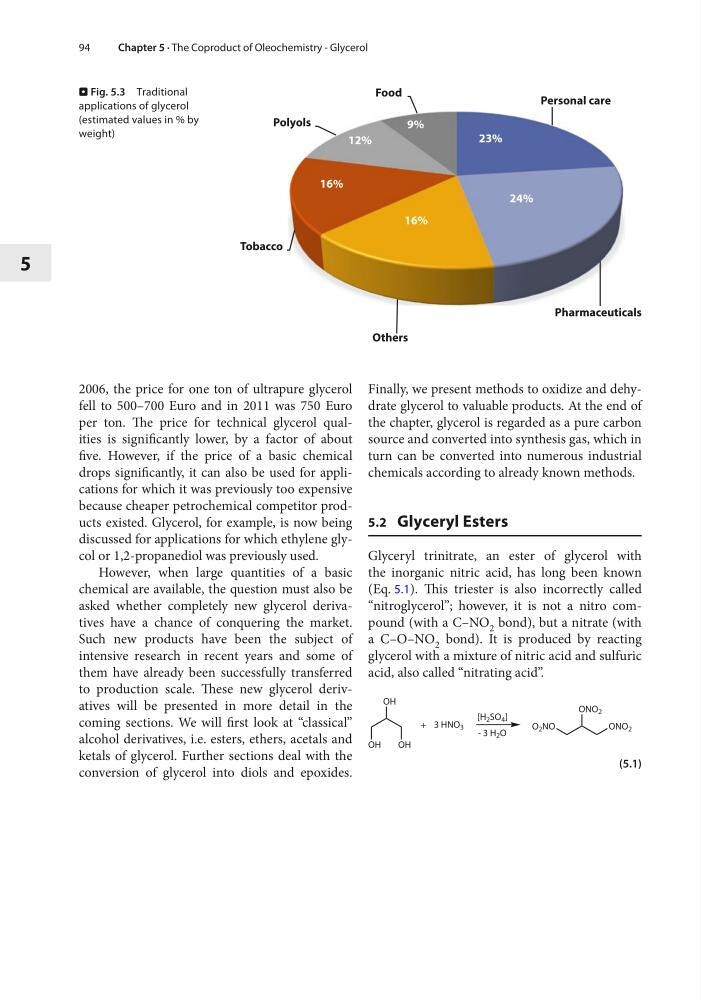
. Fig. 5.3 Traditional
applications of glycerol
(estimated values in % by
weight)
Personal care
Pharmaceuticals
Others
Tobacco
Polyols
Food
24%
16%
23%
16%
12%
9%
Chapter 5 · The Coproduct of Oleochemistry - Glycerol
5
Finally, we present methods to oxidize and dehydrate glycerol to valuable products. At the end of
the chapter, glycerol is regarded as a pure carbon
source and converted into synthesis gas, which in
turn can be converted into numerous industrial
chemicals according to already known methods.
5.2 Glyceryl Esters
Glyceryl trinitrate, an ester of glycerol with
the inorganic nitric acid, has long been known
(Eq. 5.1). This triester is also incorrectly called
“nitroglycerol”; however, it is not a nitro compound (with a C–NO 2 bond), but a nitrate (with
a C–O–NO 2 bond). It is produced by reacting
glycerol with a mixture of nitric acid and sulfuric
acid, also called “nitrating acid”.
(5.1)
OH
+ 3 HNO 3
OH
OH
[H 2 SO 4 ]
- 3 H 2 O
ONO 2
O 2 NO
ONO 2
2006, the price for one ton of ultrapure glycerol
fell to 500–700 Euro and in 2011 was 750 Euro
per ton. The price for technical glycerol qualities is significantly lower, by a factor of about
five. However, if the price of a basic chemical
drops significantly, it can also be used for applications for which it was previously too expensive
because cheaper petrochemical competitor products existed. Glycerol, for example, is now being
discussed for applications for which ethylene glycol or 1,2-propanediol was previously used.
However, when large quantities of a basic
chemical are available, the question must also be
asked whether completely new glycerol derivatives have a chance of conquering the market.
Such new products have been the subject of
intensive research in recent years and some of
them have already been successfully transferred
to production scale. These new glycerol derivatives will be presented in more detail in the
coming sections. We will first look at “classical”
alcohol derivatives, i.e. esters, ethers, acetals and
ketals of glycerol. Further sections deal with the
conversion of glycerol into diols and epoxides.
. Fig. 5.3 Traditional
applications of glycerol
(estimated values in % by
weight)
Personal care
Pharmaceuticals
Others
Tobacco
Polyols
Food
24%
16%
23%
16%
12%
9%