

Chapter 5
Finite Element Formulations
Abstract In this chapter, resultant strain and stress are introduced, such that the
volume integration can be treat as surface integration. In order to describe the unrestricted finite rotations in thin-walled smart structures, five mechanical nodal DOFs
are defined to represent the six kinematic parameters in strain-displacement relations
by using Euler angles. Furthermore, an eight-node elements with five mechanical
nodal DOFs and additionally integrated with one electrical DOF using full integration or uniformly reduced integration scheme are developed for both composite and
smart structures. Implementing both linear constitutive equations and electroelastic
nonlinear constitutive equations, one obtains nonlinear FE models by Hamilton’s
principle and the principle of virtual work, in which various geometrically nonlinear phenomena discussed in Chap. 3 are considered. In the last part of this chapter,
several numerical algorithms are developed for solving the nonlinear equilibrium
equations and the equations of motion.
5.1 Resultant Vectors
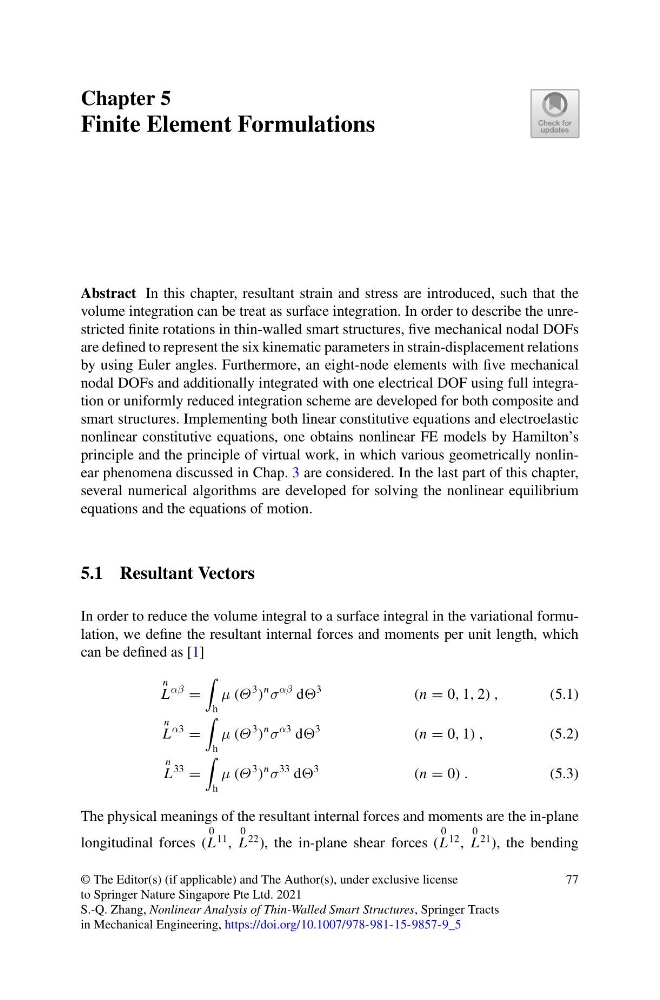
In order to reduce the volume integral to a surface integral in the variational formulation, we define the resultant internal forces and moments per unit length, which
can be defined as [1]
n
L
αβ
=
h
μ (Θ
3
)
n
σ
αβ d
3
(n = 0, 1, 2) ,
(5.1)
n
L
α3
=
h
μ (Θ
3
)
n
σ
α3 d
3
(n = 0, 1) ,
(5.2)
n
L
33
=
h
μ (Θ
3
)
n
σ
33 d
3
(n = 0) .
(5.3)
The physical meanings of the resultant internal forces and moments are the in-plane
longitudinal forces (
0
L
11 ,
0
L
22 ), the in-plane shear forces (
0
L
12 ,
0
L
21 ), the bending
© The Editor(s) (if applicable) and The Author(s), under exclusive license
to Springer Nature Singapore Pte Ltd. 2021
S.-Q. Zhang, Nonlinear Analysis of Thin-Walled Smart Structures, Springer Tracts
in Mechanical Engineering, https://doi.org/10.1007/978-981-15-9857-9_5
77
Finite Element Formulations
Abstract In this chapter, resultant strain and stress are introduced, such that the
volume integration can be treat as surface integration. In order to describe the unrestricted finite rotations in thin-walled smart structures, five mechanical nodal DOFs
are defined to represent the six kinematic parameters in strain-displacement relations
by using Euler angles. Furthermore, an eight-node elements with five mechanical
nodal DOFs and additionally integrated with one electrical DOF using full integration or uniformly reduced integration scheme are developed for both composite and
smart structures. Implementing both linear constitutive equations and electroelastic
nonlinear constitutive equations, one obtains nonlinear FE models by Hamilton’s
principle and the principle of virtual work, in which various geometrically nonlinear phenomena discussed in Chap. 3 are considered. In the last part of this chapter,
several numerical algorithms are developed for solving the nonlinear equilibrium
equations and the equations of motion.
5.1 Resultant Vectors
In order to reduce the volume integral to a surface integral in the variational formulation, we define the resultant internal forces and moments per unit length, which
can be defined as [1]
n
L
αβ
=
h
μ (Θ
3
)
n
σ
αβ d
3
(n = 0, 1, 2) ,
(5.1)
n
L
α3
=
h
μ (Θ
3
)
n
σ
α3 d
3
(n = 0, 1) ,
(5.2)
n
L
33
=
h
μ (Θ
3
)
n
σ
33 d
3
(n = 0) .
(5.3)
The physical meanings of the resultant internal forces and moments are the in-plane
longitudinal forces (
0
L
11 ,
0
L
22 ), the in-plane shear forces (
0
L
12 ,
0
L
21 ), the bending
© The Editor(s) (if applicable) and The Author(s), under exclusive license
to Springer Nature Singapore Pte Ltd. 2021
S.-Q. Zhang, Nonlinear Analysis of Thin-Walled Smart Structures, Springer Tracts
in Mechanical Engineering, https://doi.org/10.1007/978-981-15-9857-9_5
77