

4.2 Fundamental Theory of Piezoelectricity
59
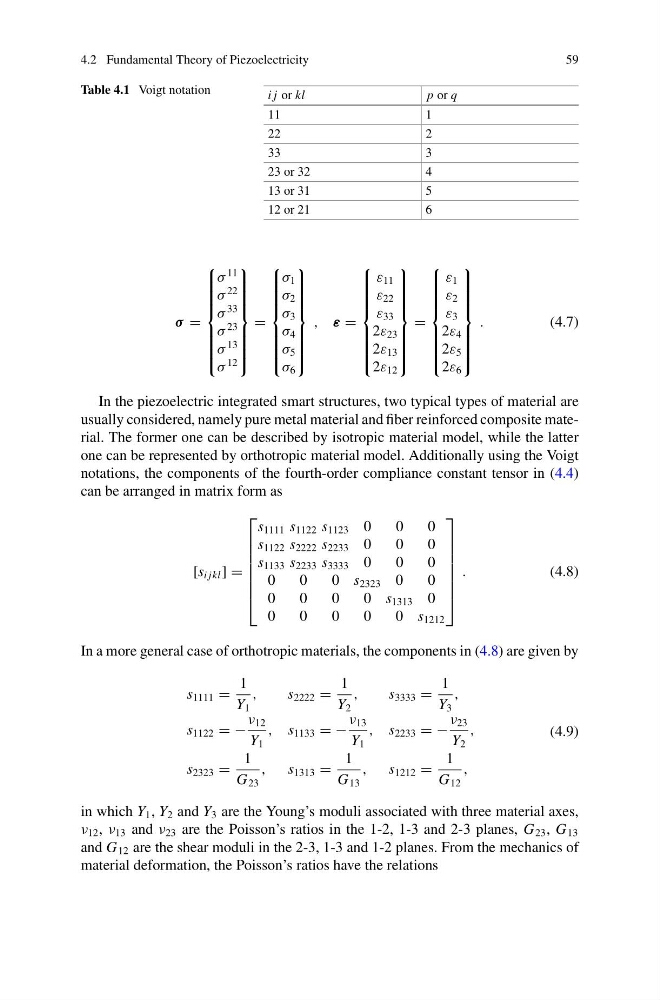
Table 4.1 Voigt notation
i j or kl
p or q
11
1
22
2
33
3
23 or 32
4
13 or 31
5
12 or 21
6
σ =
⎧
⎪ ⎪ ⎪ ⎪ ⎪ ⎪ ⎨
⎪ ⎪ ⎪ ⎪ ⎪ ⎪ ⎩
σ
11
σ
22
σ
33
σ
23
σ
13
σ
12
⎫
⎪ ⎪ ⎪ ⎪ ⎪ ⎪ ⎬
⎪ ⎪ ⎪ ⎪ ⎪ ⎪ ⎭
=
⎧
⎪ ⎪ ⎪ ⎪ ⎪ ⎪ ⎨
⎪ ⎪ ⎪ ⎪ ⎪ ⎪ ⎩
σ 1
σ 2
σ 3
σ 4
σ 5
σ 6
⎫
⎪ ⎪ ⎪ ⎪ ⎪ ⎪ ⎬
⎪ ⎪ ⎪ ⎪ ⎪ ⎪ ⎭
, ε =
⎧
⎪ ⎪ ⎪ ⎪ ⎪ ⎪ ⎨
⎪ ⎪ ⎪ ⎪ ⎪ ⎪ ⎩
ε 11
ε 22
ε 33
2ε 23
2ε 13
2ε 12
⎫
⎪ ⎪ ⎪ ⎪ ⎪ ⎪ ⎬
⎪ ⎪ ⎪ ⎪ ⎪ ⎪ ⎭
=
⎧
⎪ ⎪ ⎪ ⎪ ⎪ ⎪ ⎨
⎪ ⎪ ⎪ ⎪ ⎪ ⎪ ⎩
ε 1
ε 2
ε 3
2ε 4
2ε 5
2ε 6
⎫
⎪ ⎪ ⎪ ⎪ ⎪ ⎪ ⎬
⎪ ⎪ ⎪ ⎪ ⎪ ⎪ ⎭
.
(4.7)
In the piezoelectric integrated smart structures, two typical types of material are
usually considered, namely pure metal material and fiber reinforced composite material. The former one can be described by isotropic material model, while the latter
one can be represented by orthotropic material model. Additionally using the Voigt
notations, the components of the fourth-order compliance constant tensor in (4.4)
can be arranged in matrix form as
[s i jkl ] =
⎡
⎢
⎢
⎢
⎢
⎢
⎢
⎣
s 1111 s 1122 s 1123 0
0
0
s 1122 s 2222 s 2233 0
0
0
s 1133 s 2233 s 3333 0
0
0
0
0
0 s 2323 0
0
0
0
0
0 s 1313 0
0
0
0
0
0 s 1212
⎤
⎥
⎥
⎥
⎥
⎥
⎥
⎦
.
(4.8)
In a more general case of orthotropic materials, the components in (4.8) are given by
s 1111 =
1
Y 1
,
s 2222 =
1
Y 2
,
s 3333 =
1
Y 3
,
s 1122 = −
ν 12
Y 1
, s 1133 = −
ν 13
Y 1
, s 2233 = −
ν 23
Y 2
,
s 2323 =
1
G 23
, s 1313 =
1
G 13
, s 1212 =
1
G 12
,
(4.9)
in which Y 1 , Y 2 and Y 3 are the Young’s moduli associated with three material axes,
ν 12 , ν 13 and ν 23 are the Poisson’s ratios in the 1-2, 1-3 and 2-3 planes, G 23 , G 13
and G 12 are the shear moduli in the 2-3, 1-3 and 1-2 planes. From the mechanics of
material deformation, the Poisson’s ratios have the relations
59
Table 4.1 Voigt notation
i j or kl
p or q
11
1
22
2
33
3
23 or 32
4
13 or 31
5
12 or 21
6
σ =
⎧
⎪ ⎪ ⎪ ⎪ ⎪ ⎪ ⎨
⎪ ⎪ ⎪ ⎪ ⎪ ⎪ ⎩
σ
11
σ
22
σ
33
σ
23
σ
13
σ
12
⎫
⎪ ⎪ ⎪ ⎪ ⎪ ⎪ ⎬
⎪ ⎪ ⎪ ⎪ ⎪ ⎪ ⎭
=
⎧
⎪ ⎪ ⎪ ⎪ ⎪ ⎪ ⎨
⎪ ⎪ ⎪ ⎪ ⎪ ⎪ ⎩
σ 1
σ 2
σ 3
σ 4
σ 5
σ 6
⎫
⎪ ⎪ ⎪ ⎪ ⎪ ⎪ ⎬
⎪ ⎪ ⎪ ⎪ ⎪ ⎪ ⎭
, ε =
⎧
⎪ ⎪ ⎪ ⎪ ⎪ ⎪ ⎨
⎪ ⎪ ⎪ ⎪ ⎪ ⎪ ⎩
ε 11
ε 22
ε 33
2ε 23
2ε 13
2ε 12
⎫
⎪ ⎪ ⎪ ⎪ ⎪ ⎪ ⎬
⎪ ⎪ ⎪ ⎪ ⎪ ⎪ ⎭
=
⎧
⎪ ⎪ ⎪ ⎪ ⎪ ⎪ ⎨
⎪ ⎪ ⎪ ⎪ ⎪ ⎪ ⎩
ε 1
ε 2
ε 3
2ε 4
2ε 5
2ε 6
⎫
⎪ ⎪ ⎪ ⎪ ⎪ ⎪ ⎬
⎪ ⎪ ⎪ ⎪ ⎪ ⎪ ⎭
.
(4.7)
In the piezoelectric integrated smart structures, two typical types of material are
usually considered, namely pure metal material and fiber reinforced composite material. The former one can be described by isotropic material model, while the latter
one can be represented by orthotropic material model. Additionally using the Voigt
notations, the components of the fourth-order compliance constant tensor in (4.4)
can be arranged in matrix form as
[s i jkl ] =
⎡
⎢
⎢
⎢
⎢
⎢
⎢
⎣
s 1111 s 1122 s 1123 0
0
0
s 1122 s 2222 s 2233 0
0
0
s 1133 s 2233 s 3333 0
0
0
0
0
0 s 2323 0
0
0
0
0
0 s 1313 0
0
0
0
0
0 s 1212
⎤
⎥
⎥
⎥
⎥
⎥
⎥
⎦
.
(4.8)
In a more general case of orthotropic materials, the components in (4.8) are given by
s 1111 =
1
Y 1
,
s 2222 =
1
Y 2
,
s 3333 =
1
Y 3
,
s 1122 = −
ν 12
Y 1
, s 1133 = −
ν 13
Y 1
, s 2233 = −
ν 23
Y 2
,
s 2323 =
1
G 23
, s 1313 =
1
G 13
, s 1212 =
1
G 12
,
(4.9)
in which Y 1 , Y 2 and Y 3 are the Young’s moduli associated with three material axes,
ν 12 , ν 13 and ν 23 are the Poisson’s ratios in the 1-2, 1-3 and 2-3 planes, G 23 , G 13
and G 12 are the shear moduli in the 2-3, 1-3 and 1-2 planes. From the mechanics of
material deformation, the Poisson’s ratios have the relations