

3.4 Strain Field
47
F = ¯
g i ⊗ g
i
, F
T
= g
i
⊗ ¯
g i .
(3.61)
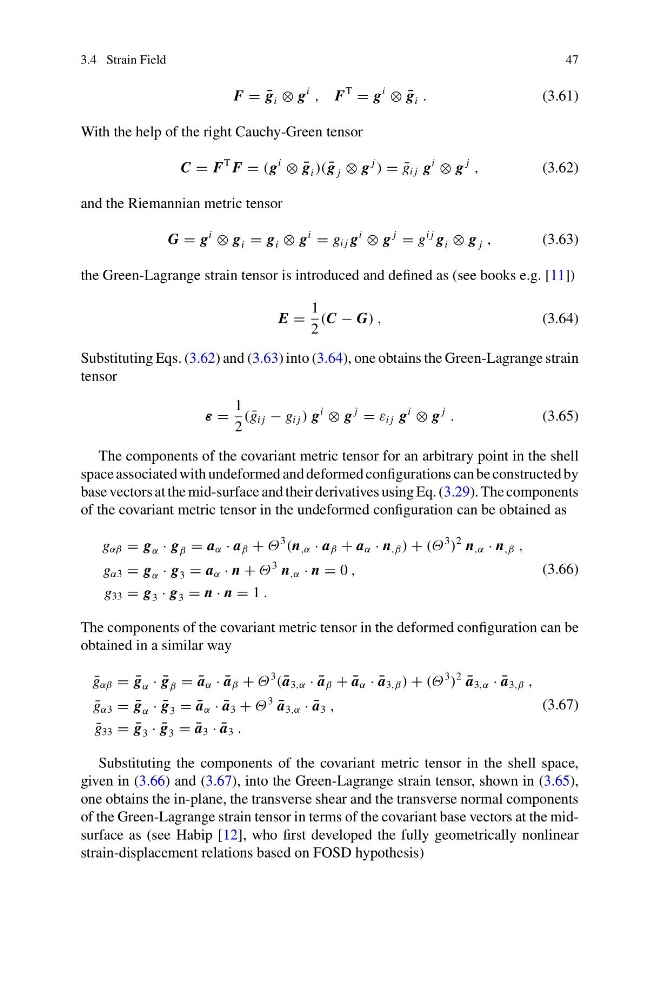
With the help of the right Cauchy-Green tensor
C = F
T F = (g
i
⊗ ¯
g i )( ¯
g j ⊗ g
j
) = ¯
g i j g
i
⊗ g
j
,
(3.62)
and the Riemannian metric tensor
G = g
i
⊗ g i = g i ⊗ g
i
= g i j g
i
⊗ g
j
= g
i j g i ⊗ g j ,
(3.63)
the Green-Lagrange strain tensor is introduced and defined as (see books e.g. [11])
E =
1
2
(C − G) ,
(3.64)
Substituting Eqs. (3.62) and (3.63) into (3.64), one obtains the Green-Lagrange strain
tensor
ε =
1
2
( ¯
g i j − g i j ) g
i
⊗ g
j
= ε i j g
i
⊗ g
j
.
(3.65)
The components of the covariant metric tensor for an arbitrary point in the shell
space associated with undeformed and deformed configurations can be constructed by
base vectors at the mid-surface and their derivatives using Eq. (3.29). The components
of the covariant metric tensor in the undeformed configuration can be obtained as
g αβ = g α · g β = a α · a β + Θ
3
(n ,α · a β + a α · n ,β ) + (Θ
3
)
2 n ,α · n ,β ,
g α3 = g α · g 3 = a α · n + Θ
3 n ,α · n = 0 ,
g 33 = g 3 · g 3 = n · n = 1 .
(3.66)
The components of the covariant metric tensor in the deformed configuration can be
obtained in a similar way
¯
g αβ = ¯
g α · ¯
g β = ¯
a α · ¯
a β + Θ
3
( ¯
a 3,α · ¯
a β + ¯
a α · ¯
a 3,β ) + (Θ
3
)
2
¯
a 3,α · ¯
a 3,β ,
¯
g α3 = ¯
g α · ¯
g 3 = ¯
a α · ¯
a 3 + Θ
3
¯
a 3,α · ¯
a 3 ,
¯
g 33 = ¯
g 3 · ¯
g 3 = ¯
a 3 · ¯
a 3 .
(3.67)
Substituting the components of the covariant metric tensor in the shell space,
given in (3.66) and (3.67), into the Green-Lagrange strain tensor, shown in (3.65),
one obtains the in-plane, the transverse shear and the transverse normal components
of the Green-Lagrange strain tensor in terms of the covariant base vectors at the midsurface as (see Habip [12], who first developed the fully geometrically nonlinear
strain-displacement relations based on FOSD hypothesis)
47
F = ¯
g i ⊗ g
i
, F
T
= g
i
⊗ ¯
g i .
(3.61)
With the help of the right Cauchy-Green tensor
C = F
T F = (g
i
⊗ ¯
g i )( ¯
g j ⊗ g
j
) = ¯
g i j g
i
⊗ g
j
,
(3.62)
and the Riemannian metric tensor
G = g
i
⊗ g i = g i ⊗ g
i
= g i j g
i
⊗ g
j
= g
i j g i ⊗ g j ,
(3.63)
the Green-Lagrange strain tensor is introduced and defined as (see books e.g. [11])
E =
1
2
(C − G) ,
(3.64)
Substituting Eqs. (3.62) and (3.63) into (3.64), one obtains the Green-Lagrange strain
tensor
ε =
1
2
( ¯
g i j − g i j ) g
i
⊗ g
j
= ε i j g
i
⊗ g
j
.
(3.65)
The components of the covariant metric tensor for an arbitrary point in the shell
space associated with undeformed and deformed configurations can be constructed by
base vectors at the mid-surface and their derivatives using Eq. (3.29). The components
of the covariant metric tensor in the undeformed configuration can be obtained as
g αβ = g α · g β = a α · a β + Θ
3
(n ,α · a β + a α · n ,β ) + (Θ
3
)
2 n ,α · n ,β ,
g α3 = g α · g 3 = a α · n + Θ
3 n ,α · n = 0 ,
g 33 = g 3 · g 3 = n · n = 1 .
(3.66)
The components of the covariant metric tensor in the deformed configuration can be
obtained in a similar way
¯
g αβ = ¯
g α · ¯
g β = ¯
a α · ¯
a β + Θ
3
( ¯
a 3,α · ¯
a β + ¯
a α · ¯
a 3,β ) + (Θ
3
)
2
¯
a 3,α · ¯
a 3,β ,
¯
g α3 = ¯
g α · ¯
g 3 = ¯
a α · ¯
a 3 + Θ
3
¯
a 3,α · ¯
a 3 ,
¯
g 33 = ¯
g 3 · ¯
g 3 = ¯
a 3 · ¯
a 3 .
(3.67)
Substituting the components of the covariant metric tensor in the shell space,
given in (3.66) and (3.67), into the Green-Lagrange strain tensor, shown in (3.65),
one obtains the in-plane, the transverse shear and the transverse normal components
of the Green-Lagrange strain tensor in terms of the covariant base vectors at the midsurface as (see Habip [12], who first developed the fully geometrically nonlinear
strain-displacement relations based on FOSD hypothesis)