

displacement of slide valve, has the advantages of strong antipollution ability, low
cost, but long lag time, low resolution, and poor dynamic performance.
The electro-hydraulic servo system is closely combined with electronic technology and computer technology to form a highly reliable, efficient, and digital
hydraulic servo mechanism. In 1980 and 1987, the US Air Force Aeronautical
Thrust Laboratory and the US Air Force Artificial Navigation Laboratory published
“Digital Electro-hydraulic Servo Mechanism for Advanced Missiles”. It consists of
a controller, a servo valve, a power vector motor, and a drive mechanism. Its
maximum output torque is 28 kgf m, its maximum no-load speed is 250
=s, and its
rudder deflection angle is up to Æ35
. It is used for airborne multipurpose
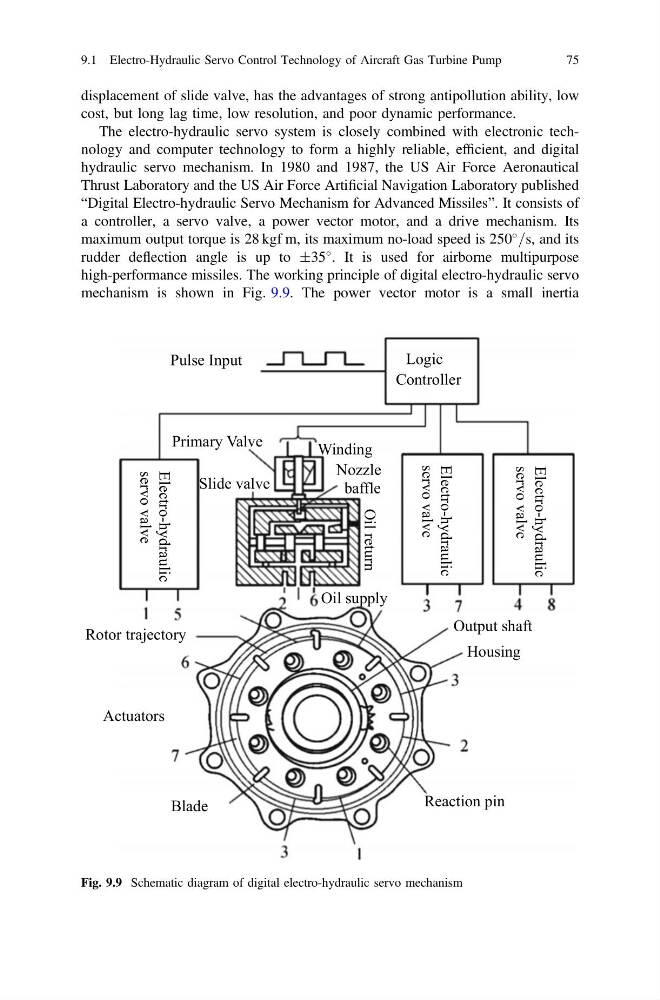
high-performance missiles. The working principle of digital electro-hydraulic servo
mechanism is shown in Fig. 9.9. The power vector motor is a small inertia
Pulse Input
Logic
Controller
Electro-hydraulic
servo valve
Primary Valve
Slide valve
Winding
Nozzle
baffle
Oil return
Electro-hydraulic
servo valve
Electro-hydraulic
servo valve
Oil supply
Rotor trajectory
Actuators
Output shaft
Housing
Reaction pin
Blade
Fig. 9.9 Schematic diagram of digital electro-hydraulic servo mechanism
9.1 Electro-Hydraulic Servo Control Technology of Aircraft Gas Turbine Pump
75
cost, but long lag time, low resolution, and poor dynamic performance.
The electro-hydraulic servo system is closely combined with electronic technology and computer technology to form a highly reliable, efficient, and digital
hydraulic servo mechanism. In 1980 and 1987, the US Air Force Aeronautical
Thrust Laboratory and the US Air Force Artificial Navigation Laboratory published
“Digital Electro-hydraulic Servo Mechanism for Advanced Missiles”. It consists of
a controller, a servo valve, a power vector motor, and a drive mechanism. Its
maximum output torque is 28 kgf m, its maximum no-load speed is 250
=s, and its
rudder deflection angle is up to Æ35
. It is used for airborne multipurpose
high-performance missiles. The working principle of digital electro-hydraulic servo
mechanism is shown in Fig. 9.9. The power vector motor is a small inertia
Pulse Input
Logic
Controller
Electro-hydraulic
servo valve
Primary Valve
Slide valve
Winding
Nozzle
baffle
Oil return
Electro-hydraulic
servo valve
Electro-hydraulic
servo valve
Oil supply
Rotor trajectory
Actuators
Output shaft
Housing
Reaction pin
Blade
Fig. 9.9 Schematic diagram of digital electro-hydraulic servo mechanism
9.1 Electro-Hydraulic Servo Control Technology of Aircraft Gas Turbine Pump
75