

toughness, and cause small pieces of erosion. For this reason, the O-ring of
metal thin tube has been developed, which is made of stainless steel and
nickel–chromium–iron alloy. Another way is to develop heat-resistant
materials with high-dimensional stability and low friction coefficient, such
as fluoroplastics with glass fibers and molybdenum disulfide (working
temperature allowed 315
C). The U.S. Space Shuttle Hydraulic System
(204
C) uses Vitin E60C synthetic rubber seals.
2. Hydraulic oil. Hydraulic oil has lower shear stability, lower viscosity, worse
lubricity, and accelerated wear of parts under high pressure and high temperature, which affects the damping characteristics of oil circuit. In order to
improve the shear stability, thermal stability, and fire resistance of hydraulic
oil, MIL-H-83282 synthetic hydrocarbon hydraulic oil was developed in the
United States and applied to the hydraulic systems of F-14 and space
shuttles. Usually, the hydraulic system using MIL-H-5606 hydraulic oil is
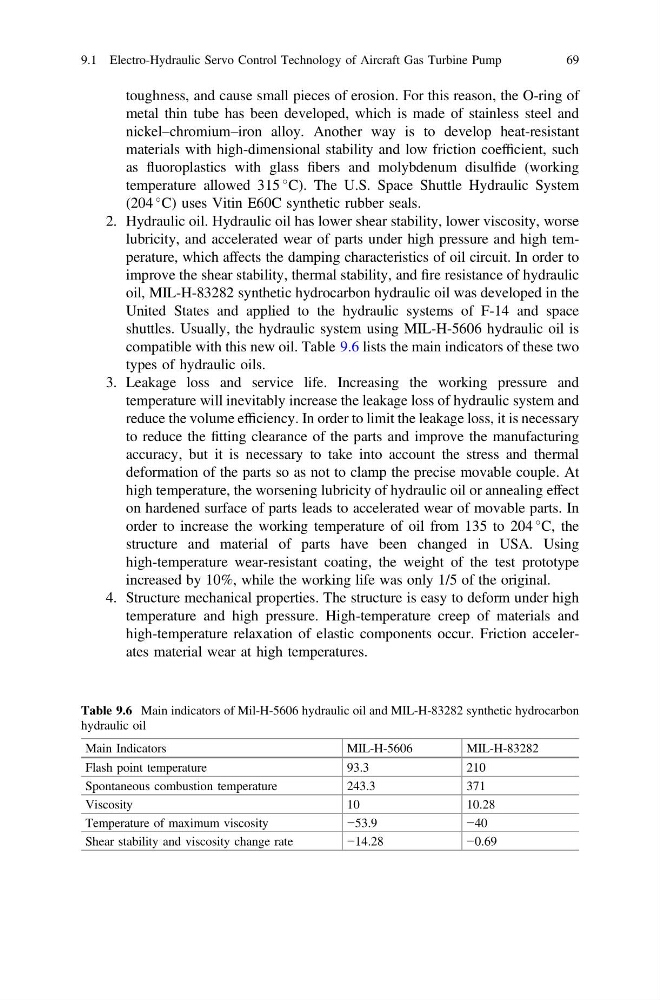
compatible with this new oil. Table 9.6 lists the main indicators of these two
types of hydraulic oils.
3. Leakage loss and service life. Increasing the working pressure and
temperature will inevitably increase the leakage loss of hydraulic system and
reduce the volume efficiency. In order to limit the leakage loss, it is necessary
to reduce the fitting clearance of the parts and improve the manufacturing
accuracy, but it is necessary to take into account the stress and thermal
deformation of the parts so as not to clamp the precise movable couple. At
high temperature, the worsening lubricity of hydraulic oil or annealing effect
on hardened surface of parts leads to accelerated wear of movable parts. In
order to increase the working temperature of oil from 135 to 204
C, the
structure and material of parts have been changed in USA. Using
high-temperature wear-resistant coating, the weight of the test prototype
increased by 10%, while the working life was only 1/5 of the original.
4. Structure mechanical properties. The structure is easy to deform under high
temperature and high pressure. High-temperature creep of materials and
high-temperature relaxation of elastic components occur. Friction accelerates material wear at high temperatures.
Table 9.6 Main indicators of Mil-H-5606 hydraulic oil and MIL-H-83282 synthetic hydrocarbon
hydraulic oil
Main Indicators
MIL-H-5606
MIL-H-83282
Flash point temperature
93.3
210
Spontaneous combustion temperature
243.3
371
Viscosity
10
10.28
Temperature of maximum viscosity
−53.9
−40
Shear stability and viscosity change rate
−14.28
−0.69
9.1 Electro-Hydraulic Servo Control Technology of Aircraft Gas Turbine Pump
69
metal thin tube has been developed, which is made of stainless steel and
nickel–chromium–iron alloy. Another way is to develop heat-resistant
materials with high-dimensional stability and low friction coefficient, such
as fluoroplastics with glass fibers and molybdenum disulfide (working
temperature allowed 315
C). The U.S. Space Shuttle Hydraulic System
(204
C) uses Vitin E60C synthetic rubber seals.
2. Hydraulic oil. Hydraulic oil has lower shear stability, lower viscosity, worse
lubricity, and accelerated wear of parts under high pressure and high temperature, which affects the damping characteristics of oil circuit. In order to
improve the shear stability, thermal stability, and fire resistance of hydraulic
oil, MIL-H-83282 synthetic hydrocarbon hydraulic oil was developed in the
United States and applied to the hydraulic systems of F-14 and space
shuttles. Usually, the hydraulic system using MIL-H-5606 hydraulic oil is
compatible with this new oil. Table 9.6 lists the main indicators of these two
types of hydraulic oils.
3. Leakage loss and service life. Increasing the working pressure and
temperature will inevitably increase the leakage loss of hydraulic system and
reduce the volume efficiency. In order to limit the leakage loss, it is necessary
to reduce the fitting clearance of the parts and improve the manufacturing
accuracy, but it is necessary to take into account the stress and thermal
deformation of the parts so as not to clamp the precise movable couple. At
high temperature, the worsening lubricity of hydraulic oil or annealing effect
on hardened surface of parts leads to accelerated wear of movable parts. In
order to increase the working temperature of oil from 135 to 204
C, the
structure and material of parts have been changed in USA. Using
high-temperature wear-resistant coating, the weight of the test prototype
increased by 10%, while the working life was only 1/5 of the original.
4. Structure mechanical properties. The structure is easy to deform under high
temperature and high pressure. High-temperature creep of materials and
high-temperature relaxation of elastic components occur. Friction accelerates material wear at high temperatures.
Table 9.6 Main indicators of Mil-H-5606 hydraulic oil and MIL-H-83282 synthetic hydrocarbon
hydraulic oil
Main Indicators
MIL-H-5606
MIL-H-83282
Flash point temperature
93.3
210
Spontaneous combustion temperature
243.3
371
Viscosity
10
10.28
Temperature of maximum viscosity
−53.9
−40
Shear stability and viscosity change rate
−14.28
−0.69
9.1 Electro-Hydraulic Servo Control Technology of Aircraft Gas Turbine Pump
69