

hardness (Hs70, Hs80, and Hs90). These curves are actually the extrusion limits
of O-rings.
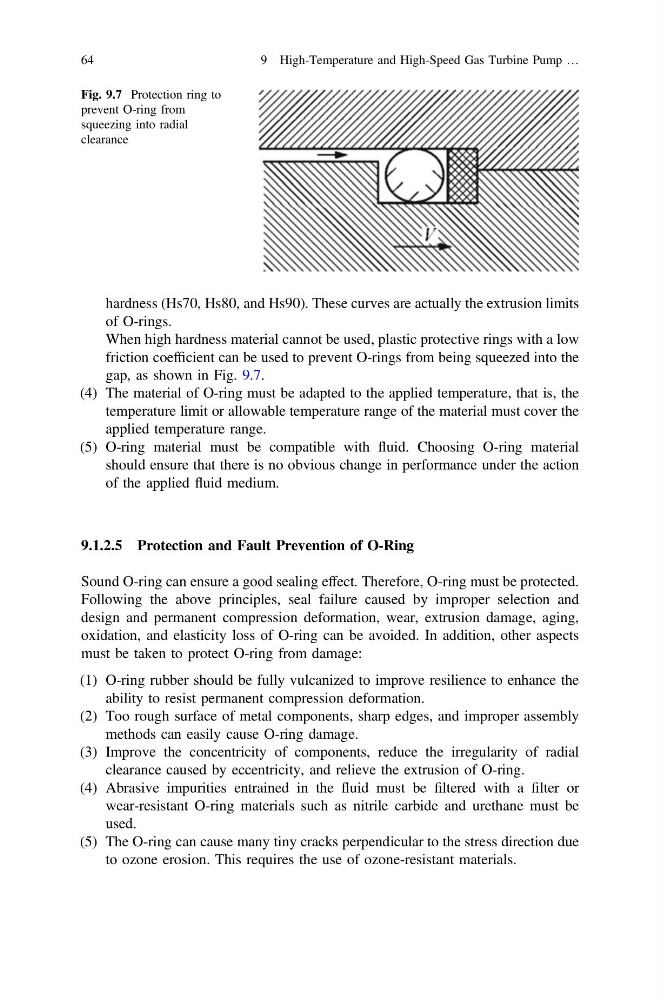
When high hardness material cannot be used, plastic protective rings with a low
friction coefficient can be used to prevent O-rings from being squeezed into the
gap, as shown in Fig. 9.7.
(4) The material of O-ring must be adapted to the applied temperature, that is, the
temperature limit or allowable temperature range of the material must cover the
applied temperature range.
(5) O-ring material must be compatible with fluid. Choosing O-ring material
should ensure that there is no obvious change in performance under the action
of the applied fluid medium.
9.1.2.5 Protection and Fault Prevention of O-Ring
Sound O-ring can ensure a good sealing effect. Therefore, O-ring must be protected.
Following the above principles, seal failure caused by improper selection and
design and permanent compression deformation, wear, extrusion damage, aging,
oxidation, and elasticity loss of O-ring can be avoided. In addition, other aspects
must be taken to protect O-ring from damage:
(1) O-ring rubber should be fully vulcanized to improve resilience to enhance the
ability to resist permanent compression deformation.
(2) Too rough surface of metal components, sharp edges, and improper assembly
methods can easily cause O-ring damage.
(3) Improve the concentricity of components, reduce the irregularity of radial
clearance caused by eccentricity, and relieve the extrusion of O-ring.
(4) Abrasive impurities entrained in the fluid must be filtered with a filter or
wear-resistant O-ring materials such as nitrile carbide and urethane must be
used.
(5) The O-ring can cause many tiny cracks perpendicular to the stress direction due
to ozone erosion. This requires the use of ozone-resistant materials.
Fig. 9.7 Protection ring to
prevent O-ring from
squeezing into radial
clearance
64
9 High-Temperature and High-Speed Gas Turbine Pump …
of O-rings.
When high hardness material cannot be used, plastic protective rings with a low
friction coefficient can be used to prevent O-rings from being squeezed into the
gap, as shown in Fig. 9.7.
(4) The material of O-ring must be adapted to the applied temperature, that is, the
temperature limit or allowable temperature range of the material must cover the
applied temperature range.
(5) O-ring material must be compatible with fluid. Choosing O-ring material
should ensure that there is no obvious change in performance under the action
of the applied fluid medium.
9.1.2.5 Protection and Fault Prevention of O-Ring
Sound O-ring can ensure a good sealing effect. Therefore, O-ring must be protected.
Following the above principles, seal failure caused by improper selection and
design and permanent compression deformation, wear, extrusion damage, aging,
oxidation, and elasticity loss of O-ring can be avoided. In addition, other aspects
must be taken to protect O-ring from damage:
(1) O-ring rubber should be fully vulcanized to improve resilience to enhance the
ability to resist permanent compression deformation.
(2) Too rough surface of metal components, sharp edges, and improper assembly
methods can easily cause O-ring damage.
(3) Improve the concentricity of components, reduce the irregularity of radial
clearance caused by eccentricity, and relieve the extrusion of O-ring.
(4) Abrasive impurities entrained in the fluid must be filtered with a filter or
wear-resistant O-ring materials such as nitrile carbide and urethane must be
used.
(5) The O-ring can cause many tiny cracks perpendicular to the stress direction due
to ozone erosion. This requires the use of ozone-resistant materials.
Fig. 9.7 Protection ring to
prevent O-ring from
squeezing into radial
clearance
64
9 High-Temperature and High-Speed Gas Turbine Pump …