

awareness. Leakage is an unsafe or dangerous hidden danger, which can lead to
accidents and even disasters. Two major accidents that shocked the world in the
mid-1980s, the nuclear leakage caused by the failure of valve seal at Chernobyl
Nuclear Power Station in the Soviet Union and the explosion accident of the
American space shuttle, were caused by the leakage, causing huge losses and
impact. From another point of view, many sophisticated products and equipment in
an unclean environment may be damaged by the infiltration of dust-laden fluid into
the interior. Therefore, the prevention of leakage is an important issue. Leakage has
always been prevented by sealing. There are many kinds of seals, such as gap seals,
elastomer compression deformation seals, mechanical seals, and ferromagnetic fluid
seals. Compression deformation of elastomer is the most commonly used sealing
form, and O-ring is the most common configuration. Elastic O-ring (hereinafter
referred to as O-ring) has been a patent for more than 70 years since it first became
a patent in 1939. In the early 1940s and 1950s, O-rings were mainly used in military
fields such as aircraft hydraulic systems, and since then, they have rapidly expanded
to other industrial fields. Today the O-ring covers almost all parts of the world and
almost all industries, from clocks and watches to jewelry to space shuttles. Sealing
technology has been developing continuously for more than 70 years, but the basic
configuration of O-ring has remained unchanged, which shows its strong vitality.
9.1.2.1 Configuration and Sealing Principle of O-Ring
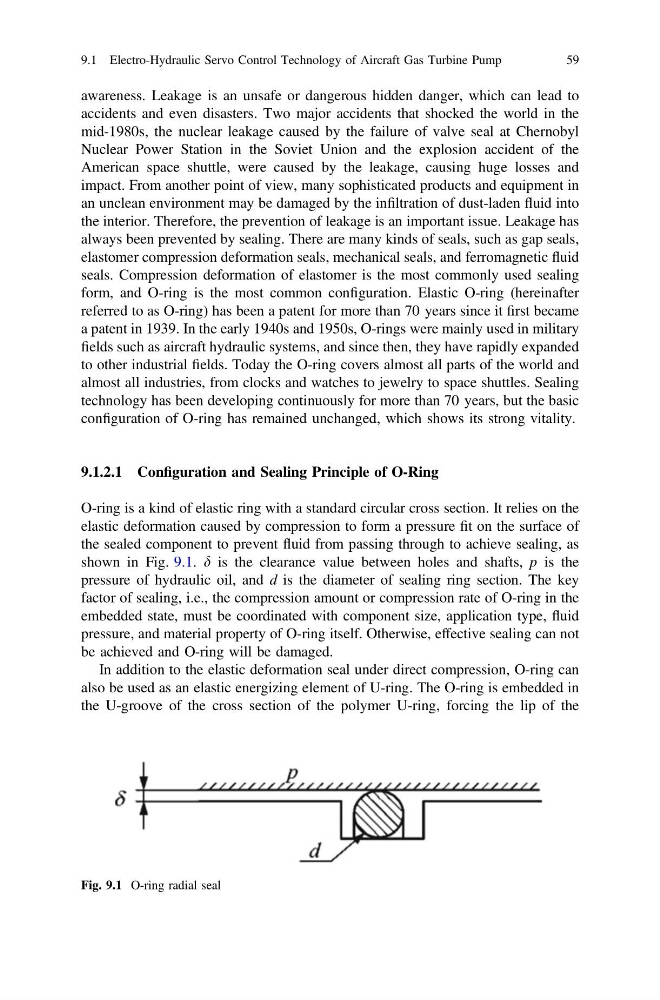
O-ring is a kind of elastic ring with a standard circular cross section. It relies on the
elastic deformation caused by compression to form a pressure fit on the surface of
the sealed component to prevent fluid from passing through to achieve sealing, as
shown in Fig. 9.1. d is the clearance value between holes and shafts, p is the
pressure of hydraulic oil, and d is the diameter of sealing ring section. The key
factor of sealing, i.e., the compression amount or compression rate of O-ring in the
embedded state, must be coordinated with component size, application type, fluid
pressure, and material property of O-ring itself. Otherwise, effective sealing can not
be achieved and O-ring will be damaged.
In addition to the elastic deformation seal under direct compression, O-ring can
also be used as an elastic energizing element of U-ring. The O-ring is embedded in
the U-groove of the cross section of the polymer U-ring, forcing the lip of the
Fig. 9.1 O-ring radial seal
9.1 Electro-Hydraulic Servo Control Technology of Aircraft Gas Turbine Pump
59
accidents and even disasters. Two major accidents that shocked the world in the
mid-1980s, the nuclear leakage caused by the failure of valve seal at Chernobyl
Nuclear Power Station in the Soviet Union and the explosion accident of the
American space shuttle, were caused by the leakage, causing huge losses and
impact. From another point of view, many sophisticated products and equipment in
an unclean environment may be damaged by the infiltration of dust-laden fluid into
the interior. Therefore, the prevention of leakage is an important issue. Leakage has
always been prevented by sealing. There are many kinds of seals, such as gap seals,
elastomer compression deformation seals, mechanical seals, and ferromagnetic fluid
seals. Compression deformation of elastomer is the most commonly used sealing
form, and O-ring is the most common configuration. Elastic O-ring (hereinafter
referred to as O-ring) has been a patent for more than 70 years since it first became
a patent in 1939. In the early 1940s and 1950s, O-rings were mainly used in military
fields such as aircraft hydraulic systems, and since then, they have rapidly expanded
to other industrial fields. Today the O-ring covers almost all parts of the world and
almost all industries, from clocks and watches to jewelry to space shuttles. Sealing
technology has been developing continuously for more than 70 years, but the basic
configuration of O-ring has remained unchanged, which shows its strong vitality.
9.1.2.1 Configuration and Sealing Principle of O-Ring
O-ring is a kind of elastic ring with a standard circular cross section. It relies on the
elastic deformation caused by compression to form a pressure fit on the surface of
the sealed component to prevent fluid from passing through to achieve sealing, as
shown in Fig. 9.1. d is the clearance value between holes and shafts, p is the
pressure of hydraulic oil, and d is the diameter of sealing ring section. The key
factor of sealing, i.e., the compression amount or compression rate of O-ring in the
embedded state, must be coordinated with component size, application type, fluid
pressure, and material property of O-ring itself. Otherwise, effective sealing can not
be achieved and O-ring will be damaged.
In addition to the elastic deformation seal under direct compression, O-ring can
also be used as an elastic energizing element of U-ring. The O-ring is embedded in
the U-groove of the cross section of the polymer U-ring, forcing the lip of the
Fig. 9.1 O-ring radial seal
9.1 Electro-Hydraulic Servo Control Technology of Aircraft Gas Turbine Pump
59