

non-expansive pneumatic motor must be greater than that of the expansive pneumatic motor. The natural frequency of non-expansion pneumatic motor is higher
than that of the same size expansion pneumatic motor. One obvious reason is that
the working volume of non-expansion pneumatic motor is smaller than that of
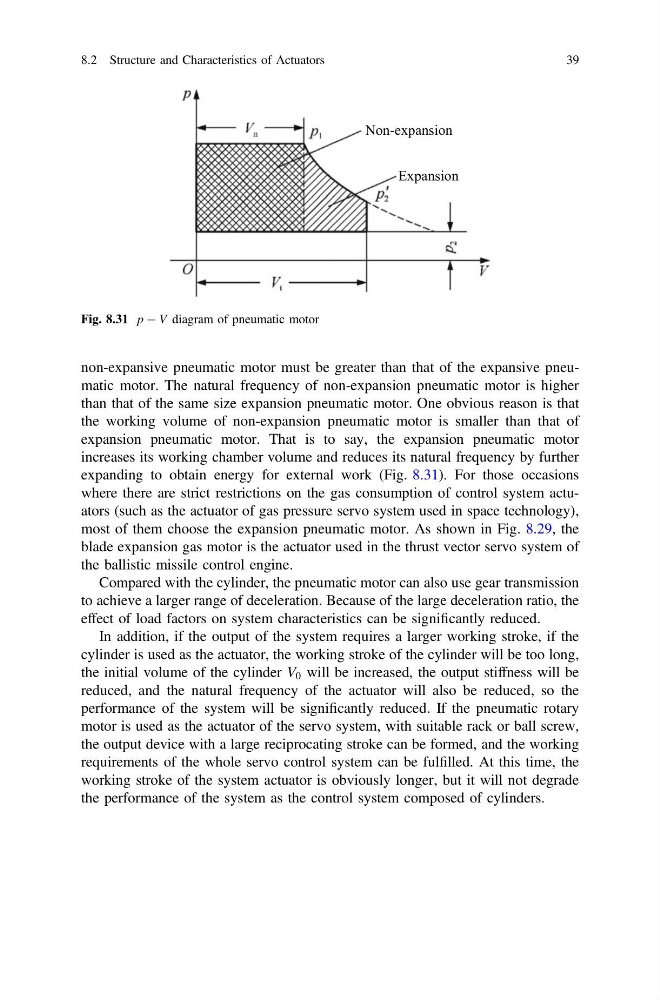
expansion pneumatic motor. That is to say, the expansion pneumatic motor
increases its working chamber volume and reduces its natural frequency by further
expanding to obtain energy for external work (Fig. 8.31). For those occasions
where there are strict restrictions on the gas consumption of control system actuators (such as the actuator of gas pressure servo system used in space technology),
most of them choose the expansion pneumatic motor. As shown in Fig. 8.29, the
blade expansion gas motor is the actuator used in the thrust vector servo system of
the ballistic missile control engine.
Compared with the cylinder, the pneumatic motor can also use gear transmission
to achieve a larger range of deceleration. Because of the large deceleration ratio, the
effect of load factors on system characteristics can be significantly reduced.
In addition, if the output of the system requires a larger working stroke, if the
cylinder is used as the actuator, the working stroke of the cylinder will be too long,
the initial volume of the cylinder V 0 will be increased, the output stiffness will be
reduced, and the natural frequency of the actuator will also be reduced, so the
performance of the system will be significantly reduced. If the pneumatic rotary
motor is used as the actuator of the servo system, with suitable rack or ball screw,
the output device with a large reciprocating stroke can be formed, and the working
requirements of the whole servo control system can be fulfilled. At this time, the
working stroke of the system actuator is obviously longer, but it will not degrade
the performance of the system as the control system composed of cylinders.
Non-expansion
Expansion
Fig. 8.31 p À V diagram of pneumatic motor
8.2 Structure and Characteristics of Actuators
39
than that of the same size expansion pneumatic motor. One obvious reason is that
the working volume of non-expansion pneumatic motor is smaller than that of
expansion pneumatic motor. That is to say, the expansion pneumatic motor
increases its working chamber volume and reduces its natural frequency by further
expanding to obtain energy for external work (Fig. 8.31). For those occasions
where there are strict restrictions on the gas consumption of control system actuators (such as the actuator of gas pressure servo system used in space technology),
most of them choose the expansion pneumatic motor. As shown in Fig. 8.29, the
blade expansion gas motor is the actuator used in the thrust vector servo system of
the ballistic missile control engine.
Compared with the cylinder, the pneumatic motor can also use gear transmission
to achieve a larger range of deceleration. Because of the large deceleration ratio, the
effect of load factors on system characteristics can be significantly reduced.
In addition, if the output of the system requires a larger working stroke, if the
cylinder is used as the actuator, the working stroke of the cylinder will be too long,
the initial volume of the cylinder V 0 will be increased, the output stiffness will be
reduced, and the natural frequency of the actuator will also be reduced, so the
performance of the system will be significantly reduced. If the pneumatic rotary
motor is used as the actuator of the servo system, with suitable rack or ball screw,
the output device with a large reciprocating stroke can be formed, and the working
requirements of the whole servo control system can be fulfilled. At this time, the
working stroke of the system actuator is obviously longer, but it will not degrade
the performance of the system as the control system composed of cylinders.
Non-expansion
Expansion
Fig. 8.31 p À V diagram of pneumatic motor
8.2 Structure and Characteristics of Actuators
39