

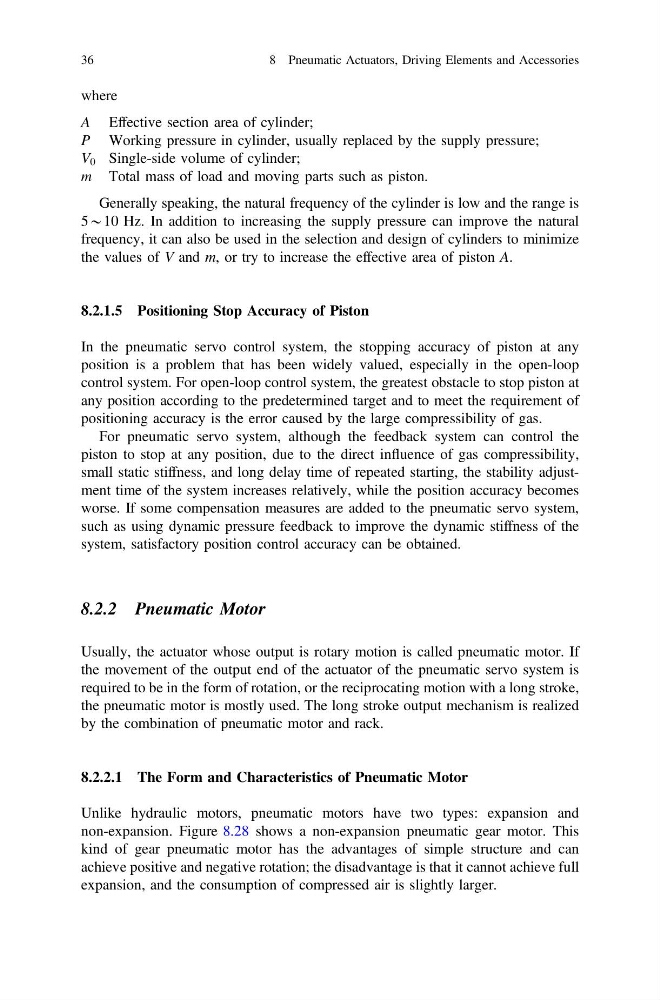
where
A Effective section area of cylinder;
P Working pressure in cylinder, usually replaced by the supply pressure;
V 0 Single-side volume of cylinder;
m Total mass of load and moving parts such as piston.
Generally speaking, the natural frequency of the cylinder is low and the range is
5*10 Hz. In addition to increasing the supply pressure can improve the natural
frequency, it can also be used in the selection and design of cylinders to minimize
the values of V and m, or try to increase the effective area of piston A.
8.2.1.5 Positioning Stop Accuracy of Piston
In the pneumatic servo control system, the stopping accuracy of piston at any
position is a problem that has been widely valued, especially in the open-loop
control system. For open-loop control system, the greatest obstacle to stop piston at
any position according to the predetermined target and to meet the requirement of
positioning accuracy is the error caused by the large compressibility of gas.
For pneumatic servo system, although the feedback system can control the
piston to stop at any position, due to the direct influence of gas compressibility,
small static stiffness, and long delay time of repeated starting, the stability adjustment time of the system increases relatively, while the position accuracy becomes
worse. If some compensation measures are added to the pneumatic servo system,
such as using dynamic pressure feedback to improve the dynamic stiffness of the
system, satisfactory position control accuracy can be obtained.
8.2.2 Pneumatic Motor
Usually, the actuator whose output is rotary motion is called pneumatic motor. If
the movement of the output end of the actuator of the pneumatic servo system is
required to be in the form of rotation, or the reciprocating motion with a long stroke,
the pneumatic motor is mostly used. The long stroke output mechanism is realized
by the combination of pneumatic motor and rack.
8.2.2.1 The Form and Characteristics of Pneumatic Motor
Unlike hydraulic motors, pneumatic motors have two types: expansion and
non-expansion. Figure 8.28 shows a non-expansion pneumatic gear motor. This
kind of gear pneumatic motor has the advantages of simple structure and can
achieve positive and negative rotation; the disadvantage is that it cannot achieve full
expansion, and the consumption of compressed air is slightly larger.
36
8 Pneumatic Actuators, Driving Elements and Accessories
A Effective section area of cylinder;
P Working pressure in cylinder, usually replaced by the supply pressure;
V 0 Single-side volume of cylinder;
m Total mass of load and moving parts such as piston.
Generally speaking, the natural frequency of the cylinder is low and the range is
5*10 Hz. In addition to increasing the supply pressure can improve the natural
frequency, it can also be used in the selection and design of cylinders to minimize
the values of V and m, or try to increase the effective area of piston A.
8.2.1.5 Positioning Stop Accuracy of Piston
In the pneumatic servo control system, the stopping accuracy of piston at any
position is a problem that has been widely valued, especially in the open-loop
control system. For open-loop control system, the greatest obstacle to stop piston at
any position according to the predetermined target and to meet the requirement of
positioning accuracy is the error caused by the large compressibility of gas.
For pneumatic servo system, although the feedback system can control the
piston to stop at any position, due to the direct influence of gas compressibility,
small static stiffness, and long delay time of repeated starting, the stability adjustment time of the system increases relatively, while the position accuracy becomes
worse. If some compensation measures are added to the pneumatic servo system,
such as using dynamic pressure feedback to improve the dynamic stiffness of the
system, satisfactory position control accuracy can be obtained.
8.2.2 Pneumatic Motor
Usually, the actuator whose output is rotary motion is called pneumatic motor. If
the movement of the output end of the actuator of the pneumatic servo system is
required to be in the form of rotation, or the reciprocating motion with a long stroke,
the pneumatic motor is mostly used. The long stroke output mechanism is realized
by the combination of pneumatic motor and rack.
8.2.2.1 The Form and Characteristics of Pneumatic Motor
Unlike hydraulic motors, pneumatic motors have two types: expansion and
non-expansion. Figure 8.28 shows a non-expansion pneumatic gear motor. This
kind of gear pneumatic motor has the advantages of simple structure and can
achieve positive and negative rotation; the disadvantage is that it cannot achieve full
expansion, and the consumption of compressed air is slightly larger.
36
8 Pneumatic Actuators, Driving Elements and Accessories