

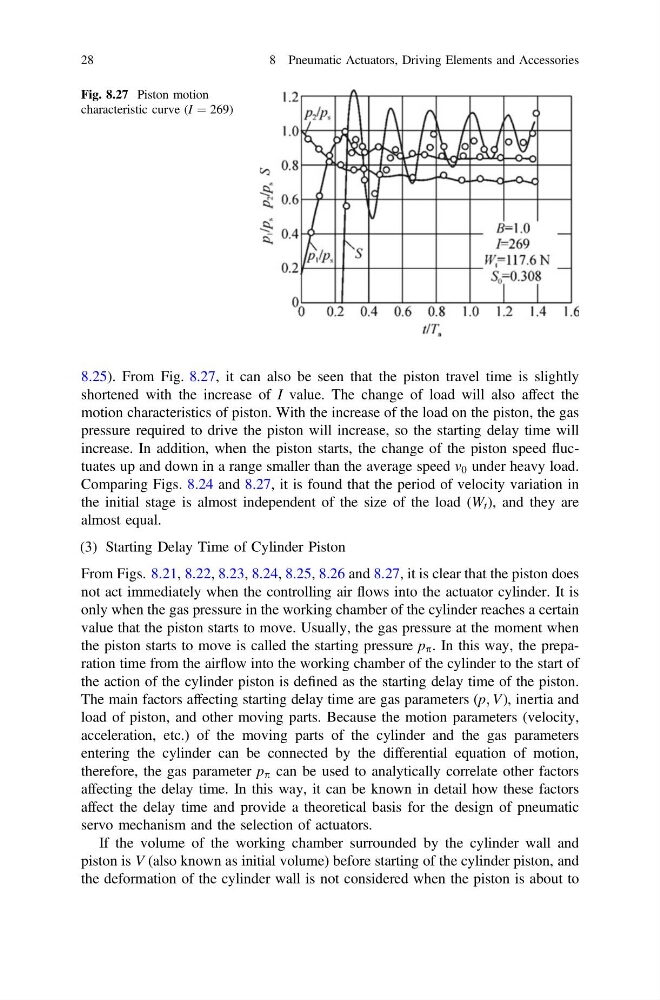
8.25). From Fig. 8.27, it can also be seen that the piston travel time is slightly
shortened with the increase of I value. The change of load will also affect the
motion characteristics of piston. With the increase of the load on the piston, the gas
pressure required to drive the piston will increase, so the starting delay time will
increase. In addition, when the piston starts, the change of the piston speed fluctuates up and down in a range smaller than the average speed v 0 under heavy load.
Comparing Figs. 8.24 and 8.27, it is found that the period of velocity variation in
the initial stage is almost independent of the size of the load (W t ), and they are
almost equal.
(3) Starting Delay Time of Cylinder Piston
From Figs. 8.21, 8.22, 8.23, 8.24, 8.25, 8.26 and 8.27, it is clear that the piston does
not act immediately when the controlling air flows into the actuator cylinder. It is
only when the gas pressure in the working chamber of the cylinder reaches a certain
value that the piston starts to move. Usually, the gas pressure at the moment when
the piston starts to move is called the starting pressure p p . In this way, the preparation time from the airflow into the working chamber of the cylinder to the start of
the action of the cylinder piston is defined as the starting delay time of the piston.
The main factors affecting starting delay time are gas parameters (p; V), inertia and
load of piston, and other moving parts. Because the motion parameters (velocity,
acceleration, etc.) of the moving parts of the cylinder and the gas parameters
entering the cylinder can be connected by the differential equation of motion,
therefore, the gas parameter p p can be used to analytically correlate other factors
affecting the delay time. In this way, it can be known in detail how these factors
affect the delay time and provide a theoretical basis for the design of pneumatic
servo mechanism and the selection of actuators.
If the volume of the working chamber surrounded by the cylinder wall and
piston is V (also known as initial volume) before starting of the cylinder piston, and
the deformation of the cylinder wall is not considered when the piston is about to
Fig. 8.27 Piston motion
characteristic curve (I ¼ 269)
28
8 Pneumatic Actuators, Driving Elements and Accessories
shortened with the increase of I value. The change of load will also affect the
motion characteristics of piston. With the increase of the load on the piston, the gas
pressure required to drive the piston will increase, so the starting delay time will
increase. In addition, when the piston starts, the change of the piston speed fluctuates up and down in a range smaller than the average speed v 0 under heavy load.
Comparing Figs. 8.24 and 8.27, it is found that the period of velocity variation in
the initial stage is almost independent of the size of the load (W t ), and they are
almost equal.
(3) Starting Delay Time of Cylinder Piston
From Figs. 8.21, 8.22, 8.23, 8.24, 8.25, 8.26 and 8.27, it is clear that the piston does
not act immediately when the controlling air flows into the actuator cylinder. It is
only when the gas pressure in the working chamber of the cylinder reaches a certain
value that the piston starts to move. Usually, the gas pressure at the moment when
the piston starts to move is called the starting pressure p p . In this way, the preparation time from the airflow into the working chamber of the cylinder to the start of
the action of the cylinder piston is defined as the starting delay time of the piston.
The main factors affecting starting delay time are gas parameters (p; V), inertia and
load of piston, and other moving parts. Because the motion parameters (velocity,
acceleration, etc.) of the moving parts of the cylinder and the gas parameters
entering the cylinder can be connected by the differential equation of motion,
therefore, the gas parameter p p can be used to analytically correlate other factors
affecting the delay time. In this way, it can be known in detail how these factors
affect the delay time and provide a theoretical basis for the design of pneumatic
servo mechanism and the selection of actuators.
If the volume of the working chamber surrounded by the cylinder wall and
piston is V (also known as initial volume) before starting of the cylinder piston, and
the deformation of the cylinder wall is not considered when the piston is about to
Fig. 8.27 Piston motion
characteristic curve (I ¼ 269)
28
8 Pneumatic Actuators, Driving Elements and Accessories