

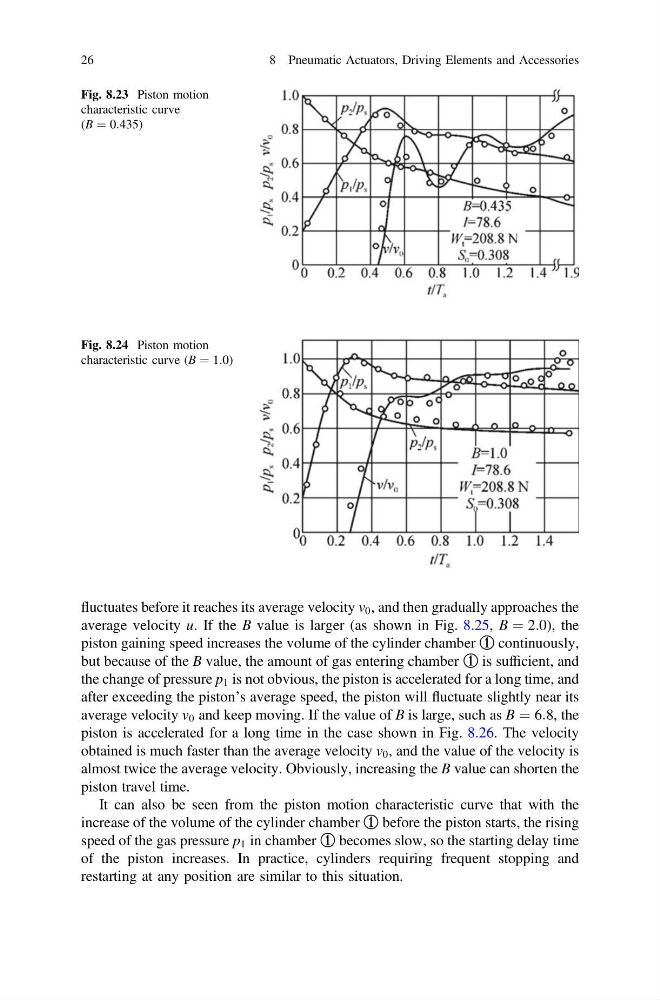
fluctuates before it reaches its average velocity v 0 , and then gradually approaches the
average velocity u. If the B value is larger (as shown in Fig. 8.25, B ¼ 2:0), the
piston gaining speed increases the volume of the cylinder chamber ① continuously,
but because of the B value, the amount of gas entering chamber ① is sufficient, and
the change of pressure p 1 is not obvious, the piston is accelerated for a long time, and
after exceeding the piston’s average speed, the piston will fluctuate slightly near its
average velocity v 0 and keep moving. If the value of B is large, such as B ¼ 6:8, the
piston is accelerated for a long time in the case shown in Fig. 8.26. The velocity
obtained is much faster than the average velocity v 0 , and the value of the velocity is
almost twice the average velocity. Obviously, increasing the B value can shorten the
piston travel time.
It can also be seen from the piston motion characteristic curve that with the
increase of the volume of the cylinder chamber ① before the piston starts, the rising
speed of the gas pressure p 1 in chamber ① becomes slow, so the starting delay time
of the piston increases. In practice, cylinders requiring frequent stopping and
restarting at any position are similar to this situation.
Fig. 8.23 Piston motion
characteristic curve
(B ¼ 0:435)
Fig. 8.24 Piston motion
characteristic curve (B ¼ 1:0)
26
8 Pneumatic Actuators, Driving Elements and Accessories
average velocity u. If the B value is larger (as shown in Fig. 8.25, B ¼ 2:0), the
piston gaining speed increases the volume of the cylinder chamber ① continuously,
but because of the B value, the amount of gas entering chamber ① is sufficient, and
the change of pressure p 1 is not obvious, the piston is accelerated for a long time, and
after exceeding the piston’s average speed, the piston will fluctuate slightly near its
average velocity v 0 and keep moving. If the value of B is large, such as B ¼ 6:8, the
piston is accelerated for a long time in the case shown in Fig. 8.26. The velocity
obtained is much faster than the average velocity v 0 , and the value of the velocity is
almost twice the average velocity. Obviously, increasing the B value can shorten the
piston travel time.
It can also be seen from the piston motion characteristic curve that with the
increase of the volume of the cylinder chamber ① before the piston starts, the rising
speed of the gas pressure p 1 in chamber ① becomes slow, so the starting delay time
of the piston increases. In practice, cylinders requiring frequent stopping and
restarting at any position are similar to this situation.
Fig. 8.23 Piston motion
characteristic curve
(B ¼ 0:435)
Fig. 8.24 Piston motion
characteristic curve (B ¼ 1:0)
26
8 Pneumatic Actuators, Driving Elements and Accessories