

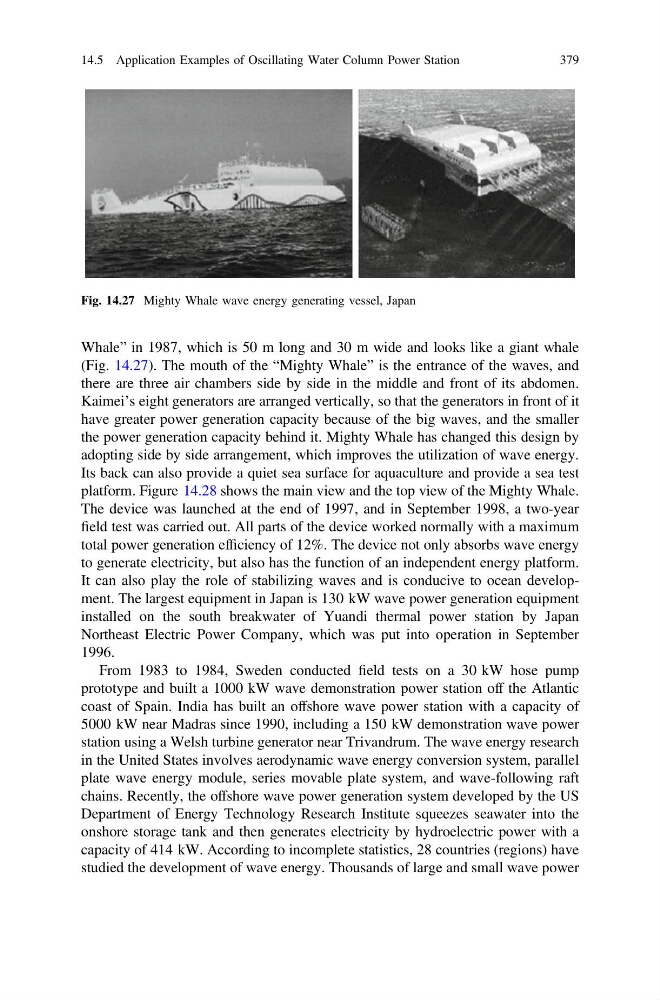
Whale” in 1987, which is 50 m long and 30 m wide and looks like a giant whale
(Fig. 14.27). The mouth of the “Mighty Whale” is the entrance of the waves, and
there are three air chambers side by side in the middle and front of its abdomen.
Kaimei’s eight generators are arranged vertically, so that the generators in front of it
have greater power generation capacity because of the big waves, and the smaller
the power generation capacity behind it. Mighty Whale has changed this design by
adopting side by side arrangement, which improves the utilization of wave energy.
Its back can also provide a quiet sea surface for aquaculture and provide a sea test
platform. Figure 14.28 shows the main view and the top view of the Mighty Whale.
The device was launched at the end of 1997, and in September 1998, a two-year
field test was carried out. All parts of the device worked normally with a maximum
total power generation efficiency of 12%. The device not only absorbs wave energy
to generate electricity, but also has the function of an independent energy platform.
It can also play the role of stabilizing waves and is conducive to ocean development. The largest equipment in Japan is 130 kW wave power generation equipment
installed on the south breakwater of Yuandi thermal power station by Japan
Northeast Electric Power Company, which was put into operation in September
1996.
From 1983 to 1984, Sweden conducted field tests on a 30 kW hose pump
prototype and built a 1000 kW wave demonstration power station off the Atlantic
coast of Spain. India has built an offshore wave power station with a capacity of
5000 kW near Madras since 1990, including a 150 kW demonstration wave power
station using a Welsh turbine generator near Trivandrum. The wave energy research
in the United States involves aerodynamic wave energy conversion system, parallel
plate wave energy module, series movable plate system, and wave-following raft
chains. Recently, the offshore wave power generation system developed by the US
Department of Energy Technology Research Institute squeezes seawater into the
onshore storage tank and then generates electricity by hydroelectric power with a
capacity of 414 kW. According to incomplete statistics, 28 countries (regions) have
studied the development of wave energy. Thousands of large and small wave power
Fig. 14.27 Mighty Whale wave energy generating vessel, Japan
14.5 Application Examples of Oscillating Water Column Power Station
379
(Fig. 14.27). The mouth of the “Mighty Whale” is the entrance of the waves, and
there are three air chambers side by side in the middle and front of its abdomen.
Kaimei’s eight generators are arranged vertically, so that the generators in front of it
have greater power generation capacity because of the big waves, and the smaller
the power generation capacity behind it. Mighty Whale has changed this design by
adopting side by side arrangement, which improves the utilization of wave energy.
Its back can also provide a quiet sea surface for aquaculture and provide a sea test
platform. Figure 14.28 shows the main view and the top view of the Mighty Whale.
The device was launched at the end of 1997, and in September 1998, a two-year
field test was carried out. All parts of the device worked normally with a maximum
total power generation efficiency of 12%. The device not only absorbs wave energy
to generate electricity, but also has the function of an independent energy platform.
It can also play the role of stabilizing waves and is conducive to ocean development. The largest equipment in Japan is 130 kW wave power generation equipment
installed on the south breakwater of Yuandi thermal power station by Japan
Northeast Electric Power Company, which was put into operation in September
1996.
From 1983 to 1984, Sweden conducted field tests on a 30 kW hose pump
prototype and built a 1000 kW wave demonstration power station off the Atlantic
coast of Spain. India has built an offshore wave power station with a capacity of
5000 kW near Madras since 1990, including a 150 kW demonstration wave power
station using a Welsh turbine generator near Trivandrum. The wave energy research
in the United States involves aerodynamic wave energy conversion system, parallel
plate wave energy module, series movable plate system, and wave-following raft
chains. Recently, the offshore wave power generation system developed by the US
Department of Energy Technology Research Institute squeezes seawater into the
onshore storage tank and then generates electricity by hydroelectric power with a
capacity of 414 kW. According to incomplete statistics, 28 countries (regions) have
studied the development of wave energy. Thousands of large and small wave power
Fig. 14.27 Mighty Whale wave energy generating vessel, Japan
14.5 Application Examples of Oscillating Water Column Power Station
379