

of cylinder and piston in the isothermal process under the standard state; T 0 is the
time required for the piston to complete a stroke Z p with the average velocity v 0 ,
that is, T a ¼ z p =v 0 .
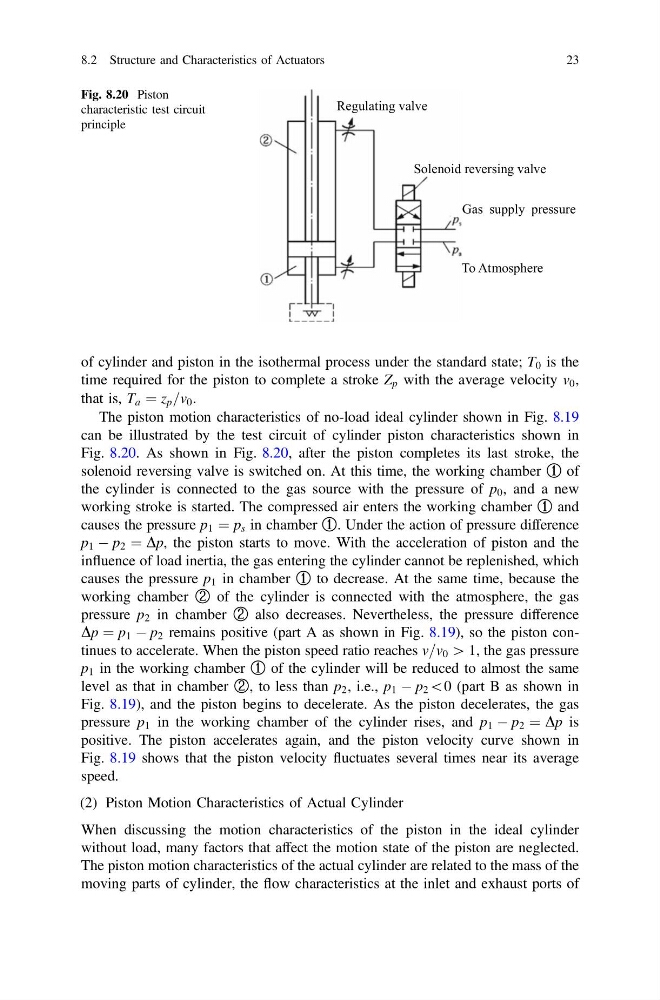
The piston motion characteristics of no-load ideal cylinder shown in Fig. 8.19
can be illustrated by the test circuit of cylinder piston characteristics shown in
Fig. 8.20. As shown in Fig. 8.20, after the piston completes its last stroke, the
solenoid reversing valve is switched on. At this time, the working chamber ① of
the cylinder is connected to the gas source with the pressure of p 0 , and a new
working stroke is started. The compressed air enters the working chamber ① and
causes the pressure p 1 ¼ p s in chamber ①. Under the action of pressure difference
p 1 À p 2 ¼ Dp, the piston starts to move. With the acceleration of piston and the
influence of load inertia, the gas entering the cylinder cannot be replenished, which
causes the pressure p 1 in chamber ① to decrease. At the same time, because the
working chamber ② of the cylinder is connected with the atmosphere, the gas
pressure p 2 in chamber ② also decreases. Nevertheless, the pressure difference
Dp ¼ p 1 À p 2 remains positive (part A as shown in Fig. 8.19), so the piston continues to accelerate. When the piston speed ratio reaches v=v 0 [ 1, the gas pressure
p 1 in the working chamber ① of the cylinder will be reduced to almost the same
level as that in chamber ②, to less than p 2 , i.e., p 1 À p 2 \0 (part B as shown in
Fig. 8.19), and the piston begins to decelerate. As the piston decelerates, the gas
pressure p 1 in the working chamber of the cylinder rises, and p 1 À p 2 ¼ Dp is
positive. The piston accelerates again, and the piston velocity curve shown in
Fig. 8.19 shows that the piston velocity fluctuates several times near its average
speed.
(2) Piston Motion Characteristics of Actual Cylinder
When discussing the motion characteristics of the piston in the ideal cylinder
without load, many factors that affect the motion state of the piston are neglected.
The piston motion characteristics of the actual cylinder are related to the mass of the
moving parts of cylinder, the flow characteristics at the inlet and exhaust ports of
Regulating valve
Solenoid reversing valve
Gas supply pressure
To Atmosphere
Fig. 8.20 Piston
characteristic test circuit
principle
8.2 Structure and Characteristics of Actuators
23
time required for the piston to complete a stroke Z p with the average velocity v 0 ,
that is, T a ¼ z p =v 0 .
The piston motion characteristics of no-load ideal cylinder shown in Fig. 8.19
can be illustrated by the test circuit of cylinder piston characteristics shown in
Fig. 8.20. As shown in Fig. 8.20, after the piston completes its last stroke, the
solenoid reversing valve is switched on. At this time, the working chamber ① of
the cylinder is connected to the gas source with the pressure of p 0 , and a new
working stroke is started. The compressed air enters the working chamber ① and
causes the pressure p 1 ¼ p s in chamber ①. Under the action of pressure difference
p 1 À p 2 ¼ Dp, the piston starts to move. With the acceleration of piston and the
influence of load inertia, the gas entering the cylinder cannot be replenished, which
causes the pressure p 1 in chamber ① to decrease. At the same time, because the
working chamber ② of the cylinder is connected with the atmosphere, the gas
pressure p 2 in chamber ② also decreases. Nevertheless, the pressure difference
Dp ¼ p 1 À p 2 remains positive (part A as shown in Fig. 8.19), so the piston continues to accelerate. When the piston speed ratio reaches v=v 0 [ 1, the gas pressure
p 1 in the working chamber ① of the cylinder will be reduced to almost the same
level as that in chamber ②, to less than p 2 , i.e., p 1 À p 2 \0 (part B as shown in
Fig. 8.19), and the piston begins to decelerate. As the piston decelerates, the gas
pressure p 1 in the working chamber of the cylinder rises, and p 1 À p 2 ¼ Dp is
positive. The piston accelerates again, and the piston velocity curve shown in
Fig. 8.19 shows that the piston velocity fluctuates several times near its average
speed.
(2) Piston Motion Characteristics of Actual Cylinder
When discussing the motion characteristics of the piston in the ideal cylinder
without load, many factors that affect the motion state of the piston are neglected.
The piston motion characteristics of the actual cylinder are related to the mass of the
moving parts of cylinder, the flow characteristics at the inlet and exhaust ports of
Regulating valve
Solenoid reversing valve
Gas supply pressure
To Atmosphere
Fig. 8.20 Piston
characteristic test circuit
principle
8.2 Structure and Characteristics of Actuators
23