

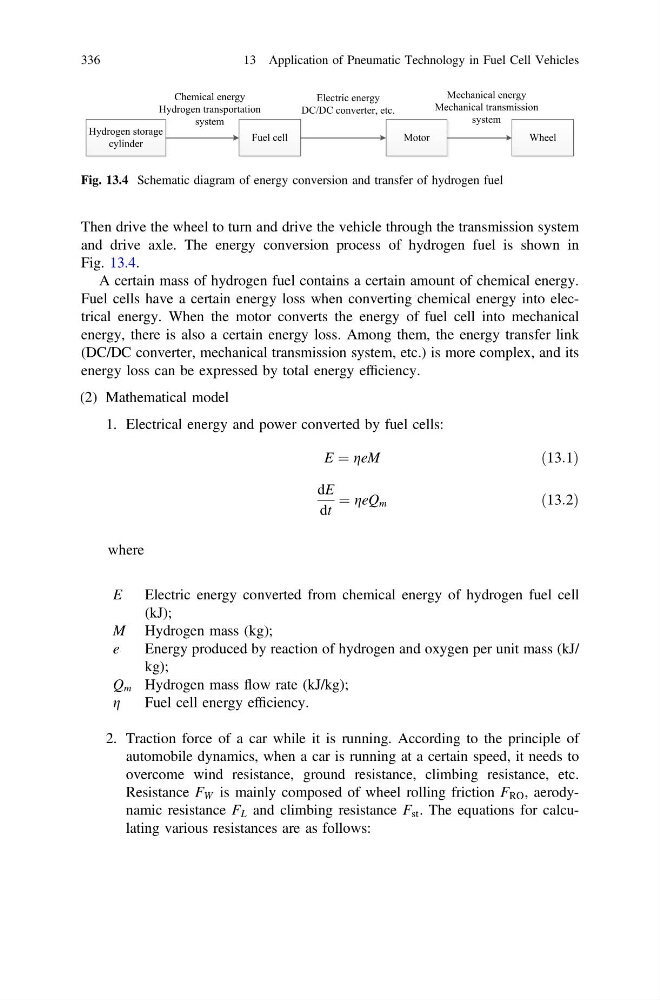
Then drive the wheel to turn and drive the vehicle through the transmission system
and drive axle. The energy conversion process of hydrogen fuel is shown in
Fig. 13.4.
A certain mass of hydrogen fuel contains a certain amount of chemical energy.
Fuel cells have a certain energy loss when converting chemical energy into electrical energy. When the motor converts the energy of fuel cell into mechanical
energy, there is also a certain energy loss. Among them, the energy transfer link
(DC/DC converter, mechanical transmission system, etc.) is more complex, and its
energy loss can be expressed by total energy efficiency.
(2) Mathematical model
1. Electrical energy and power converted by fuel cells:
E ¼ geM
ð13:1Þ
dE
dt
¼ geQ m
ð13:2Þ
where
E
Electric energy converted from chemical energy of hydrogen fuel cell
(kJ);
M Hydrogen mass (kg);
e
Energy produced by reaction of hydrogen and oxygen per unit mass (kJ/
kg);
Q m Hydrogen mass flow rate (kJ/kg);
g
Fuel cell energy efficiency.
2. Traction force of a car while it is running. According to the principle of
automobile dynamics, when a car is running at a certain speed, it needs to
overcome wind resistance, ground resistance, climbing resistance, etc.
Resistance F W is mainly composed of wheel rolling friction F RO , aerodynamic resistance F L and climbing resistance F st . The equations for calculating various resistances are as follows:
Hydrogen storage
cylinder
Fuel cell
Chemical energy
Hydrogen transportation
system
Motor
Wheel
Electric energy
DC/DC converter, etc.
Mechanical energy
Mechanical transmission
system
Fig. 13.4 Schematic diagram of energy conversion and transfer of hydrogen fuel
336
13 Application of Pneumatic Technology in Fuel Cell Vehicles
and drive axle. The energy conversion process of hydrogen fuel is shown in
Fig. 13.4.
A certain mass of hydrogen fuel contains a certain amount of chemical energy.
Fuel cells have a certain energy loss when converting chemical energy into electrical energy. When the motor converts the energy of fuel cell into mechanical
energy, there is also a certain energy loss. Among them, the energy transfer link
(DC/DC converter, mechanical transmission system, etc.) is more complex, and its
energy loss can be expressed by total energy efficiency.
(2) Mathematical model
1. Electrical energy and power converted by fuel cells:
E ¼ geM
ð13:1Þ
dE
dt
¼ geQ m
ð13:2Þ
where
E
Electric energy converted from chemical energy of hydrogen fuel cell
(kJ);
M Hydrogen mass (kg);
e
Energy produced by reaction of hydrogen and oxygen per unit mass (kJ/
kg);
Q m Hydrogen mass flow rate (kJ/kg);
g
Fuel cell energy efficiency.
2. Traction force of a car while it is running. According to the principle of
automobile dynamics, when a car is running at a certain speed, it needs to
overcome wind resistance, ground resistance, climbing resistance, etc.
Resistance F W is mainly composed of wheel rolling friction F RO , aerodynamic resistance F L and climbing resistance F st . The equations for calculating various resistances are as follows:
Hydrogen storage
cylinder
Fuel cell
Chemical energy
Hydrogen transportation
system
Motor
Wheel
Electric energy
DC/DC converter, etc.
Mechanical energy
Mechanical transmission
system
Fig. 13.4 Schematic diagram of energy conversion and transfer of hydrogen fuel
336
13 Application of Pneumatic Technology in Fuel Cell Vehicles