

for the inner screw rod and 7 $ 8 r=min for the outer casing. The screw rod should
be lifted to remove the drilling slag once when the drilling footage reaches 5 $ 8 m.
When DTH hammer drills into bedrock or bearing stratum, its footage becomes
slower and vibration and impulse induction is obvious. After reaching the designed
hole depth, the hole is cleared by high-speed air pressure through the bottom slag
discharge channel of DTH hammer for 2 $ 3 minutes, and the screw rod is lifted.
The drilling slag can be directly discharged out of the hole to complete the hole
clearing work. The DTH hammer is put out of the hole.
11.6.4 Analysis of Bit Usage and Phenomenon
In the process of drilling 20 drill pipes with large diameter pneumatic DTH hammer, the work of the pneumatic DTH hammer and its bit is generally normal, the
spherical teeth of the bit are normal wear and tear, the center teeth are normal, and
there is no loss of teeth. This shows that the overall design of the bit is normal and
the tooth arrangement design and fixing technology are reasonable. However, the
following problems are still found in use:
(1) Fracture of Edge Teeth
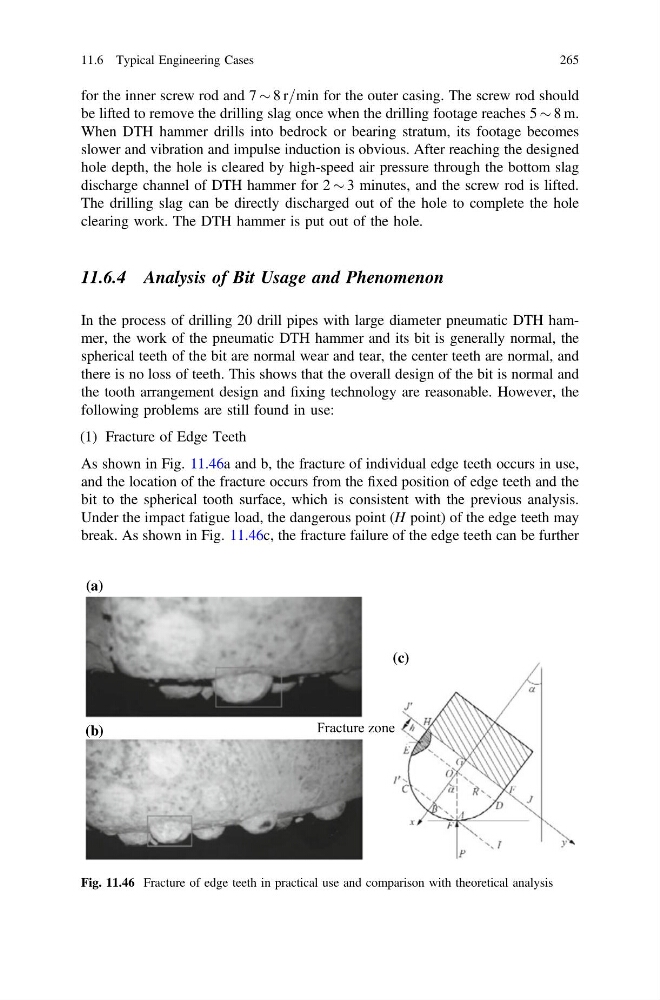
As shown in Fig. 11.46a and b, the fracture of individual edge teeth occurs in use,
and the location of the fracture occurs from the fixed position of edge teeth and the
bit to the spherical tooth surface, which is consistent with the previous analysis.
Under the impact fatigue load, the dangerous point (H point) of the edge teeth may
break. As shown in Fig. 11.46c, the fracture failure of the edge teeth can be further
Fracture zone
(a)
(c)
(b)
Fig. 11.46 Fracture of edge teeth in practical use and comparison with theoretical analysis
11.6 Typical Engineering Cases
265
be lifted to remove the drilling slag once when the drilling footage reaches 5 $ 8 m.
When DTH hammer drills into bedrock or bearing stratum, its footage becomes
slower and vibration and impulse induction is obvious. After reaching the designed
hole depth, the hole is cleared by high-speed air pressure through the bottom slag
discharge channel of DTH hammer for 2 $ 3 minutes, and the screw rod is lifted.
The drilling slag can be directly discharged out of the hole to complete the hole
clearing work. The DTH hammer is put out of the hole.
11.6.4 Analysis of Bit Usage and Phenomenon
In the process of drilling 20 drill pipes with large diameter pneumatic DTH hammer, the work of the pneumatic DTH hammer and its bit is generally normal, the
spherical teeth of the bit are normal wear and tear, the center teeth are normal, and
there is no loss of teeth. This shows that the overall design of the bit is normal and
the tooth arrangement design and fixing technology are reasonable. However, the
following problems are still found in use:
(1) Fracture of Edge Teeth
As shown in Fig. 11.46a and b, the fracture of individual edge teeth occurs in use,
and the location of the fracture occurs from the fixed position of edge teeth and the
bit to the spherical tooth surface, which is consistent with the previous analysis.
Under the impact fatigue load, the dangerous point (H point) of the edge teeth may
break. As shown in Fig. 11.46c, the fracture failure of the edge teeth can be further
Fracture zone
(a)
(c)
(b)
Fig. 11.46 Fracture of edge teeth in practical use and comparison with theoretical analysis
11.6 Typical Engineering Cases
265