

spherical teeth. In the past, according to the principle of equal volume crushing
working conditions, the number of teeth of each ring column was determined.
Because of the complex lithology, when determining the spacing between the
cylinder teeth in each circle, the combined crushing effect of the two teeth should be
considered, which needs to be studied. It is of great significance to study the
mechanism of the two teeth and to optimize the spherical teeth layout of large
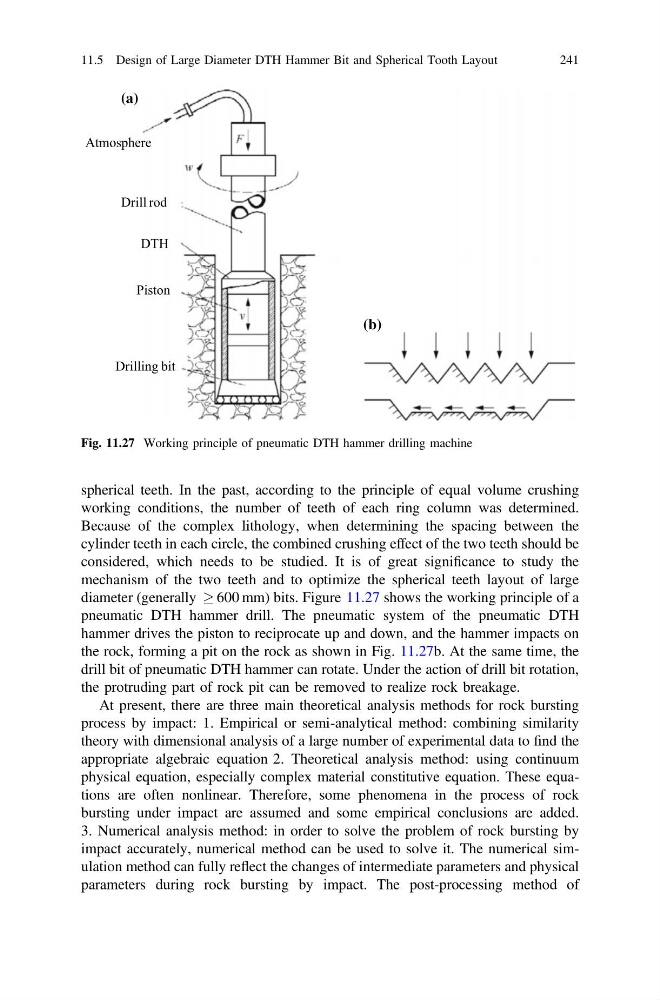
diameter (generally ! 600 mm) bits. Figure 11.27 shows the working principle of a
pneumatic DTH hammer drill. The pneumatic system of the pneumatic DTH
hammer drives the piston to reciprocate up and down, and the hammer impacts on
the rock, forming a pit on the rock as shown in Fig. 11.27b. At the same time, the
drill bit of pneumatic DTH hammer can rotate. Under the action of drill bit rotation,
the protruding part of rock pit can be removed to realize rock breakage.
At present, there are three main theoretical analysis methods for rock bursting
process by impact: 1. Empirical or semi-analytical method: combining similarity
theory with dimensional analysis of a large number of experimental data to find the
appropriate algebraic equation 2. Theoretical analysis method: using continuum
physical equation, especially complex material constitutive equation. These equations are often nonlinear. Therefore, some phenomena in the process of rock
bursting under impact are assumed and some empirical conclusions are added.
3. Numerical analysis method: in order to solve the problem of rock bursting by
impact accurately, numerical method can be used to solve it. The numerical simulation method can fully reflect the changes of intermediate parameters and physical
parameters during rock bursting by impact. The post-processing method of
Drilling bit
Atmosphere
Drill rod
DTH
Piston
(a)
(b)
Fig. 11.27 Working principle of pneumatic DTH hammer drilling machine
11.5 Design of Large Diameter DTH Hammer Bit and Spherical Tooth Layout
241
working conditions, the number of teeth of each ring column was determined.
Because of the complex lithology, when determining the spacing between the
cylinder teeth in each circle, the combined crushing effect of the two teeth should be
considered, which needs to be studied. It is of great significance to study the
mechanism of the two teeth and to optimize the spherical teeth layout of large
diameter (generally ! 600 mm) bits. Figure 11.27 shows the working principle of a
pneumatic DTH hammer drill. The pneumatic system of the pneumatic DTH
hammer drives the piston to reciprocate up and down, and the hammer impacts on
the rock, forming a pit on the rock as shown in Fig. 11.27b. At the same time, the
drill bit of pneumatic DTH hammer can rotate. Under the action of drill bit rotation,
the protruding part of rock pit can be removed to realize rock breakage.
At present, there are three main theoretical analysis methods for rock bursting
process by impact: 1. Empirical or semi-analytical method: combining similarity
theory with dimensional analysis of a large number of experimental data to find the
appropriate algebraic equation 2. Theoretical analysis method: using continuum
physical equation, especially complex material constitutive equation. These equations are often nonlinear. Therefore, some phenomena in the process of rock
bursting under impact are assumed and some empirical conclusions are added.
3. Numerical analysis method: in order to solve the problem of rock bursting by
impact accurately, numerical method can be used to solve it. The numerical simulation method can fully reflect the changes of intermediate parameters and physical
parameters during rock bursting by impact. The post-processing method of
Drilling bit
Atmosphere
Drill rod
DTH
Piston
(a)
(b)
Fig. 11.27 Working principle of pneumatic DTH hammer drilling machine
11.5 Design of Large Diameter DTH Hammer Bit and Spherical Tooth Layout
241