

the maximum value. But when the natural frequency is the minimum, the piston is
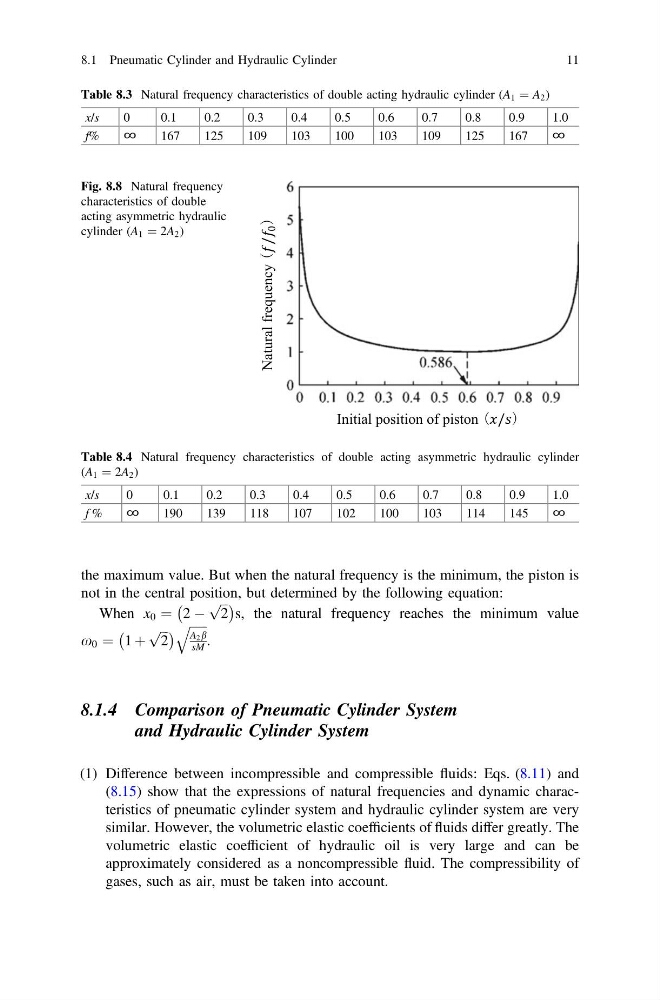
not in the central position, but determined by the following equation:
When x 0 ¼ 2 À
ffiffi ffi
2
p
À
Á
s, the natural frequency reaches the minimum value
x 0 ¼ 1 þ
ffiffi ffi
2
p
À
Á ffiffiffiffiffi ffi
A 2 b
sM
q
.
8.1.4 Comparison of Pneumatic Cylinder System
and Hydraulic Cylinder System
(1) Difference between incompressible and compressible fluids: Eqs. (8.11) and
(8.15) show that the expressions of natural frequencies and dynamic characteristics of pneumatic cylinder system and hydraulic cylinder system are very
similar. However, the volumetric elastic coefficients of fluids differ greatly. The
volumetric elastic coefficient of hydraulic oil is very large and can be
approximately considered as a noncompressible fluid. The compressibility of
gases, such as air, must be taken into account.
Table 8.3 Natural frequency characteristics of double acting hydraulic cylinder (A 1 ¼ A 2 )
x/s
0
0.1
0.2
0.3
0.4
0.5
0.6
0.7
0.8
0.9
1.0
f%
∞
167
125
109
103
100
103
109
125
167
∞
Natural frequency
Initial position of piston
Fig. 8.8 Natural frequency
characteristics of double
acting asymmetric hydraulic
cylinder (A 1 ¼ 2A 2 )
Table 8.4 Natural frequency characteristics of double acting asymmetric hydraulic cylinder
(A 1 ¼ 2A 2 )
x/s
0
0.1
0.2
0.3
0.4
0.5
0.6
0.7
0.8
0.9
1.0
f %
∞
190
139
118
107
102
100
103
114
145
∞
8.1 Pneumatic Cylinder and Hydraulic Cylinder
11
not in the central position, but determined by the following equation:
When x 0 ¼ 2 À
ffiffi ffi
2
p
À
Á
s, the natural frequency reaches the minimum value
x 0 ¼ 1 þ
ffiffi ffi
2
p
À
Á ffiffiffiffiffi ffi
A 2 b
sM
q
.
8.1.4 Comparison of Pneumatic Cylinder System
and Hydraulic Cylinder System
(1) Difference between incompressible and compressible fluids: Eqs. (8.11) and
(8.15) show that the expressions of natural frequencies and dynamic characteristics of pneumatic cylinder system and hydraulic cylinder system are very
similar. However, the volumetric elastic coefficients of fluids differ greatly. The
volumetric elastic coefficient of hydraulic oil is very large and can be
approximately considered as a noncompressible fluid. The compressibility of
gases, such as air, must be taken into account.
Table 8.3 Natural frequency characteristics of double acting hydraulic cylinder (A 1 ¼ A 2 )
x/s
0
0.1
0.2
0.3
0.4
0.5
0.6
0.7
0.8
0.9
1.0
f%
∞
167
125
109
103
100
103
109
125
167
∞
Natural frequency
Initial position of piston
Fig. 8.8 Natural frequency
characteristics of double
acting asymmetric hydraulic
cylinder (A 1 ¼ 2A 2 )
Table 8.4 Natural frequency characteristics of double acting asymmetric hydraulic cylinder
(A 1 ¼ 2A 2 )
x/s
0
0.1
0.2
0.3
0.4
0.5
0.6
0.7
0.8
0.9
1.0
f %
∞
190
139
118
107
102
100
103
114
145
∞
8.1 Pneumatic Cylinder and Hydraulic Cylinder
11