

change by modifying the coefficient, so the results may be closer to the actual
results. In order to obtain a more accurate internal dynamic process of DTH
hammer, it is necessary to consider the influence of gas heat transfer in the front and
rear chamber of impactor. For this reason, the mathematical model of piston motion
in cylinder block and the change of gas state in front and rear chamber are
established.
11.3.5 Design of Key Parts
11.3.5.1 Design of Cylinder
The main structural parameters of DTH hammer include cylinder diameter, piston
structural stroke and piston size. Cylinder block is the guiding device of piston
movement, and also the frame of the whole impactor. From the point of view of
valve distribution, the cylinder block is also used to transport working media.
Increasing the diameter of the cylinder can increase the impact energy and frequency of the impactor. Therefore, the diameter of the cylinder should be enlarged
as much as possible when the size of the structure is allowed. Generally, the
difference between the outside diameter and the hole diameter of DTH hammer
should not be less than 15 $ 20 mm, while the outer sleeve and cylinder of DTH
hammer should not be too thin. Therefore, the ratio of cylinder diameter to borehole
diameter of DTH hammer is more than 0.5.
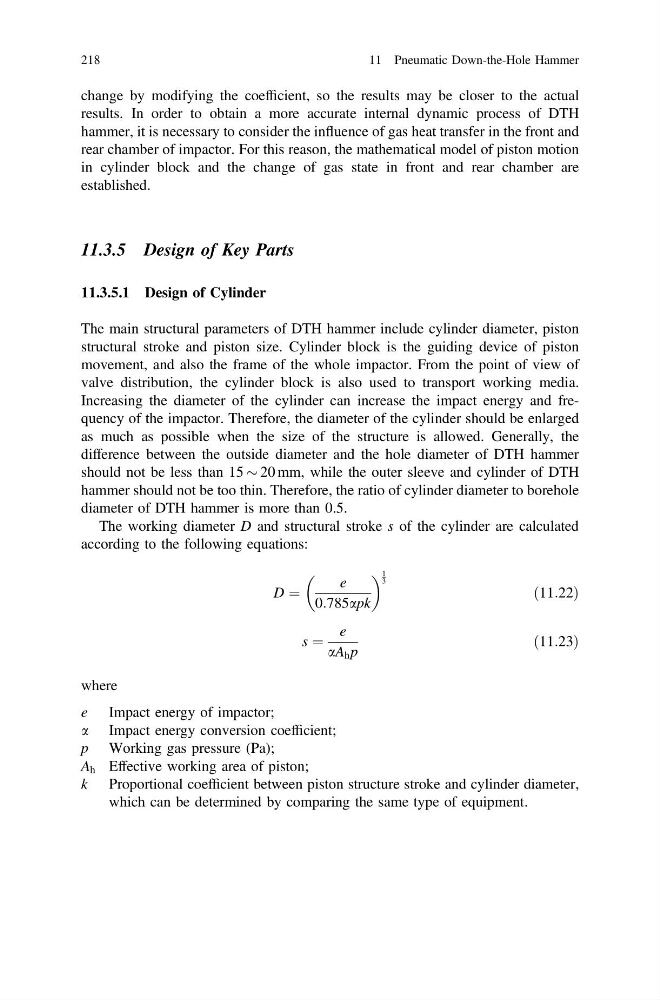
The working diameter D and structural stroke s of the cylinder are calculated
according to the following equations:
D ¼
e
0:785apk
1
3
ð11:22Þ
s ¼
e
aA h p
ð11:23Þ
where
e Impact energy of impactor;
a Impact energy conversion coefficient;
p Working gas pressure (Pa);
A h Effective working area of piston;
k Proportional coefficient between piston structure stroke and cylinder diameter,
which can be determined by comparing the same type of equipment.
218
11 Pneumatic Down-the-Hole Hammer
results. In order to obtain a more accurate internal dynamic process of DTH
hammer, it is necessary to consider the influence of gas heat transfer in the front and
rear chamber of impactor. For this reason, the mathematical model of piston motion
in cylinder block and the change of gas state in front and rear chamber are
established.
11.3.5 Design of Key Parts
11.3.5.1 Design of Cylinder
The main structural parameters of DTH hammer include cylinder diameter, piston
structural stroke and piston size. Cylinder block is the guiding device of piston
movement, and also the frame of the whole impactor. From the point of view of
valve distribution, the cylinder block is also used to transport working media.
Increasing the diameter of the cylinder can increase the impact energy and frequency of the impactor. Therefore, the diameter of the cylinder should be enlarged
as much as possible when the size of the structure is allowed. Generally, the
difference between the outside diameter and the hole diameter of DTH hammer
should not be less than 15 $ 20 mm, while the outer sleeve and cylinder of DTH
hammer should not be too thin. Therefore, the ratio of cylinder diameter to borehole
diameter of DTH hammer is more than 0.5.
The working diameter D and structural stroke s of the cylinder are calculated
according to the following equations:
D ¼
e
0:785apk
1
3
ð11:22Þ
s ¼
e
aA h p
ð11:23Þ
where
e Impact energy of impactor;
a Impact energy conversion coefficient;
p Working gas pressure (Pa);
A h Effective working area of piston;
k Proportional coefficient between piston structure stroke and cylinder diameter,
which can be determined by comparing the same type of equipment.
218
11 Pneumatic Down-the-Hole Hammer