

coefficient of hydraulic oil varies little with pressure and temperature, so it can be
regarded as a hydraulic spring with larger spring stiffness. As shown in Fig. 8.4, the
spring stiffness of the two equivalent springs of the double acting hydraulic cylinder
system are respectively,
K eq1 ¼
A
2
1 b
V 10 þ A 1 x
; K eq2 ¼
A
2
2 b
V 20 þ A 2 s À x
ð
Þ
The double acting hydraulic cylinder can be regarded as a mass–spring system
consisting of two springs in parallel. The spring stiffness and natural frequency are,
respectively,
K ¼
A
2
1 b
V 10 þ A 1 x
þ
A
2
2 b
V 20 þ A 2 s À x
ð
Þ
x ¼
ffiffiffiffi ffi
K
M
r
¼
ffiffiffiffiffiffiffiffiffiffiffiffiffiffiffiffiffiffiffiffiffiffiffiffiffiffiffiffiffiffiffiffiffiffiffiffiffiffiffiffiffiffiffiffiffiffiffiffiffiffiffiffiffiffiffiffiffiffiffiffiffiffiffiffiffiffiffiffiffiffi ffi
A 2
1 b
ðV 10 þ A 1 xÞM
þ
A 2
2 b
½V 20 þ A 2 s À x
ð
ÞM
s
ð8:15Þ
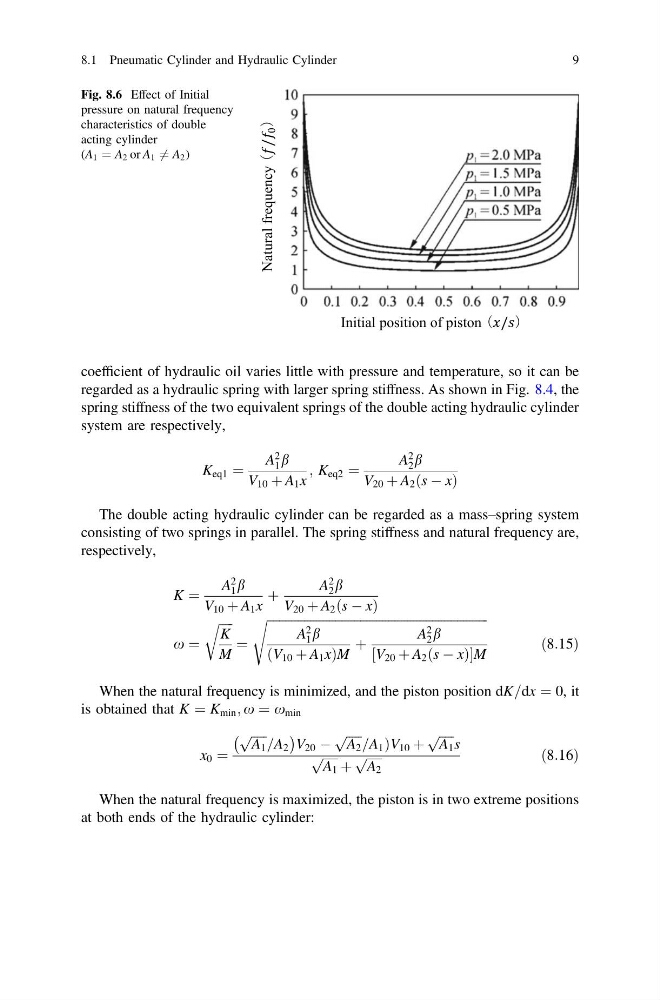
When the natural frequency is minimized, and the piston position dK=dx ¼ 0, it
is obtained that K ¼ K min ; x ¼ x min
x 0 ¼
ffiffiffiffiffi
A 1
p =A 2
À
Á
V 20 À
ffiffiffiffiffi
A 2
p =A 1 ÞV 10 þ
ffiffiffiffiffi
A 1
p
s
ffiffiffiffiffi
A 1
p þ
ffiffiffiffiffi
A 2
p
ð8:16Þ
When the natural frequency is maximized, the piston is in two extreme positions
at both ends of the hydraulic cylinder:
atural frequency
Initial position of piston
Fig. 8.6 Effect of Initial
pressure on natural frequency
characteristics of double
acting cylinder
(A 1 ¼ A 2 or A 1 6 ¼ A 2 )
8.1 Pneumatic Cylinder and Hydraulic Cylinder
9
regarded as a hydraulic spring with larger spring stiffness. As shown in Fig. 8.4, the
spring stiffness of the two equivalent springs of the double acting hydraulic cylinder
system are respectively,
K eq1 ¼
A
2
1 b
V 10 þ A 1 x
; K eq2 ¼
A
2
2 b
V 20 þ A 2 s À x
ð
Þ
The double acting hydraulic cylinder can be regarded as a mass–spring system
consisting of two springs in parallel. The spring stiffness and natural frequency are,
respectively,
K ¼
A
2
1 b
V 10 þ A 1 x
þ
A
2
2 b
V 20 þ A 2 s À x
ð
Þ
x ¼
ffiffiffiffi ffi
K
M
r
¼
ffiffiffiffiffiffiffiffiffiffiffiffiffiffiffiffiffiffiffiffiffiffiffiffiffiffiffiffiffiffiffiffiffiffiffiffiffiffiffiffiffiffiffiffiffiffiffiffiffiffiffiffiffiffiffiffiffiffiffiffiffiffiffiffiffiffiffiffiffiffi ffi
A 2
1 b
ðV 10 þ A 1 xÞM
þ
A 2
2 b
½V 20 þ A 2 s À x
ð
ÞM
s
ð8:15Þ
When the natural frequency is minimized, and the piston position dK=dx ¼ 0, it
is obtained that K ¼ K min ; x ¼ x min
x 0 ¼
ffiffiffiffiffi
A 1
p =A 2
À
Á
V 20 À
ffiffiffiffiffi
A 2
p =A 1 ÞV 10 þ
ffiffiffiffiffi
A 1
p
s
ffiffiffiffiffi
A 1
p þ
ffiffiffiffiffi
A 2
p
ð8:16Þ
When the natural frequency is maximized, the piston is in two extreme positions
at both ends of the hydraulic cylinder:
atural frequency
Initial position of piston
Fig. 8.6 Effect of Initial
pressure on natural frequency
characteristics of double
acting cylinder
(A 1 ¼ A 2 or A 1 6 ¼ A 2 )
8.1 Pneumatic Cylinder and Hydraulic Cylinder
9