

x ¼
ffiffiffiffiffiffiffiffiffiffiffiffi
K eq
M
¼
r
ffiffiffiffiffiffiffiffiffiffi
nA 2 p
VM
r
¼
ffiffiffiffiffiffiffiffiffiffiffiffiffiffiffiffiffiffiffiffiffiffiffi ffi
nA 2 p
V 0 þ Ax
ð
Þ M
s
ð8:6Þ
When the piston is at the extreme position of the cylinder, that is, at the end of
the piston x ¼ 0
ð
Þ, the natural frequency reaches the maximum. At this point, the
natural frequency is
x max ¼
ffiffiffiffiffiffiffiffiffiffi
nA 2 p
V 0 M
s
ð8:7Þ
As shown in Eq. (8.7), the smaller the volume of gas (V 0 ) in the pipeline
connected to the cylinder, that is, when the piston is at the end of the cylinder, the
natural frequency of the cylinder system theoretically has the maximum value.
Especially as shown in Eq. (8.6), the smaller the gas volume (V 0 ) in the pipeline,
such as V 0 ¼ 0, when the piston is at the end of the cylinder, the theoretical natural
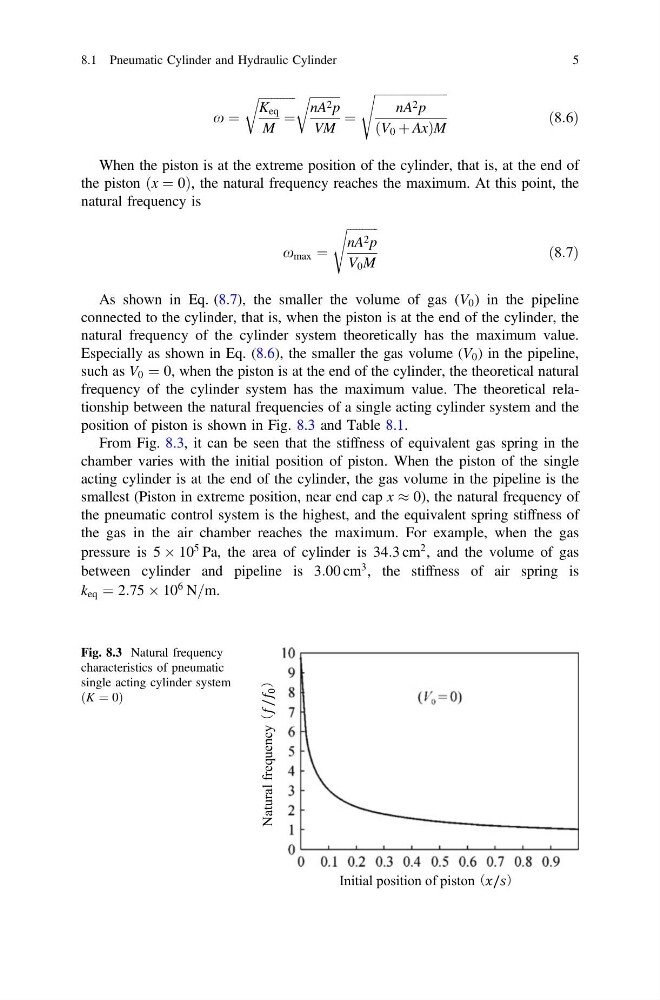
frequency of the cylinder system has the maximum value. The theoretical relationship between the natural frequencies of a single acting cylinder system and the
position of piston is shown in Fig. 8.3 and Table 8.1.
From Fig. 8.3, it can be seen that the stiffness of equivalent gas spring in the
chamber varies with the initial position of piston. When the piston of the single
acting cylinder is at the end of the cylinder, the gas volume in the pipeline is the
smallest (Piston in extreme position, near end cap x % 0), the natural frequency of
the pneumatic control system is the highest, and the equivalent spring stiffness of
the gas in the air chamber reaches the maximum. For example, when the gas
pressure is 5 Â 10
5 Pa, the area of cylinder is 34:3 cm
2 , and the volume of gas
between cylinder and pipeline is 3:00 cm
3 , the stiffness of air spring is
k eq ¼ 2:75 Â 10
6 N=m.
Natural frequency
Initial position of piston
Fig. 8.3 Natural frequency
characteristics of pneumatic
single acting cylinder system
K ¼ 0
ð
Þ
8.1 Pneumatic Cylinder and Hydraulic Cylinder
5
ffiffiffiffiffiffiffiffiffiffiffiffi
K eq
M
¼
r
ffiffiffiffiffiffiffiffiffiffi
nA 2 p
VM
r
¼
ffiffiffiffiffiffiffiffiffiffiffiffiffiffiffiffiffiffiffiffiffiffiffi ffi
nA 2 p
V 0 þ Ax
ð
Þ M
s
ð8:6Þ
When the piston is at the extreme position of the cylinder, that is, at the end of
the piston x ¼ 0
ð
Þ, the natural frequency reaches the maximum. At this point, the
natural frequency is
x max ¼
ffiffiffiffiffiffiffiffiffiffi
nA 2 p
V 0 M
s
ð8:7Þ
As shown in Eq. (8.7), the smaller the volume of gas (V 0 ) in the pipeline
connected to the cylinder, that is, when the piston is at the end of the cylinder, the
natural frequency of the cylinder system theoretically has the maximum value.
Especially as shown in Eq. (8.6), the smaller the gas volume (V 0 ) in the pipeline,
such as V 0 ¼ 0, when the piston is at the end of the cylinder, the theoretical natural
frequency of the cylinder system has the maximum value. The theoretical relationship between the natural frequencies of a single acting cylinder system and the
position of piston is shown in Fig. 8.3 and Table 8.1.
From Fig. 8.3, it can be seen that the stiffness of equivalent gas spring in the
chamber varies with the initial position of piston. When the piston of the single
acting cylinder is at the end of the cylinder, the gas volume in the pipeline is the
smallest (Piston in extreme position, near end cap x % 0), the natural frequency of
the pneumatic control system is the highest, and the equivalent spring stiffness of
the gas in the air chamber reaches the maximum. For example, when the gas
pressure is 5 Â 10
5 Pa, the area of cylinder is 34:3 cm
2 , and the volume of gas
between cylinder and pipeline is 3:00 cm
3 , the stiffness of air spring is
k eq ¼ 2:75 Â 10
6 N=m.
Natural frequency
Initial position of piston
Fig. 8.3 Natural frequency
characteristics of pneumatic
single acting cylinder system
K ¼ 0
ð
Þ
8.1 Pneumatic Cylinder and Hydraulic Cylinder
5