

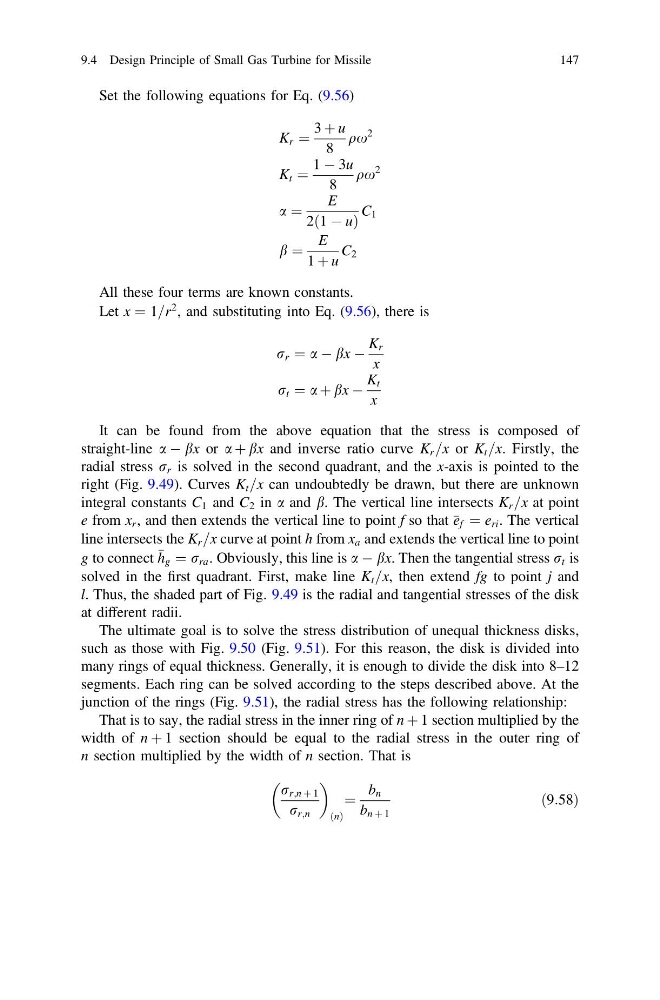
Set the following equations for Eq. (9.56)
K r ¼
3 þ u
8
qx
2
K t ¼
1 À 3u
8
qx
2
a ¼
E
2 1 À u
ð
Þ
C 1
b ¼
E
1 þ u
C 2
All these four terms are known constants.
Let x ¼ 1=r
2 , and substituting into Eq. (9.56), there is
r r ¼ a À bx À
K r
x
r t ¼ a þ bx À
K t
x
It can be found from the above equation that the stress is composed of
straight-line a À bx or a þ bx and inverse ratio curve K r =x or K t =x. Firstly, the
radial stress r r is solved in the second quadrant, and the x-axis is pointed to the
right (Fig. 9.49). Curves K t =x can undoubtedly be drawn, but there are unknown
integral constants C 1 and C 2 in a and b. The vertical line intersects K r =x at point
e from x r , and then extends the vertical line to point f so that e f ¼ e ri . The vertical
line intersects the K r =x curve at point h from x a and extends the vertical line to point
g to connect h g ¼ r ra . Obviously, this line is a À bx. Then the tangential stress r t is
solved in the first quadrant. First, make line K t =x, then extend fg to point j and
l. Thus, the shaded part of Fig. 9.49 is the radial and tangential stresses of the disk
at different radii.
The ultimate goal is to solve the stress distribution of unequal thickness disks,
such as those with Fig. 9.50 (Fig. 9.51). For this reason, the disk is divided into
many rings of equal thickness. Generally, it is enough to divide the disk into 8–12
segments. Each ring can be solved according to the steps described above. At the
junction of the rings (Fig. 9.51), the radial stress has the following relationship:
That is to say, the radial stress in the inner ring of n þ 1 section multiplied by the
width of n þ 1 section should be equal to the radial stress in the outer ring of
n section multiplied by the width of n section. That is
r r;n þ 1
r r;n
ðnÞ
¼
b n
b n þ 1
ð9:58Þ
9.4 Design Principle of Small Gas Turbine for Missile
147
K r ¼
3 þ u
8
qx
2
K t ¼
1 À 3u
8
qx
2
a ¼
E
2 1 À u
ð
Þ
C 1
b ¼
E
1 þ u
C 2
All these four terms are known constants.
Let x ¼ 1=r
2 , and substituting into Eq. (9.56), there is
r r ¼ a À bx À
K r
x
r t ¼ a þ bx À
K t
x
It can be found from the above equation that the stress is composed of
straight-line a À bx or a þ bx and inverse ratio curve K r =x or K t =x. Firstly, the
radial stress r r is solved in the second quadrant, and the x-axis is pointed to the
right (Fig. 9.49). Curves K t =x can undoubtedly be drawn, but there are unknown
integral constants C 1 and C 2 in a and b. The vertical line intersects K r =x at point
e from x r , and then extends the vertical line to point f so that e f ¼ e ri . The vertical
line intersects the K r =x curve at point h from x a and extends the vertical line to point
g to connect h g ¼ r ra . Obviously, this line is a À bx. Then the tangential stress r t is
solved in the first quadrant. First, make line K t =x, then extend fg to point j and
l. Thus, the shaded part of Fig. 9.49 is the radial and tangential stresses of the disk
at different radii.
The ultimate goal is to solve the stress distribution of unequal thickness disks,
such as those with Fig. 9.50 (Fig. 9.51). For this reason, the disk is divided into
many rings of equal thickness. Generally, it is enough to divide the disk into 8–12
segments. Each ring can be solved according to the steps described above. At the
junction of the rings (Fig. 9.51), the radial stress has the following relationship:
That is to say, the radial stress in the inner ring of n þ 1 section multiplied by the
width of n þ 1 section should be equal to the radial stress in the outer ring of
n section multiplied by the width of n section. That is
r r;n þ 1
r r;n
ðnÞ
¼
b n
b n þ 1
ð9:58Þ
9.4 Design Principle of Small Gas Turbine for Missile
147