

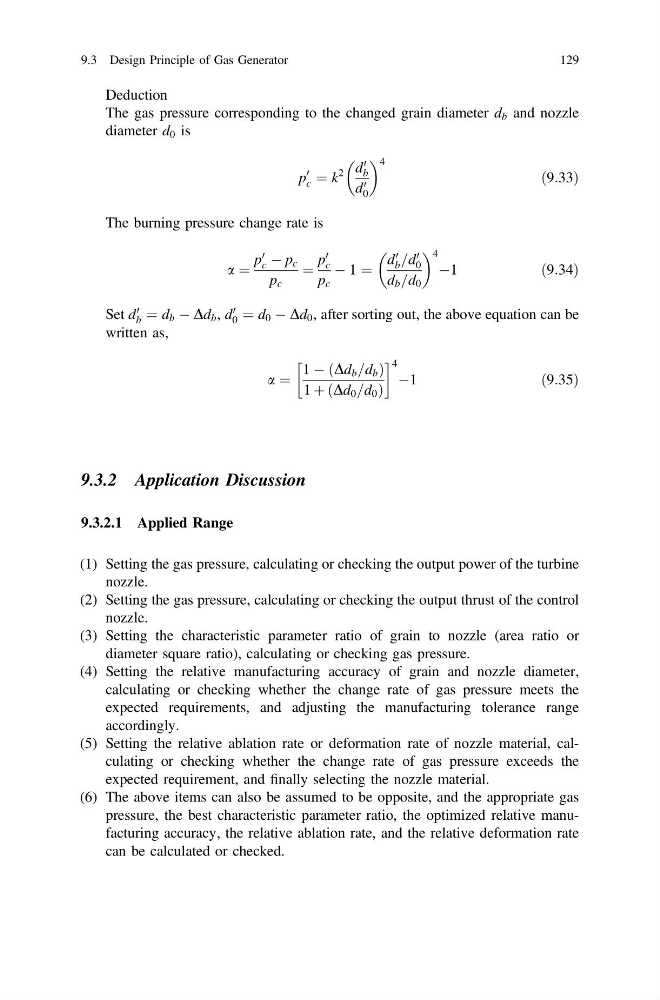
Deduction
The gas pressure corresponding to the changed grain diameter d b and nozzle
diameter d 0 is
p
0
c ¼ k
2 d
0
b
d 0
0
4
ð9:33Þ
The burning pressure change rate is
a ¼
p
0
c À p c
p c
¼
p
0
c
p c
À 1 ¼
d
0
b =d
0
0
d b =d 0
4
À1
ð9:34Þ
Set d
0
b ¼ d b À Dd b , d
0
0 ¼ d 0 À Dd 0 , after sorting out, the above equation can be
written as,
a ¼
1 À Dd b =d b
ð
Þ
1 þ Dd 0 =d 0
ð
Þ
! 4
À1
ð9:35Þ
9.3.2 Application Discussion
9.3.2.1 Applied Range
(1) Setting the gas pressure, calculating or checking the output power of the turbine
nozzle.
(2) Setting the gas pressure, calculating or checking the output thrust of the control
nozzle.
(3) Setting the characteristic parameter ratio of grain to nozzle (area ratio or
diameter square ratio), calculating or checking gas pressure.
(4) Setting the relative manufacturing accuracy of grain and nozzle diameter,
calculating or checking whether the change rate of gas pressure meets the
expected requirements, and adjusting the manufacturing tolerance range
accordingly.
(5) Setting the relative ablation rate or deformation rate of nozzle material, calculating or checking whether the change rate of gas pressure exceeds the
expected requirement, and finally selecting the nozzle material.
(6) The above items can also be assumed to be opposite, and the appropriate gas
pressure, the best characteristic parameter ratio, the optimized relative manufacturing accuracy, the relative ablation rate, and the relative deformation rate
can be calculated or checked.
9.3 Design Principle of Gas Generator
129
The gas pressure corresponding to the changed grain diameter d b and nozzle
diameter d 0 is
p
0
c ¼ k
2 d
0
b
d 0
0
4
ð9:33Þ
The burning pressure change rate is
a ¼
p
0
c À p c
p c
¼
p
0
c
p c
À 1 ¼
d
0
b =d
0
0
d b =d 0
4
À1
ð9:34Þ
Set d
0
b ¼ d b À Dd b , d
0
0 ¼ d 0 À Dd 0 , after sorting out, the above equation can be
written as,
a ¼
1 À Dd b =d b
ð
Þ
1 þ Dd 0 =d 0
ð
Þ
! 4
À1
ð9:35Þ
9.3.2 Application Discussion
9.3.2.1 Applied Range
(1) Setting the gas pressure, calculating or checking the output power of the turbine
nozzle.
(2) Setting the gas pressure, calculating or checking the output thrust of the control
nozzle.
(3) Setting the characteristic parameter ratio of grain to nozzle (area ratio or
diameter square ratio), calculating or checking gas pressure.
(4) Setting the relative manufacturing accuracy of grain and nozzle diameter,
calculating or checking whether the change rate of gas pressure meets the
expected requirements, and adjusting the manufacturing tolerance range
accordingly.
(5) Setting the relative ablation rate or deformation rate of nozzle material, calculating or checking whether the change rate of gas pressure exceeds the
expected requirement, and finally selecting the nozzle material.
(6) The above items can also be assumed to be opposite, and the appropriate gas
pressure, the best characteristic parameter ratio, the optimized relative manufacturing accuracy, the relative ablation rate, and the relative deformation rate
can be calculated or checked.
9.3 Design Principle of Gas Generator
129